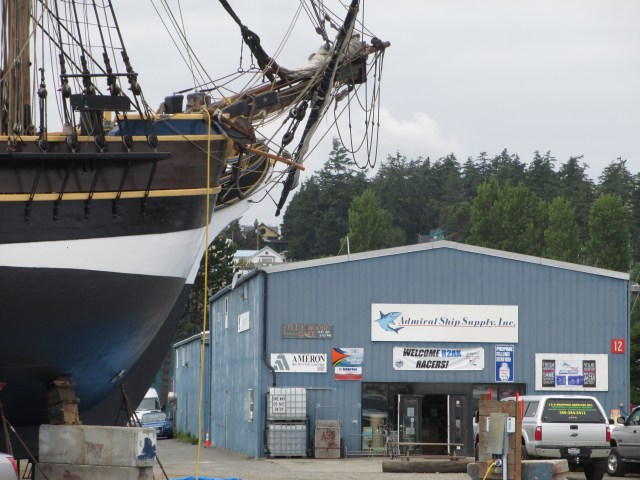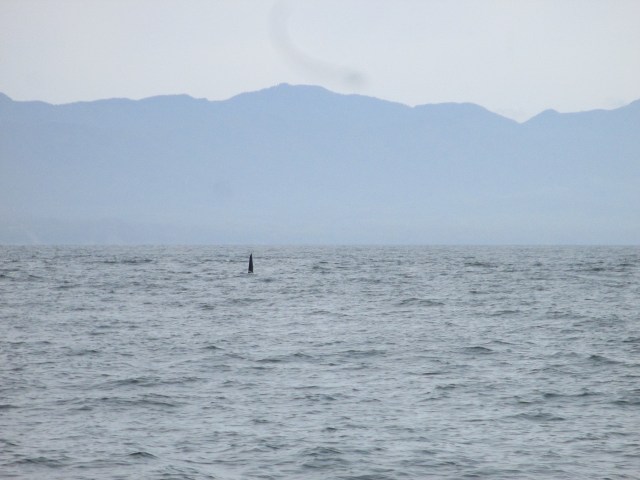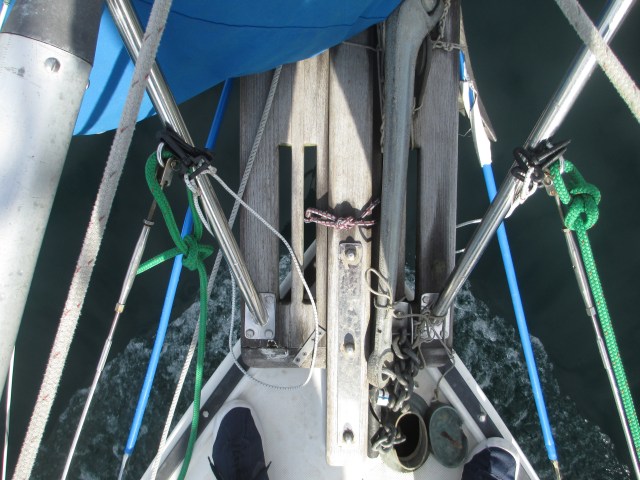
A new propane solenoid and rewired stern light. The project is not completely done in this picture but it is now. You can see the jug of distilled water as I was doing battery maintenance too.

Propane Solenoid

Here we have an auxiliary set up. This little 17 amp battery will charge my phone and other USB devices. It will also run the DC to AC power inverter if I need to charge the camera battery or VHF. It might not be so good for the Mac though. The solar panel isn’t much but I will use it to try to keep the battery topped up. These are all loaner items and the set-up will be ad hoc as opposed to well spec’d.

Battery solar panel

Here I added a Sta-Lok fitting to my starboard shroud. The T-bolt was bent so I sawed it off at the swage and replaced it with a new one and a toggle, which doubled as a spacer.  This was my first Sta-Lok installation and I feel good about the result. It was also an easy and inexpensive fix that I was able to manage at the dock.

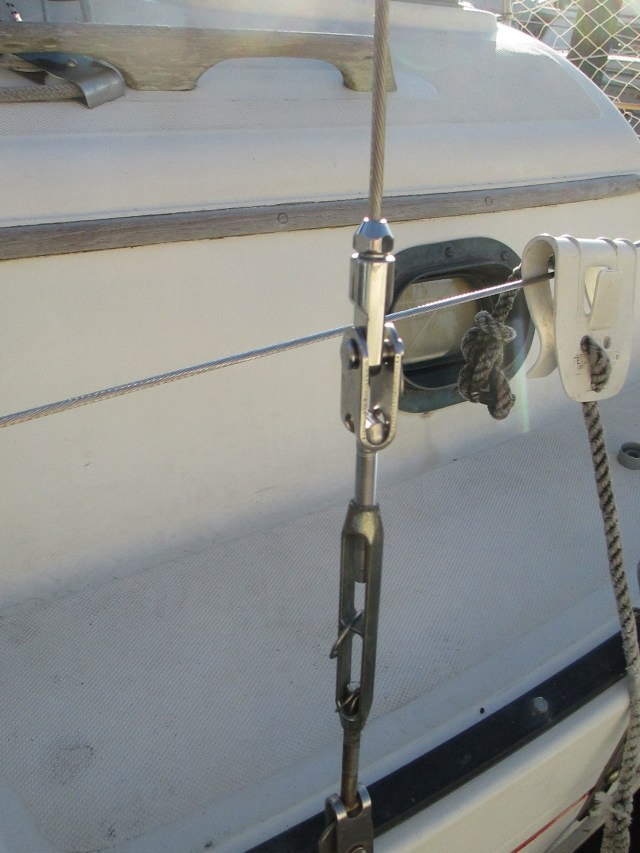
Sta-LokSta-Lok

This is the stern of the boat backed up to the dock. This is how I am able to remove the motor easily.

Motor Mount

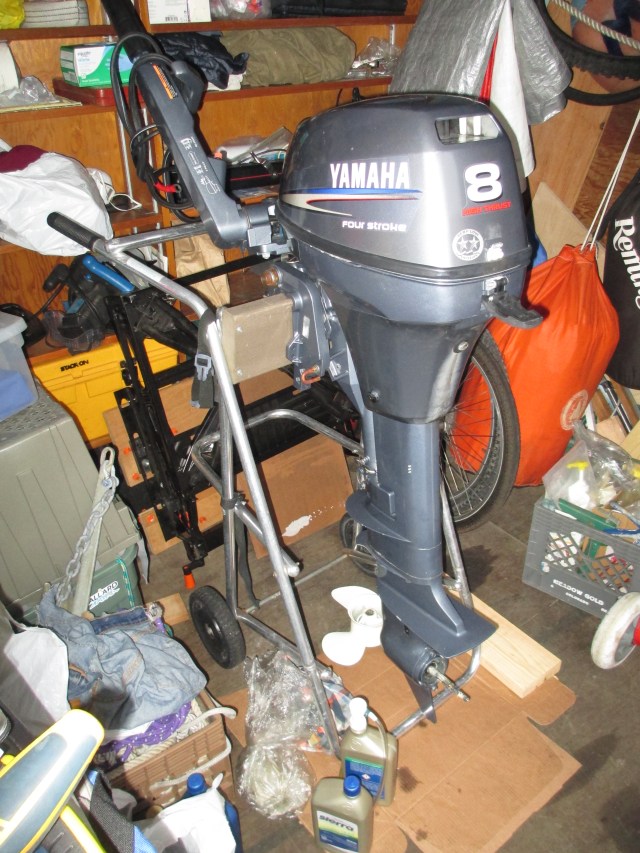
I then take the motor to the storage unit where it is much easier to perform maintenance.
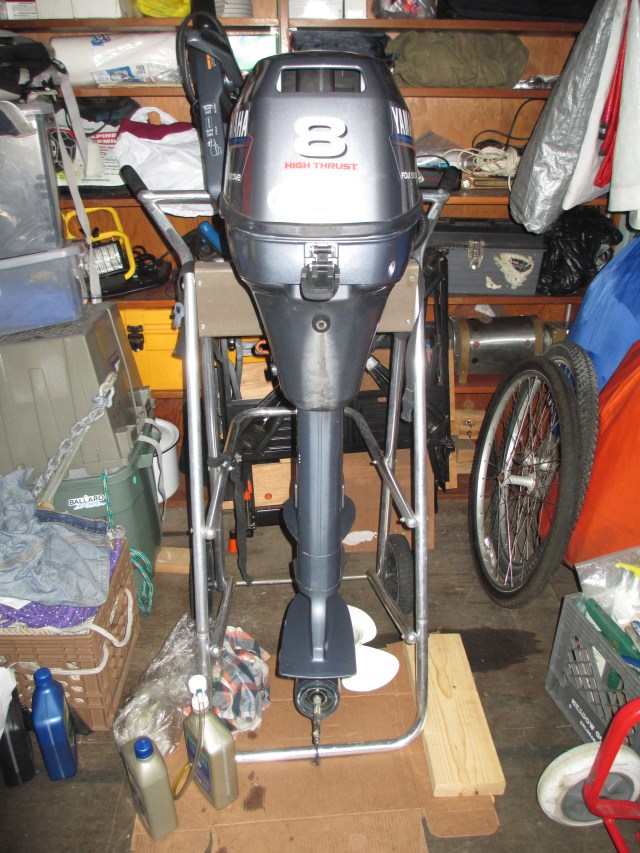
Yamaha 8 HPYamaha 8 HP

List of to-dos:

Me

Day 2 – Inspect bottom, photos, future haul out to-dos list

Day 3 – Disassemble, Inspect, Reassemble Bow Platform, Bowsprit, Anchor Chafe Guards, Change Zinc on the rudder pintle

Day 4 – Disassemble, Inspect, Lubricate, Reassemble Seacocks, Inspect, Lubricate Motor Mount

Day 5 – Prep boat for floating

Day 6 – Check the through Hulls upon float and return to slip

The Yard

Day 2 –  Waterline – Strike and prep

Day 3 – Prep Bottom, 1 coat applied

Day 4 – 2nd coat applied

Day 5 – Boat moved and painted under blocks

Day 6 – Put the boat in the water


Flicka 20

Paint it Black. A different color is good for contrast against the undercoat.
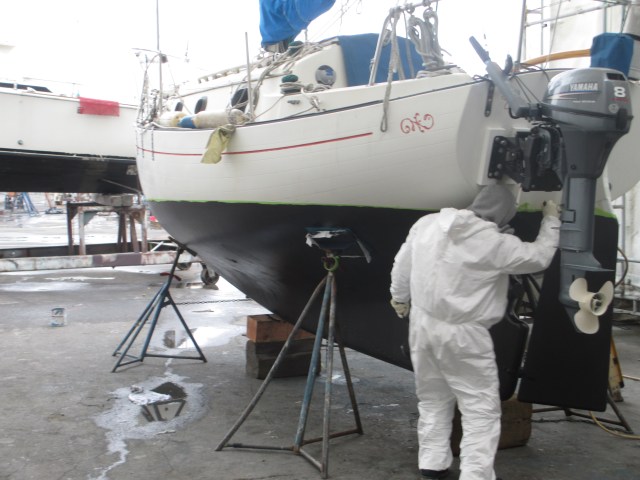
Flicka 20

Alex doing touch ups.

Groco SV

The disassembled Galley Sink seacock. These are the inner working of the Groco SV seacock. I have disassembled and lubricated the three seacocks on the boat.

Groco SV

Just what it says. The plug and disc go in there.
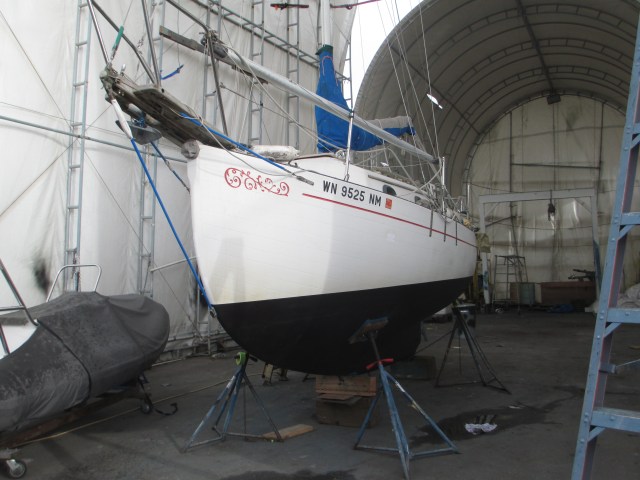
Flicka 20

The step ladder to the right was helpful for inspecting the bowsprit to the left.

Flicka 20

From the starboard quarter.

Flicka 20

The Stern.


Flicka 20

Ready to float again.

This morning I had a haul-out for the Flicka scheduled at the Yard in Ballard at 9am. It started snowing at about 7pm last night and the temperature dropped below freezing overnight. I awoke this morning to an inch of snow at 27 degrees. The heat was on overnight so there was chunky layer of ice between the deck and the snow. I went and got some coffee and stopped by the boat yard to make sure we were still on. They were gung ho. The business must go on. So back to the boat for last minute preparations. Brush off the snow, pack for the day, throw out the garbage, start the motor. The motor started well enough though it took a bit extra time to warm up. I excused it. I warped the boat from the slip and made the short trip to the Yard. A bit of extra caution was needed walking on the decks with the remaining ice and snow, but our arrival was uneventful. I watched the yard hoist the boat out, took some pictures, talked to the yard manager and went to about my day. I would be awaiting an estimate for various requested items. More on that on a later time. Flicka 20 Travellift

Up

Flicka 20

And Up Close

Flicka 20 Sling

Pressure Wash That Turns to Blue Ice 

Boat Yard

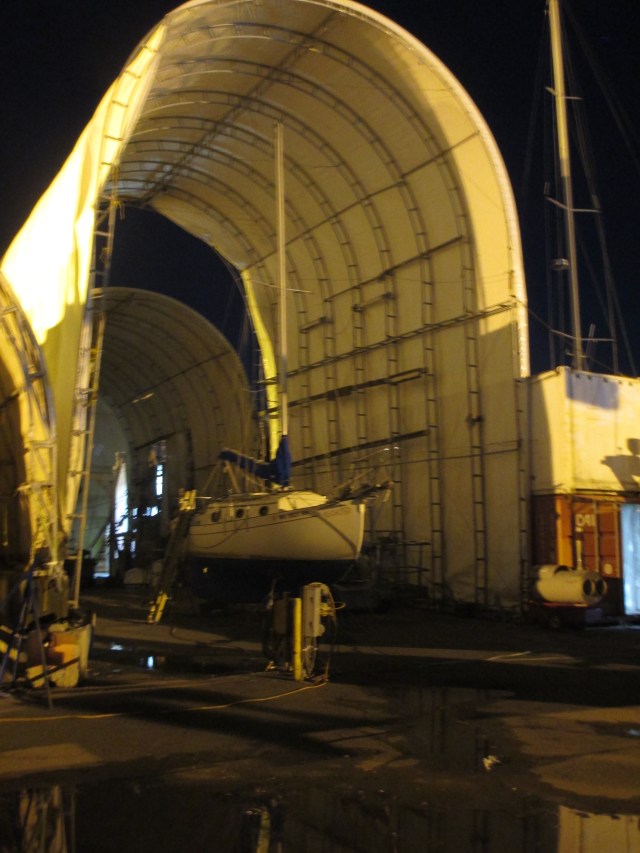
My View From the Veranda. Very Cold with a Halogen Glow. Surrounded by Fish Out of Water.
Flicka 20 Boat Yard

Little Boat in a Big Tent. Not Sure Why I Ended Up in Here. The Yard is Pretty Full. A Ladder to Board and Shore Power for the Heat.


Flicka 20 Thru-Hull

Sampaguita’s cockpit drain seacocks. This photo is post repair. The one on the left was the leaker.  The seacock on the right is an example of the previous putty jobs. The smaller inner tube into the orange juice jug is drainage for the ice box.

I came to the conclusion one of my cockpit drain seacocks was leaking. Well, not actually the seacock, but the elbow attached to it. I actually think it might have been amiss for a long time but I just officially realized it. The leak was so slight that a small 2 or 3 drip puddle of water was all there might be in the bilge, and sometimes nothing. I finally  saw  the trail of water from under the elbow and down the seacock. Anyway, once I came to the confident conclusion that it was leaking, there was no turning back and no letting it go. Time to explore.

I did my normal over investigation and research but I am uncertain what the original build on this particular boat was. There are four components to the cockpit drain. Top to bottom, there is a plastic cockpit drain, a hose, a Marelon(plastic) elbow and a bronze thru-hull/seacock. The seacocks are original. They are the Groco SV-1250, an old design that hasn’t been made since 1992. While obsolete, they are still solid and I feel confident in them. The cockpit drains are original. I come to this conclusion because they look as they are the original install. The hoses are consistent with each other and it is the same type of hose used for the manual bilge pump set up. Either these were all replaced together or they are the original install. This leaves the elbows. The Marelon is a solid product, but why not bronze elbows? Why was the putty used to seal the elbows so sloppily done? Was this factory installed or a later repair?

I closed the seacock and removed the hose from the elbow. Good news is the seacock closes and seals properly. I have opened and closed the seacock before, but with the hose on, you cannot tell if it actually is working as it is supposed to. More good news is that the seal between the hose and the elbow is very tight, even with the hose clamps removed water did not seep through. I used a steamed cloth to soften the hose for easier removal.

With the hose off, I was then able to easily break the putty seal and unscrew the elbow from the seacock by hand. My research informed me that I need to use a sealant when installing Marelon elbows to make the connection water tight.  This delicateness was an eye-opener in a system that I wanted to be bullet proof. Would the bronze elbows be better?

Groco SV Flicka 20

The seacock with the elbow removed. No leakage from the inner plug. The bronze looks solid, however there was some corrosion on the top edge of the threads. You can see the off-color on the top ring. I established this was not a safety issue but took note of it as something to keep an eye on.

Marelon Elbow

The Marelon elbow

Marelon Elbow

I picked up the appropriate bronze elbow (TPC-1250) from the marine store to test it out. It is a sturdy feeling piece of hardware with a neoprene gasket that will make the hard mechanical seal I imagined in a strong system. The first thing I noticed was that the bronze elbow does not have any hose barbs on the end for added sealing security. I imagined this would be alright, however the second thing I noticed was that the hose end of the elbow was only 1.25″ in O.D. while my existing hose was 1.5″ I.D. This was going to be a problem and it shed some light on why the system was as it was.

Flicka 20 Cockpit Drain

The underside of the cockpit drain and laundry detergent.

The installed cockpit drains were sized to have a 1.5″ I.D. hose on them. To change the hose size would mean changing the cockpit drains too (a sizable production) or add an adapter (less production) which would decrease performance and increase fragility and complexity to the system. On the other end, we could increase the seacock size (very major production) to match the drain and hose size. The Marelon elbow was the apparent solution for mating the 2 different sizes together.

My hopes of improving the system beyond the present were dashed as I am presently unwilling to take on the major production of rebuilding the cockpit drain/seacock system. So I cleaned up the pieces, bought some Teflon tape, practiced assembling the system a couple of times to be confident in the seal and tightened it up. I chose the Teflon tape as it cleans up so easily on disassembly. If I find it doesn’t last, I can give the putty a go.

I did fix the leak…for now. I’ll keep my eye on it for sure. The repair, while important, was so small in comparison to the exploration of the system. Hours of fuss only to fix it with a screwdriver and $1.31 of Teflon tape. On the other hand, I have a very comprehensive understanding of the system, it’s maintenance and how I would rebuild it differently to make it better if I were so inclined. So I’ve got that going for me.

Over the years, as minor changes were made to the design of the Flicka 20 in response to real world feedback and changing technologies, certain solutions were adapted to facilitate the changes. I speculate that the Marelon elbows were a factory install as an adapter to facilitate these design changes. When I peeled away the old putty, the bronze underneath has a fresh look so I could even believe the sloppy putty job could be from the factory.

Thru-Hull Teflon seal

The new seal with the Teflon tape.


Appletree Cove

appletree cove

The Last Age of Sail

I awoke to a generous amount of wake as fishermen were coming and going from the Kingston Marina. No matter though, I was not interested in hanging out. I weighed anchor at 8:35am and with a light SE breeze and sailed from of the anchorage. I tacked out of the cove against the waning flood and sailed east toward Point Wells. The going was slow and 3 hrs later, just as I had reached the Point, the wind went calm. An ebb was on and so at 11:50, I turned on the outboard and made a bee line for Shilshole. In the good light of the morning I had checked my fuel level and was convinced I had much more than enough for the trip to Seattle. The day was very nice, the Sound was calm. I had made a good go of the sailing earlier, but it was obvious we were done with that for the day and the trip. It was a Wakesville day too, so my journey had a series of bouncy sessions. Wakesville is what I call a day when the wind is calm and the water is flat except for other boats’ wakes, which can at times, be quite substantial. Dependent on which direction they come from will determine whether it’s a roll, a yaw or a pitch.

shilshole channel

Blurry Eyed at Shilshole Channel

Ballard Locks

Circling at the Locks

After a couple of hours of droning along, I reached Shilshole Channel and headed up to the small lock waiting area. On a Thursday before the 4th of July weekend, outbound traffic was heavy, while inbound traffic was light. I waited through two lock cycles as the Argosy tour boat had also arrived. Their transit took priority as they live higher up on the maritime locking through hierarchy.  In the mean time, there was a small fishing boat coming and going and setting nets. A tug with a gravel barge also came through for the large lock, so I timed my circles accordingly. I was taken aback at how stressful it was to be in an urban waterworld with so many hazards around.

Alas, my turn arrived and I piloted through the locks uneventfully and on to my home slip in Ballard. It was 3pm and an undramatic ending to a great adventure. The boat was unkept as the last 3 days were more focused on home port fever than domestic chores. That would change over the next 2 days. I had plenty of time to do some tidying and cleaning now, adjusting to the home port life again.

This concludes an epic adventure and even more epic posting of the adventure. Thank you for stopping by and I hope you are also considering an adventure of your own.

Stats: TO – 14.30NM, MS – 4.8kt, MA – 2.4kt, TT – 6hr, 57min, Motor on – 190min.

Pedro


June on the Hook Summary

Departure – June 6th, 2017                      Return – June 29th, 2017

20 evenings on the hook                          3 evenings tied to a dock

19 days traveling                                       5 layover days

Total Expenditures – $218.33 (this only includes expenses incurred after departure and does not include preparatory expenses)

Moorage – $44.40 – 3 nights

Fuel – $27.86 – 3 top offs

Provisions – $48.95

Entertainment – $92.87

Showers./Misc. – $4.25


Date NM minutes minutes

6/6/17

8.6

241

36

6/7/17

29.53

902

133

6/8/17

15.9

381

30

6/9/17

15.91

458

377

6/10/17

7.54

243

0

6/11/17

4.5

208

0

6/12/17

14.74

323

30

6/13/17

19.67

445

12

6/16/17

27.61

503

45

6/17/17

24.92

423

40

6/18/17

40.48

716

180

6/19/17

11.31

230

135

6/21/17

32.51

581

100

6/22/17

39.23

678

365

6/23/17

27.09

619

210

6/24/17

25.26

546

180

6/27/17

40.60

746

540

6/28/17

46.86

828

240

6/29/17

14.3

417

190

Total

446.56

9488

2843

Avg./ travel day – 19

23.50

Avg./ day – 24

18.61

Hours traveled

158.13

% of travel time motor was on

29.96%

Shortest Dist. in 1 day

4.5

Longest Dist. in 1 day

46.86

Avg. Speed – kts

2.82

Saratoga passage

I sailed out of the Utsalady Bay anchorage at 9am with a light South wind and a waning flood tide. I sailed around the North end of Camano Island and beat my way down Saratoga Passage. The flood turned to ebb but the current was “weak and variable” in this area. Still, I made decent progress. As I approached Camano Island State Park, I got a lift from the wind as its direction seemed to veer to the SW. This may have been an effect of Holmes Sound tucked into Whidbey Island as it appeared to funnel from this direction. I was able to hold the starboard tack and sailed an arc which took me very close to the point at Camano Island SP. I was trying to make the most of it, all the time ready to tack over if it looked like I would run out of room or the wind decided to change direction or strength. I made the point and soon after the SW wind faded and shifted back to the South, which was right on the nose. It was light and variable and just enough to keep  me moving in the ebb tide. I tacked back and forth, trying to make the most of it through the afternoon. Eventually, the tide turned to a flood and at 5:19pm, I started the motor.

Utsalady

Leaving Utsalady Bay

Utsalady

Looking Back at Utsalady Bay

Saratoga Passage

A Good Beat Down Saratoga Passage

Saratoga passage

The Beat Slows Down

I was still thinking I could make it back to Ballard that evening, but my hopes faded quickly as I realized I was fighting a 1-2 knot tidal current in Possession Sound. I considered my options.

  • First, I could go for Ballard. I would likely get there between midnight and 2am. I would still have to transit the locks, which are open 24/7, but I also was concerned that I could run out of gasoline. It can be difficult to judge how far you can go on a given amount of gas. I tend to think more in how many hours I can run, rather than how far I can go. Factors such as wind and tide can slow progress. Another significant determination is how many RPM you are running. The fuel used and the progress gained is not linear. As you approach hull speed, it takes more and more energy to eke out each fraction of a knot. Finally there is a point where, even though the engine will continue to increase RPM, get louder and use more fuel, the boat will not go any faster through the water. Hull speed for a full displacement boat such as mine can be determined by a the formula, HS = 1.34 x √LWL with LWL being the length of the boats water line in feet. My water line is 18’2” so my hull speed is about 5.7 knots. I find the sweet spot where I can balance fuel economy, engine volume and progress is about 4.3 knots through the water.
  • Second, I could go to Everett which I have never sailed to. This would take me a bit off course and would also mean I would need to rent a slip, as I do not know of any anchorage in the Everett area.
  • Third, I could go to Edmonds. This is on the way and they would have fuel in the morning, yet would require renting a slip, as there is no anchorage there. I have been to this marina before and in fact, Sampaguita was in this marina when I purchased her.
  • Fourth, I could go to Appletree Cove at Kingston. Here I could get a slip or anchor out. I have never anchored here but I have read about it and I have seen it done often. If I needed fuel, I would be able to get this there in the morn. Appletree Cove is the farthest of the four choices, but the anchoring option was a big plus and it would be a fairly quick trip to get home the next day.

I decided on Appletree Cove. I motored and fought the current past Possession Point. I set the sails again on a WSW course in the light S wind, and in the open space of Puget Sound. Once past Scatchet Head, the flood tide on the nose, became a flood tide on the stern. This is because the tidal current floods through Admiralty Inlet into Puget Sound from the North, then fills into Possession Sound from the South.

Admiralty Inlet

Sailing With the Sunset

Kingston

Evening Push to Appletree Cove

I found myself running out of light for the second day in a row. The return legs from a trip always seem the hardest. The territory is familiar and the real exploring and fresh scenery is long gone. The urge for some might be to motor up and beeline to the home port (I call it home port fever,) making the return leg a chore to be done as quickly as possible. I could do this, if I was smart enough. Instead, I drag the trip out as I meander from beginning to end worshiping the sail. Still, I see the end goal and recognize my hard push to achieve it in my own way.

I found myself in the shipping channel with the waning light and in between two converging tugs. I turned on my navigation lights, turned the motor on and lowered the sails. I figured I could get to Appletree Cove in an hour if I didn’t hit any floating debris. I made it across the ferry lane and to the anchorage with the stars beginning to show. There were two fishing boats at anchor, the wind was calm and forecast to remain so. At 10:30pm, I dropped the hook in 40 foot of water and let out 130 foot of scope. The anchorage would be a bit rolly from the ferry and from boats coming and going from the marina, but manageable. I tidied the boat up, exhausted from a second long day, and crawled in to the berth.

Stats: TO – 46.86, MS – 6.1kt, MA 3.5kt, TT – 13hr 48min, AD – 40ft, AS – 140ft

Misc.: Motor on – 240mins, First time in Kingston anchorage

Utsalady Bay

The long marine road to Seattle goes through La Conner. Did I know I was going to go that way when I left Friday Harbor? No. I had originally planned to go through Deception Pass and inside along the eastern edge of Whidbey Island for protection from the forecast Small Craft Advisory in the Strait of Juan de Fuca. The usual and shortest route to Seattle goes past Cattle Point at the southern entrance to San Juan Channel and across the Strait of Juan de Fuca to Port Townsend. I have taken the usual route several times but I was a bit leery with the weather forecast on the Strait. Normally this would sound fun, but not with a compromised shroud.

I weighed anchor from Shipyard Cove at 11am, which was a bit of a late start. With currents, timing is everything and this late start would determine my route. I was on an ebb tide and  I headed east in the archipelago with moderate sailing winds. I had decided to take Peavine Pass which leads the way into Rosario Strait between Blakely Island to the South and Obstruction Island to the North. I chose Peavine Pass because I had never been through it before, and because it was closest. I hoped to get through it and into Rosario Strait while there was still an ebb tide so I could ride the current to Deception Pass.

I have only gone through Deception Pass once and that was headed west, so an eastward transit is on my list. It wouldn’t be this time though. As the day went on and the wind dissipated to nil, I turned the motor on at 1:42pm as I prepared for Peavine Pass. By the time I made it through Peavine, I only had about an hour of ebb tide left. The thought of slogging against the flood in Rosario Straight as far as Deception Pass, which was still 10 miles away, sounded dreadful and downright impractical. So I decided I would turn east into Guemes Channel and checkout Anacortes. This turn then put the flood on my stern and I started to make very good time, hitting speeds over 7 knots. With this boost I was inspired to keep on going and with Seattle as my goal, my only option was the Swinomish Channel, through La Conner.


Quest

The National Geographic “Quest”

Washington State Ferry

Washington State Ferry in Dry Dock

Anacortes

Hoisting Supplies Aboard

Anacortes

Tankers and Tugs at the Refinery

Anacortes

Objects are Closer Than They Appear

Anacortes

The Tesoro Anacortes Refinery at Padilla Bay

I continued on past Anacortes with its shipyards, its massive oil refinery/depot, it’s large vessel anchorage and carefully followed the channel buoys. The channel through Padilla Bay is surrounded by mudflats so it is imperative to stay in the channel. These mudflats are populated with many sea birds such as herons, grebes, eagles and Dunlins. This wildlife contrasts with the massive human industrial complex in and around the bay. I have been this way once before and while La Conner is an inviting little town, this route is not particularly inspiring. It generally requires motoring exclusively, the scenery is mostly industrial and drab, the waters are shoal and the tides can be difficult to read. It’s one major advantage, and this is a big one which makes it necessary and popular, especially amongst power boaters, is that it is an all-weather passage providing an inland and docile route around the Strait of Juan de Fuca with its potential for higher winds and the resultant sea state. This is why I was there.

I made good time and reached La Conner with a following tidal current the entire way. I very nearly pulled up to the city dock for the evening as it was getting late. There was a spot for me and the current was manageable. The tide turns the narrow channel into a river which changes direction four times a day. This can make docking and undocking a bit tricky, especially by oneself. The wind was very light, so I decided to forego the land trap and keep on as I thought I may be able to find a quiet anchorage in Skagit Bay. This was the original plan when I had originally considered Deception Pass.

Skagit Bay

Hole in the Wall to Skagit Bay

Well, as soon as I passed La Conner, the tidal current shifted to the bow. This was where the floods met and my progress suddenly slowed considerably. Determined to stay the course, I pushed on through Hole in the Wall which is just what it sounds like, a chasm where the channel cuts through a wall of rock. The channel makes a 90 degree turn to the West once you exit the wall and you are thrust out into the open of Skagit Bay. This hard turn creates eddies to negotiate and once through, there was a brisk West wind on the nose. I suspected this was the Small Craft Warning wind from the Strait of Juan de Fuca coming over the saddle of Whidbey Island. The channel here is straight and shoal, with a range set up on Whidbey Island to help guide you out. I was having regrets about not tying up to the La Conner dock and I suppose I could have turned back, but push on is what I did. The going was slow against the wind and the tide but I made it and turned South again once past the final buoy.

I raised the sails, but as I was closer to Whidbey Island now and away from the saddle, the wind had lost some of its spark and the tide was still adverse. Going was slow and I realized that I was running out of light. The anchorage I had imagined I would use, didn’t really exist. I pulled out the chart and studied it, trying to locate where a good place to anchor might be. I wanted to reach one before it got dark and I wanted one that would protect me from a West wind that could blow in off the Strait of Juan de Fuca. Penn Cove was too far. So was Oak Harbor and it has a tricky entrance I have only done once, several years ago. The guide books had nothing for this area either. I settled on Utsalady Bay on the northern edge of Camano Island. It looked like I could tuck in behind Utsalady Point in about three fathoms of water with a mud bottom. It was a high tide so the approach would be fine. I could see where I wanted to go, but it was still about five miles away. That would be over an hour by motor and I was cutting it close as far as light was concerned. I motored up and went for it.

Utsalady Anchorage

The Improv Anchorage

I arrived at Utsalady Point and I decided it would do. It was just beyond dusk. There was a mooring field there with several pleasure craft so I dropped the hook on the outer edge of this field. It might get a little rolly, but would do just fine and by the time the anchor was set, the other boats were just silhouettes against the street lights and television sets ashore. By the time I had tidied up the boat and grabbed something to eat it was midnight. It was a long day and it was debatable that I had made a good decision by not stopping in La Conner. On one hand, I passed up an inexpensive city dock in a quaint little town and pitted myself against the elements of adverse current and wind without having a well researched anchorage plan. On the other hand it appears to have worked out and the anchorage was suitable in the present weather. To boot, this was the first anchorage I have used that I had not been guided to by a book. Up until now, I had played it safe and followed those who had gone before me and have been clever enough to publish books about it.

Stats.: 40.6NM, MS – 7.6kts, MA – 3.5kts, TT – 12hrs 26mins., AD – ~28ft, AS – 130ft

Misc.: Unpublished anchorage, 550mins. motoring, debatable planning.


Lime Kiln Point

Southern Resident Orcas Sighting Off of Lime Kiln State Park, June 25th 2017

One of the great things about exploring the Pacific Northwest from a small boat is the marine wildlife that I experience. I observe orcas, humpback and grey whales, sea lions, sea otters, Dahl’s porpoise, harbor porpoise, salmon, cormorants, eagles and kingfishers to name only a few. My encounters with marine wildlife have typically been by chance. When I am on the water, my attention is often focused on the wind, the currents, the boat, my schedule, what will I eat, am I keeping myself hydrated and a number of other self-absorbed thoughts. I look out over the surface and often see a barren landscape. Then, often suddenly, marine wildlife breaches the surface and I am reminded of the activity, diversity and biomass that begins just below the surface.

Whales are the marine life that piques most people’s interest and are typically the rarest. Still, I have come to expect a couple sightings per year. In 2017, I watched a humpback off of Apple Cove Point near Kingston for 45 minutes. It was diving in the tide ripped waters while I drifted on a windless June day in the Flicka. In previous years I have seen humpback and grey whales in the Strait of Juan de Fuca and along the West coast of Vancouver Island. These massive animals surfacing and breaching a stones throw away are larger than the Flicka and heighten the experience with a level of fright. Once, when I was circumnavigating Vashon Island in Puget Sound in my canoe, a humpback surfaced 50 feet away. Startling, alarming and amazing to say the least. “Wow, it’s awesome to see you, now please swim away.”

While technically dolphins, I have witnessed southern resident orca pods off of Kingston, Blake Island, and San Juan Island. I have spotted transient orca, in Spieden Channel, in Port Jervis Inlet and in Puget Sound.  Transients can be identified by their small groups or solo appearance. The mother of all sightings was not actually from my boat, but from Lime Kiln Sate Park on San Juan Island, which I was visiting on my June 2017 sailing trip (so I was still exploring in my small boat.) It was remarkable. We watched the J and K pods go by in Haro Strait for 15-20 minutes on a beautiful day and several were only about 100 yards off shore.

Southern Pod

The Lime of Whale Watching Boats in the Distance

There are laws designed to protect the marine wildlife and set parameters for viewing.

Orcas

The Parade……

Haro Strait

……Goes On……

Haro Strait

…… And On……

Lime Kiln Point

Mama and Babe

Lime Kiln

The Old Lime Kiln

San Juan Island

Red Skies at Night

San Juan Island

A Barbecue and Sunset from San Juan County Park

San Juan Island

Looking South Over Haro Strait

San Juan Island

June 25th, Whales, Barbecues and a Skiff Ride to Canoe Cove on Lopez Island

Friday Harbor

June 26th, List of Chores Completed:

Kayak to get Fuel, Empty Trash, Do Dishes, Charge Phone, Call John Van Lund for Flicka Tour, Tidy Boat, Prep to Leave on Tuesday, Check Rigging, Book July 4th Trip to Sidney, Fix Back-Up Headlamp, Retrieve Flashlight from JC, Suss Solar Lamp – Battery?, Check Bilge, Check Anchor and Suss New Boat to Anchorage, Tighten Halyards.


Spieden Channel

I awoke at sunrise and prepared to paddle the kayak around Portland Island. It would be good exercise and a way to use time before the 9am low tide, when I was going to attempt a retrieval of the anchor rode chafe guard I dropped overboard the previous day. I saw a neighboring boater returning from a similar exploit, but with a hard shell kayak. I would make a counterclockwise circumnavigation with the hope I would get some favorable tide on the way back.

Princess Bay

Sunrise in Princess Bay

Portland Island

Kayaking Around Portland Island. Of note are the reefs on the NE side.

The waters around the island are reef strewn and the current flows dramatically through these reefs. This makes them unpredictable. There was also a challenge to stay in water that was deep enough for the kayak. While the kayak only needs a few inches of water depth, the paddles need considerably more. The reefs are a bit jagged, so keeping the PVC inflatable off of these was a priority. It was a great work out physically and mentally to weave through the reefs and currents, especially along the northeast side of the island.

Portland Island

Kayaks and Campers

Compost Toilet

Mmmm, Wood Chips

Portland Island

Looking North

Portland Island

Looking North, Zoomed In. The mountains in the distance are mainland BC.

When I got to the northern most point, I pulled ashore onto a beach just east of Royal Cove. I took some photos and used the outhouse. The outhouse was the nicest smelling outhouse I have ever been in. In true Canadian style of practicality and simplicity, they had a composting toilet with a box of fresh-cut wood chips to the side that you sprinkled on your business when you are done. The dominant aroma was this box of wood chips. If only all outhouses could smell this nice. I suspect that this island is easy to service by the parks department due to its proximity to Sidney and this style outhouse is not yet a norm in all Canadian parks. There were also some campers in this cove as there was an official campsite located here. These folks had travelled in by kayak which is a very common mode of exploration in both the Canadian Gulf Islands and the American San Juan Islands.

I continued on around to the west of the island. I arrived back to Princess Bay in time to plan my attempt at retrieving the chafe guard. I dd not know exactly where I had dropped it but I knew it was likely within a 50 foot radius of the boat. I was going to use the kayak and paddle the bay in a grid pattern. I started with my best guess and quickly located it. The water was clear and shallow at this time and the white piece of hose contrasted well enough against the mud bottom. I used the leadline with a fender buoy to mark the spot, which at first worked well enough. However, the hose wasn’t far from where the boat was and the breeze and current kept swinging the boat around at anchor and into my buoy. This wanted to drag it off the mark and the line eventually got caught between the rudder and keel. For a chafe guard retrieval tool, I took a jib pole and extended it out and then duct taped an extended boat hook to this. Now I had one 14 foot long rigid pole. A big challenge was keeping the kayak in the correct spot. Any force, be it wind, current, or movement of the pole through the water, wanted to push me off target. Another challenge was to correctly judge where the hose was and not be fooled by the water’s refraction. I found that the poles also needed to fill with water for without this, they had too much buoyancy. After about seven tries, I was able to snag the hose and I brought it to the surface with a sense of achievement. Next, was to use the same pole to unsnag the leadline from the rudder and finally to drain the poles of the water. The plan and procedure worked about as good as I could hope for and I had the satisfaction of not littering, not losing the boats gear and successfully creating and completing a rescue operation. To boot, I gave the elderly couple in the boat next to me a chance to “anchor gaze” while I was at it. “What is he doing over there?”

Haro Strait

Losing the Wind

Inflateable Kayak

Leaving Princess Bay

Spieden Channel

Battling the Tide

San Juan Channel

Sailing Toward Friday Harbor

I prepped to leave in hopes that I could play the current into the San Juan Islands. I weighed anchor at 10:30am and motored out of Princess Bay. I quickly got the main and jib up and shut the motor down at 10:38am. I had a brief sail until the wind faded at the Canadian edge of Haro Strait. I started the motor and continued across the Strait. Haro Strait is the main channel for tidal flow in and out of the Canadian Gulf Islands. It is the Strait that separates the American San Juan Islands from the Canadian Gulf Islands, this border established by the resolution of The Pig War. I had some favorable tide here that had me moving up to 7.2 knots, but once across and headed into Spieden Channel the current was against me and slowed me to about 1-2 knots. I have had these adverse currents headed in this direction of Spieden Channel before. I have not figured out what the optimum transit time is relative to the tides. I ground it out and made a play for the inside channel between Spieden Island and Sentinel Island in hopes to get relief from the current. A bit earlier, I saw the Washington State Ferry take this route. I suspect they either did it for relief from the tide or to get closer to Spieden Island in hopes to view some of the exotic wildlife that was transplanted there in the 1970s in a now defunct, private, big game hunting resort.  This strategy seemed to work and the farther I went, the more favorable the tides became. I finally picked up the full flood on the northeast side of San Juan Island and down to Friday Harbor. I was also able to do some sailing here with a NW wind of about 10 knots.

Friday Harbor

The Customs Dock and Friday Harbor


I  was required to check in with U.S. Customs when I landed for the first time in the U.S., returning from Canada. I went to the clearance dock they have designated for this at the Port of Friday Harbor.  I landed and went to the phone provided and called Customs. I spoke to an officer and he asked the standard questions. What was my nationality? Where was I coming from? How long had I been there? Do I have anything to declare? When satisfied, he said I could go to my slip, but then I needed to come up to the offices on Spring Street and verify the information. I explained that I would be anchoring out. He said I should leave the boat at the clearance dock and come up now. So I grabbed my ID and my boat’s papers, which is a fancy way of saying my registration. Truthfully, there are other documents included in the portfolio of “boat’s papers,” but the registration was all I would need. When I arrived I was met by an officer who asked, “Sampaguita?” I said yes, he said, “Like the National Flower of the Philippines?” I said yes ,“I am from the Philippines” he said and went on to thank me for coming up to Spring Street as they were presently short-staffed.

He checked my ID and my boats papers and that was that. Sampaguita is under 30 foot in length, so there is no fee for re-entering the U.S. as there is for boats over 30 feet. This is a small boat advantage. I bounded out the door and back to the clearance dock as I was interested in getting anchored and settled in, sooner than later. It was a week since my last shower, so I wanted to get that done too. There was quite a bit of bustle going on in the Port and the tall ships, the Hawaiian Chieftain and the Lady Washington were in the harbor. The Lady Washington has world fame as being one of the ships they used in filming the Pirates of the Caribbean: The Curse of the Black Pearl. They were giving tours and getting ready for some sort of “pirate re-enactment” with mock battles out in the channel. Amusing, but not for me.

I sailed off of the customs dock and headed over to Shipyards Cove where I like to anchor. I anchored here for 4 nights in May and it suited me fine to be a bit away from “downtown.” I could paddle into the Port or over to Shipyard Marina. I had friends who used the latter and I could meet them there.

Shipyard Cove

Anchoring in Shipyard Cove

I re-anchored once as I didn’t like my first attempts proximity to an empty, permanent buoy. Once set, I checked the depths at 40 feet and I let out 145 feet of scope. The anchorage was empty and I set to work tidying up the boat, putting on chafe guards and gathering my trash to take ashore. I was planning on being here for a couple of days, so I was making the boat comfortable.

I touched base with my friend Jenevieve to meet about 7pm. She had a skiff at Shipyard Marina and she would come out to the Flicka. This would give me time for a shower and snack. When she arrived, we decided to take the skiff to Turn Island State Park which is just east of Friday Harbor with the highlight being a deer swimming across Boat Channel from San Juan Island to Turn Island. I was very impressed and wished I had gotten a picture of the deer. Then we took the skiff over to the Port and tied up at the Dinghy Dock and went and got some food and drinks. Boats are fun.

Stats: (This included kayaking around Portland Island) TO – 25.26NM, MS – 7.2kts, MA 3.1kts, TT – 9hr, 6mins, AD 40ft, AS – 145ft

Misc.: Motor – 168mins.


Portland Island

I made another early start from Telegraph Harbor. My plan was to catch the ebb tide down through Sansum Narrows, on the west side of Salt Spring Island. In combination with a north breeze, this should get me down to the Southern Gulf Islands and possibly to the San Juans. I had never been through Samsun Narrows and I felt like it could be a shortcut with favorable tidal currents of 3 knots. Making it to the San Juans was a lofty goal that would depend on optimum sailing conditions and a motor. Going through customs and anchoring need to be considered too.

Telegraph Harbot

The Comic Drift

At 5:30am, I weighed the anchor in Telegraph Harbor and started my drift out. I say drift because the sun was up but the wind was not. I had the main and jib raised and the only draw I was getting in the sails was from the air flow caused by my fraction of a knot drift. I tacked a few times and gybed once to stay in the narrow channel and avoid buoyed boats. The scene was kind of ridiculous, but the idea of starting the motor on the quiet and peaceful morning was unappealing too. I stubbornly held out for the breeze that I was sure was going to set in anytime from the north.

Light Winds

Waiting it Out

I worked the sails for any air movement I could harness to get into Stuart Channel. I was putting quite a bit of effort into getting the most out of the light and variable winds and getting little reward. So I boiled some eggs, I ate some salad, I drank some tea and watch the world (at least Canada) go buy at a snail’s pace. I still had the ebb tide but that was not going to last beyond noon. At this rate I was not going to make the San Juans and I was beginning to doubt I would even make it through Sansum Narrows.

Samsum Narrows

Sailing Through Sansum Narrows

Finally about 10am the N wind filled in. Maybe 10 knots? This was enough to set me on my way. I wanted to put the genoa up, but decided against it with the uncertain shroud. I would have to settle with the main and the working jib. The narrowest part of Samsun Narrows is brief, but the full channel as it winds through the gap between Salt Spring Island and Vancouver Island is several miles (nautical? kilometers?) long. This results in elevated tidal currents along its length which can be a 1-4 knot boost over the distance. Of course, it can be a 1-4 knots against too. The four and a half hours lost waiting for the wind to appear would prove to be significant. I will confess that had I turned the motor on in the beginning and taken full advantage of the tidal cycle, I would have likely arrived at Portland Island having run the motor less time than I eventually did. The motor is such a bore to me that I make these choices.

IMG_2609

Baynes Peak, Sansum Narrows

IMG_2610

Looking North

IMG_2613

The Narrow Bit

But for now, I still had a favorable tide and wind so I wished myself along as fast as possible. I gybed my way through the channel with the good following wind which was winding through the channel too. I heard the rig creak a few times and this got my attention, but kept on. As I approached the narrow part of the channel, the swirling currents kept me on my guard. I mentally went through the steps of lowering the motor and getting it started. The whirlpools wanted to set me toward the rocks or the shore and it was difficult to tell which way the current was truly flowing. The wind was still pushing me south and out of the swirling clutches of current, but my progress was slowing and I could see that the wind was diminishing the farther down the strait I went.

IMG_2614

Looking Back Through the Narrows. Tide Rips to the Right.

IMG_2615

Looking South, Almost Through.

Convergnce zone

Where the Wind Ends

I thought I was going to be able to sail all the way through the channel, but alas, it was not to be. The wind became light and the current adverse. I gybed back and forth a few times to see if I could work my way through, but while the flood tide was picking up, the wind was not. I gave in and started the motor. It was about 12:40pm and I escaped the grips of the Narrows, but had an afternoon of heading straight into a 1-2 knot flood tide with plenty of sunshine, but no wind. This is Satellite Channel that feeds Saanish Inlet and the Sansum Narrows and I could see that with a following tide, one could make great progress and, at least under motor, and easily make the trip to or from the northern gulf islands in a day.

The Slog

Satellite Channel and Against the Tide

I spent the next three and a half hours motoring against the tide to Princess Bay on Portland Island. Portland Island is part of the Gulf Islands National Park Reserve and I arrived to a nearly full anchorage. I thought one boat was leaving, but they were just reanchoring. I was faked out by another boat starting its motor, but maybe to charge its batteries. I finally found a spot that I was satisfied with and I dropped the hook in 18 ft of water at about mid tide. In the process of grabbing my leadline to check the depth, I knocked the anchor rode chafe guard into the bay. It is just a spiral cut piece of hose, so nothing fancy and I had extra hose to make a replacement. However, I didn’t like the idea that I had just lost plastic tubing into the Park Reserve and if the chafe guard had been returned to its proper storage place, it would not have fallen in.

PI

Portland Island

Portland Anchorage

Princess Bay from Satellite

IMG_2616

Princess Bay From the Dinghy Dock. Sampaguita is in the Center. The Kayak is at the Dock.

I tidied up the boat, made a new chafe guard and thought it through. With water levels at 18 feet and rising, I could not really see the bottom of the bay, but tomorrow at about 9am the tide will be low and the water level should be around 12 feet. Maybe I can formulate a plan of retrieval for that time. If conditions permit, I will be able to see the bottom, locate the hose and have the correct sized tools to fish it out.

A few more boats entered the anchorage and found spots either on the fringes or stern tied to the shore. While I ways happy with how I was set, I saw a bit of reanchoring going on and anchors coming up with lots of weeds on them. I inflated the kayak for the first time since False Creek and headed ashore. There is a dinghy/ranger dock in the bay and there are well-marked trails intersecting the Island. The island has a long and interesting history of being inhabited, evident by the 3000-year-old midden beach and the more recent 100-year-old orchard planted by Hawaiians.

After a couple of loops and 2-3 miles I headed back to the dinghy and the Flicka. I ate dinner and did some reading. The night was beautiful and you could see the bioluminescence in the bay when you disturbed the water. The clear skies meant the stars and the Milky Way were in full view. This was my last night in Canada for this trip. I was moving forward and would head to Friday Harbor to regroup.

Stats: TO – 27.09NM, MS – 5.6kt, MA – 2.6kt, TT – 10hr, 44min, AD ~ 18ft, AS – 75ft.

Misc.: Motor time – 210min., some mosquitos, anchorage so-so, trails are good and the Island is interesting, popular as it is a quick overnight/day trip from Sidney.