Spieden Channel

I awoke at sunrise and prepared to paddle the kayak around Portland Island. It would be good exercise and a way to use time before the 9am low tide, when I was going to attempt a retrieval of the anchor rode chafe guard I dropped overboard the previous day. I saw a neighboring boater returning from a similar exploit, but with a hard shell kayak. I would make a counterclockwise circumnavigation with the hope I would get some favorable tide on the way back.

Princess Bay

Sunrise in Princess Bay

Portland Island

Kayaking Around Portland Island. Of note are the reefs on the NE side.

The waters around the island are reef strewn and the current flows dramatically through these reefs. This makes them unpredictable. There was also a challenge to stay in water that was deep enough for the kayak. While the kayak only needs a few inches of water depth, the paddles need considerably more. The reefs are a bit jagged, so keeping the PVC inflatable off of these was a priority. It was a great work out physically and mentally to weave through the reefs and currents, especially along the northeast side of the island.

Portland Island

Kayaks and Campers

Compost Toilet

Mmmm, Wood Chips

Portland Island

Looking North

Portland Island

Looking North, Zoomed In. The mountains in the distance are mainland BC.

When I got to the northern most point, I pulled ashore onto a beach just east of Royal Cove. I took some photos and used the outhouse. The outhouse was the nicest smelling outhouse I have ever been in. In true Canadian style of practicality and simplicity, they had a composting toilet with a box of fresh-cut wood chips to the side that you sprinkled on your business when you are done. The dominant aroma was this box of wood chips. If only all outhouses could smell this nice. I suspect that this island is easy to service by the parks department due to its proximity to Sidney and this style outhouse is not yet a norm in all Canadian parks. There were also some campers in this cove as there was an official campsite located here. These folks had travelled in by kayak which is a very common mode of exploration in both the Canadian Gulf Islands and the American San Juan Islands.

I continued on around to the west of the island. I arrived back to Princess Bay in time to plan my attempt at retrieving the chafe guard. I dd not know exactly where I had dropped it but I knew it was likely within a 50 foot radius of the boat. I was going to use the kayak and paddle the bay in a grid pattern. I started with my best guess and quickly located it. The water was clear and shallow at this time and the white piece of hose contrasted well enough against the mud bottom. I used the leadline with a fender buoy to mark the spot, which at first worked well enough. However, the hose wasn’t far from where the boat was and the breeze and current kept swinging the boat around at anchor and into my buoy. This wanted to drag it off the mark and the line eventually got caught between the rudder and keel. For a chafe guard retrieval tool, I took a jib pole and extended it out and then duct taped an extended boat hook to this. Now I had one 14 foot long rigid pole. A big challenge was keeping the kayak in the correct spot. Any force, be it wind, current, or movement of the pole through the water, wanted to push me off target. Another challenge was to correctly judge where the hose was and not be fooled by the water’s refraction. I found that the poles also needed to fill with water for without this, they had too much buoyancy. After about seven tries, I was able to snag the hose and I brought it to the surface with a sense of achievement. Next, was to use the same pole to unsnag the leadline from the rudder and finally to drain the poles of the water. The plan and procedure worked about as good as I could hope for and I had the satisfaction of not littering, not losing the boats gear and successfully creating and completing a rescue operation. To boot, I gave the elderly couple in the boat next to me a chance to “anchor gaze” while I was at it. “What is he doing over there?”

Haro Strait

Losing the Wind

Inflateable Kayak

Leaving Princess Bay

Spieden Channel

Battling the Tide

San Juan Channel

Sailing Toward Friday Harbor

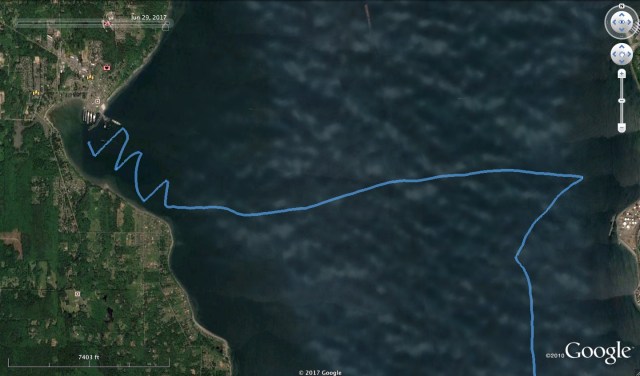
I prepped to leave in hopes that I could play the current into the San Juan Islands. I weighed anchor at 10:30am and motored out of Princess Bay. I quickly got the main and jib up and shut the motor down at 10:38am. I had a brief sail until the wind faded at the Canadian edge of Haro Strait. I started the motor and continued across the Strait. Haro Strait is the main channel for tidal flow in and out of the Canadian Gulf Islands. It is the Strait that separates the American San Juan Islands from the Canadian Gulf Islands, this border established by the resolution of The Pig War. I had some favorable tide here that had me moving up to 7.2 knots, but once across and headed into Spieden Channel the current was against me and slowed me to about 1-2 knots. I have had these adverse currents headed in this direction of Spieden Channel before. I have not figured out what the optimum transit time is relative to the tides. I ground it out and made a play for the inside channel between Spieden Island and Sentinel Island in hopes to get relief from the current. A bit earlier, I saw the Washington State Ferry take this route. I suspect they either did it for relief from the tide or to get closer to Spieden Island in hopes to view some of the exotic wildlife that was transplanted there in the 1970s in a now defunct, private, big game hunting resort.  This strategy seemed to work and the farther I went, the more favorable the tides became. I finally picked up the full flood on the northeast side of San Juan Island and down to Friday Harbor. I was also able to do some sailing here with a NW wind of about 10 knots.

Friday Harbor

The Customs Dock and Friday Harbor


I  was required to check in with U.S. Customs when I landed for the first time in the U.S., returning from Canada. I went to the clearance dock they have designated for this at the Port of Friday Harbor.  I landed and went to the phone provided and called Customs. I spoke to an officer and he asked the standard questions. What was my nationality? Where was I coming from? How long had I been there? Do I have anything to declare? When satisfied, he said I could go to my slip, but then I needed to come up to the offices on Spring Street and verify the information. I explained that I would be anchoring out. He said I should leave the boat at the clearance dock and come up now. So I grabbed my ID and my boat’s papers, which is a fancy way of saying my registration. Truthfully, there are other documents included in the portfolio of “boat’s papers,” but the registration was all I would need. When I arrived I was met by an officer who asked, “Sampaguita?” I said yes, he said, “Like the National Flower of the Philippines?” I said yes ,“I am from the Philippines” he said and went on to thank me for coming up to Spring Street as they were presently short-staffed.

He checked my ID and my boats papers and that was that. Sampaguita is under 30 foot in length, so there is no fee for re-entering the U.S. as there is for boats over 30 feet. This is a small boat advantage. I bounded out the door and back to the clearance dock as I was interested in getting anchored and settled in, sooner than later. It was a week since my last shower, so I wanted to get that done too. There was quite a bit of bustle going on in the Port and the tall ships, the Hawaiian Chieftain and the Lady Washington were in the harbor. The Lady Washington has world fame as being one of the ships they used in filming the Pirates of the Caribbean: The Curse of the Black Pearl. They were giving tours and getting ready for some sort of “pirate re-enactment” with mock battles out in the channel. Amusing, but not for me.

I sailed off of the customs dock and headed over to Shipyards Cove where I like to anchor. I anchored here for 4 nights in May and it suited me fine to be a bit away from “downtown.” I could paddle into the Port or over to Shipyard Marina. I had friends who used the latter and I could meet them there.

Shipyard Cove

Anchoring in Shipyard Cove

I re-anchored once as I didn’t like my first attempts proximity to an empty, permanent buoy. Once set, I checked the depths at 40 feet and I let out 145 feet of scope. The anchorage was empty and I set to work tidying up the boat, putting on chafe guards and gathering my trash to take ashore. I was planning on being here for a couple of days, so I was making the boat comfortable.

I touched base with my friend Jenevieve to meet about 7pm. She had a skiff at Shipyard Marina and she would come out to the Flicka. This would give me time for a shower and snack. When she arrived, we decided to take the skiff to Turn Island State Park which is just east of Friday Harbor with the highlight being a deer swimming across Boat Channel from San Juan Island to Turn Island. I was very impressed and wished I had gotten a picture of the deer. Then we took the skiff over to the Port and tied up at the Dinghy Dock and went and got some food and drinks. Boats are fun.

Stats: (This included kayaking around Portland Island) TO – 25.26NM, MS – 7.2kts, MA 3.1kts, TT – 9hr, 6mins, AD 40ft, AS – 145ft

Misc.: Motor – 168mins.


Portland Island

I made another early start from Telegraph Harbor. My plan was to catch the ebb tide down through Sansum Narrows, on the west side of Salt Spring Island. In combination with a north breeze, this should get me down to the Southern Gulf Islands and possibly to the San Juans. I had never been through Samsun Narrows and I felt like it could be a shortcut with favorable tidal currents of 3 knots. Making it to the San Juans was a lofty goal that would depend on optimum sailing conditions and a motor. Going through customs and anchoring need to be considered too.

Telegraph Harbot

The Comic Drift

At 5:30am, I weighed the anchor in Telegraph Harbor and started my drift out. I say drift because the sun was up but the wind was not. I had the main and jib raised and the only draw I was getting in the sails was from the air flow caused by my fraction of a knot drift. I tacked a few times and gybed once to stay in the narrow channel and avoid buoyed boats. The scene was kind of ridiculous, but the idea of starting the motor on the quiet and peaceful morning was unappealing too. I stubbornly held out for the breeze that I was sure was going to set in anytime from the north.

Light Winds

Waiting it Out

I worked the sails for any air movement I could harness to get into Stuart Channel. I was putting quite a bit of effort into getting the most out of the light and variable winds and getting little reward. So I boiled some eggs, I ate some salad, I drank some tea and watch the world (at least Canada) go buy at a snail’s pace. I still had the ebb tide but that was not going to last beyond noon. At this rate I was not going to make the San Juans and I was beginning to doubt I would even make it through Sansum Narrows.

Samsum Narrows

Sailing Through Sansum Narrows

Finally about 10am the N wind filled in. Maybe 10 knots? This was enough to set me on my way. I wanted to put the genoa up, but decided against it with the uncertain shroud. I would have to settle with the main and the working jib. The narrowest part of Samsun Narrows is brief, but the full channel as it winds through the gap between Salt Spring Island and Vancouver Island is several miles (nautical? kilometers?) long. This results in elevated tidal currents along its length which can be a 1-4 knot boost over the distance. Of course, it can be a 1-4 knots against too. The four and a half hours lost waiting for the wind to appear would prove to be significant. I will confess that had I turned the motor on in the beginning and taken full advantage of the tidal cycle, I would have likely arrived at Portland Island having run the motor less time than I eventually did. The motor is such a bore to me that I make these choices.

IMG_2609

Baynes Peak, Sansum Narrows

IMG_2610

Looking North

IMG_2613

The Narrow Bit

But for now, I still had a favorable tide and wind so I wished myself along as fast as possible. I gybed my way through the channel with the good following wind which was winding through the channel too. I heard the rig creak a few times and this got my attention, but kept on. As I approached the narrow part of the channel, the swirling currents kept me on my guard. I mentally went through the steps of lowering the motor and getting it started. The whirlpools wanted to set me toward the rocks or the shore and it was difficult to tell which way the current was truly flowing. The wind was still pushing me south and out of the swirling clutches of current, but my progress was slowing and I could see that the wind was diminishing the farther down the strait I went.

IMG_2614

Looking Back Through the Narrows. Tide Rips to the Right.

IMG_2615

Looking South, Almost Through.

Convergnce zone

Where the Wind Ends

I thought I was going to be able to sail all the way through the channel, but alas, it was not to be. The wind became light and the current adverse. I gybed back and forth a few times to see if I could work my way through, but while the flood tide was picking up, the wind was not. I gave in and started the motor. It was about 12:40pm and I escaped the grips of the Narrows, but had an afternoon of heading straight into a 1-2 knot flood tide with plenty of sunshine, but no wind. This is Satellite Channel that feeds Saanish Inlet and the Sansum Narrows and I could see that with a following tide, one could make great progress and, at least under motor, and easily make the trip to or from the northern gulf islands in a day.

The Slog

Satellite Channel and Against the Tide

I spent the next three and a half hours motoring against the tide to Princess Bay on Portland Island. Portland Island is part of the Gulf Islands National Park Reserve and I arrived to a nearly full anchorage. I thought one boat was leaving, but they were just reanchoring. I was faked out by another boat starting its motor, but maybe to charge its batteries. I finally found a spot that I was satisfied with and I dropped the hook in 18 ft of water at about mid tide. In the process of grabbing my leadline to check the depth, I knocked the anchor rode chafe guard into the bay. It is just a spiral cut piece of hose, so nothing fancy and I had extra hose to make a replacement. However, I didn’t like the idea that I had just lost plastic tubing into the Park Reserve and if the chafe guard had been returned to its proper storage place, it would not have fallen in.

PI

Portland Island

Portland Anchorage

Princess Bay from Satellite

IMG_2616

Princess Bay From the Dinghy Dock. Sampaguita is in the Center. The Kayak is at the Dock.

I tidied up the boat, made a new chafe guard and thought it through. With water levels at 18 feet and rising, I could not really see the bottom of the bay, but tomorrow at about 9am the tide will be low and the water level should be around 12 feet. Maybe I can formulate a plan of retrieval for that time. If conditions permit, I will be able to see the bottom, locate the hose and have the correct sized tools to fish it out.

A few more boats entered the anchorage and found spots either on the fringes or stern tied to the shore. While I ways happy with how I was set, I saw a bit of reanchoring going on and anchors coming up with lots of weeds on them. I inflated the kayak for the first time since False Creek and headed ashore. There is a dinghy/ranger dock in the bay and there are well-marked trails intersecting the Island. The island has a long and interesting history of being inhabited, evident by the 3000-year-old midden beach and the more recent 100-year-old orchard planted by Hawaiians.

After a couple of loops and 2-3 miles I headed back to the dinghy and the Flicka. I ate dinner and did some reading. The night was beautiful and you could see the bioluminescence in the bay when you disturbed the water. The clear skies meant the stars and the Milky Way were in full view. This was my last night in Canada for this trip. I was moving forward and would head to Friday Harbor to regroup.

Stats: TO – 27.09NM, MS – 5.6kt, MA – 2.6kt, TT – 10hr, 44min, AD ~ 18ft, AS – 75ft.

Misc.: Motor time – 210min., some mosquitos, anchorage so-so, trails are good and the Island is interesting, popular as it is a quick overnight/day trip from Sidney.


Strait of Georgia

Crossing the Strait of Georgia became my main prerogative, so I decided to wake up early and see if there was a weather window. I had an interest in crossing in more settled weather with the uncertainty of the shroud. This was a bit of an attitude change. I couldn’t ignore the Strait. Thermals can build in the afternoon to 20 and 30 knots. It was the June Frazier River freshet after a high precipitation winter and there was debris in the water.  A window early in the morning would be the best bet and sooner rather than later.  I was on the back half of my trip and if strong winds rolled in, I could be trapped on the east side.

I woke for the 4am Environment Canada update. Environment Canada is the Canadian version of NOAA Weather Radio that broadcasts on the VHF weather channels. The forecast agreed with crossing if I left immediately. It would likely be a 6 hour crossing, with the expectation I would motor most of the way. The predictions of days ahead were of less optimum conditions so I decided to hit it. I started the motor at 4:53am.

I left Snug Cove, following Queen Charlotte Channel to the Strait of Georgia. Winds were light in the beginning with moderate seas, though beamish.  I raised the main with one reef and we made good time, but both the wind and seas increased over the next few hours. Our relation to the wind was good for the main sail, but the beamish wave angle as per my heading were making the boat roll. More so as the waves increased. My heading was 240 degrees magnetic toward Silva Bay, or at least I hoped. The Strait is just large enough to challenge my pilotage on several occasions. There is often a haze and the distance is such that the curve of the earth plays a role and you can’t actually see the opposite shoreline, most of which I have little recognition of anyway.

Gabriola Reef

The Approach to Gabriola Passage

As the seas increased, I felt a need to change my heading more to the south. I cracked off to about 220 degrees magnetic.  There was an ebb tide and a NW wind putting our current and wind in agreement and that was good, though increasing our southing. This extra southing started about halfway across. This caused me to miss Silva Bay and by the time I knew where I was, it would have meant heading up wind, against the current to make good. This had little going for it. The location tip-off was the Thrasher Rock Marker which is part of the Gabriola Reef, south of where I wanted to enter Silva Bay.  This was a point of anxiety though not an unfamiliar one. I was never certain of my position the entire crossing until I recognized and comprehended Thrasher Rock. I was practicing steering by magnetic heading and I was unfamiliar with the look of the land.

I experienced this area on the outward leg and I accepted that this was my new approach. With effort and time, I located all of my markers and buoys and used the handheld GPS to help tune my approach. My reasoning came up with two options. Option one would be to try to make it through Gabriola Passage in time to beat the tide or to approach Silva Bay from the protected waters to its south. I decided the first with the second as the back up plan.

Gabriola Passage

Gabriola Passage

I knew I was not going to catch the tide through the passage, so it was all about getting through before the current became so strong as to stop forward motion. It looked like I could make it within the first hour. Maybe. The flood tide moves north through the Gulf Islands into the Strait of Georgia. So a flood tide in Gabriola Passage was flowing into the Strait and against the Flicka’s direction. This slowed my progress and by the time I got to the bottle neck I had the throttle wide open on the outboard and we made about .5 – 1 knot over ground. That puts the current at  5 knots. Once beyond the bottle neck we increased speed and I believed we would make it. If you recall my outward leg, there is a log boom area just inside the pass in Pylades Channel. I was just entering the Channel from the Passage when to my alarm there was a deadhead about 8 ft to my port beam, floating one foot below the surface of the murky water. If in my path, I would never have seen the deadhead before striking it.  It was 10:30am.

Gabriola Passage

Gybing Down the Gulf Islands.

Gulf Islands

Looking West. The Main is Double Reefed. Vancouver Island in the Distance.

Thetis Island

Looking South. Protected Gulf Island Waters. Thetis Island to the Left. In the Far Distance, Vancouver Island and the Catalyst Paper Corporation Papermill.

Gulf Islands

Looking East.  The Mountains in the Distant Far Left is the Canadian Mainland. The Island Behind the Anchored Ships in Trincomali Channel, is Valdez Island.

The day had blossomed into sunshine and I had made it across the Strait and was safely inside the Gulf Islands. At 10:58am I turned the motor off after 6 hours of the dull roar. I then had a good following breeze from the NW, so I gybed my way through the islands. I kept the main sail double reefed until I reached the entrance to Telegraph Harbor. The sheltered waters of the Gulf Islands put me at ease with the rig and I felt I needed to get my mojo back.

My final approaches to Telegraph Harbor had me threading the needle through the rocks and dodging the ferry. I had shaken out the reefs and was using the flooding tide. I finally got tucked into the harbor and dropped the anchor. It’s a tight spot because there are many boats on buoys, shallow depths and there was one other boat anchored when I arrived. I found a good spot off the south end of the Telegraph Harbor Marina with enough room to swing and great shelter from any wind and waves.

Terlegraph Harbor

Approaching Telegraph Harbor.

It was about 5:30pm by the time I had the boat tidied up for the evening. I made a salad from the Granville Market produce, read One Island, One Ocean, about the Around the Americas trip and fell asleep early. I woke up in the middle of the night to check the anchor and the lay of the boats. The view of the stars and universe was amazing.

Telegraph Harbor

Anchored, Looking East at The Cut.

Telegraph Harbor

Looking South Down Telegraph Harbor.

Stats.: To – 39.23NM, MS – 7.1kts, MA – 3.1kts, TT – 11hr, 18min, AD – ~20ft, AS – 75ft

Misc.: Used 2.25 gallons of fuel, Motor on 6hr, 5min., Amazing stars.


Sailing HARD

It was a beautiful day the morning I left False Creek. The wind was forecast from the northwest and I decided to go up to Howe Sound.  This would mean a bit of beating until I got out beyond Point Atkinson where I would hopefully be able to catch the thermals up the Sound. I had set my destination for Port Graves, which is the middle inlet on the south side of Gambier Island. I had fantasies about climbing Mount Artaban on the island and getting some good exercise and a great view.

Flicka 20

A Friend in Vancouver

Flicka 20

A Friend in Vancouver Too.

I weighed anchor at 9:15am and headed over to Heather Civic Marina. The slip next to Simon’s Flicka was temporarily vacant, due to his neighbors’ boat was being hauled out. He offered that I stop by on my way out and fill up on my water tanks. I had decided to take him up on it and took the opportunity to offload my garbage too. I captured a few photos of the sisters together.

English Bay

The Northwest Fetch into English Bay?

English Bay

The First Reef.

I then motored on through and out of False Creek. When I reached English Bay the northwest breeze was blowing, upwards of 15 knots. I raised the main and the working jib and began my beat to Point Atkinson. After a couple of short tacks, the wind continued to build to about 17 knots (yes, I am guessing here, as wind speed is “by feel” for me,) and I sensed I should put in a reef, so I followed through. This made the boat feel  more comfortable as the seas in the bay began to build impressively. The fetch coming down the Strait of Georgia into English Bay is about 37 nautical miles for a northwest breeze and the waves rolling in showed it. As I was reefing I could see several small boats in the anchorage hauling in their anchors and making a run for the Creek.  I certainly would have too with the dramatic pitching and rolling that was going on. It was a “hold on!” anchorage by this point.


English Bay

The Second Reef

I made a long tack across English Bay with the wind and waves continuing to build. It was exhilarating. There were only a few other sailboats out and I was certainly the smallest. There was some freighter and tug traffic to add to the dynamic. Some of these were anchored, while others were on the move.  Every wind and wave event in a new place brings a new experience unlike any other experience you have previously been in. Heady, right? The boat was doing a great job. I just had to move some lines here and there, push and pull a little bit on the tiller and hold on, tangled in the joy of doing it and the fear of breaking something. I feel confident in the boat, so this is really about me.

It wasn’t long before I was considering putting a second reef in the main and the only hesitation was finding the right moment in the seas to do it. With waves this large (how large? gee I don’t know, 4-8 feet?) and the boat rolling and bobbing, I wanted to make sure the boat was powered up enough to maintain speed and maneuverability in order to get up and over the waves. Reefing too early is not much better than reefing too late. I chose my time on the port tack as that felt like the better side in relation to the waves. Rarely are conditions acting with symmetry on the boat and there usually is a better tack for both making headway and, in this case, adding a reef. Most of my lines are rigged back to the cockpit, but I do need to go on deck to adjust the tack of the sail. It is a very quick job that only takes seconds, but it does mean de-powering the main in order to bring the sail down. This will take the boat a bit more beam-on to the waves.

Point Atkinson

Rounding Point Atkinson

I got the second reef in and wouldn’t you know, not long after the wind settled down a bit. I actually had to hurry and shake out a reef going around Port Atkinson because there was a tug (no tow) coming in the other direction and I needed to be able to maneuver around it. This, while the tide was pushing me towards the Point. Note to self, give Atkinson Point a wide berth henceforth.

Going around the Point and headed up Howe Sound, the wind fell back to our port quarter. The thermal in-flow had not kicked in yet here so I had a bit of time to tidy up the cabin, brush my teeth and eat a little something. The cabin was secured for most days of sailing, but todays was a little beyond my preparation. Some water jugs fell to the cabin sole from the settee (one was leaking) and a few clothes had fallen from the shelf onto the v-berth. The fire extinguishers went a little awry and the guide books were sliding around on the navigation table. The last of which is also the two-burner propane stove covered with a cutting board. Small boat disadvantage.

Howe Sound

Howe Sound and Port Graves

As I approached the top of Bowen Island, the wind continued to decrease until the sails were flopping. No need to wait too long though, as once around the top, the thermals kicked in and it turned into a beat again as I worked my way to Port Graves. I hadn’t expected this sort of wind, but in hindsight, I see how that was my oversight. 20-25 knots of thermal winds were rushing up behind Bowen Island and then up Howe Sound. While I had known there would be thermal winds, I did not have the experience and the local knowledge of the particular patterns.  This created some short and choppy waves which made it a wet experience on the Flicka. With the sailing and wind intense as I approached Port Graves, I questioned whether I really wanted to chance going into the Port. The wind and waves were streaming straight into the inlet and I considered whether I might not like the conditions once inside. If I needed to exit, the wind and waves would make it quite uncomfortable.

So I decided to retreat back to Snug Cove. It had been a very intense day of sailing, however I was not going to make my goal and I was not going to get to the top of the mountain. I had not read the conditions very well and so my ETA’s were poorly judged.  The day was getting on and I was hungry and tired. Hard solo sailing doesn’t leave much time for eating. Time passes in an odd way on a small boat, traveling at a joggers pace in a zigzag, the scenery changing very slowly. Time seems to crawl until you realize you have been doing it for hours. Refueling and rehydrating get neglected. This is poor planning as it is easier to maintain refreshment than to play catch up. I had a vision of the pub, with internet, a burger and a beer. That’s just like hiking to the top of a mountain, right?

I arrived in Snug Cove as the Queen of Capilano, the ferry from the mainland, was taking on passengers. I wanted to wait until the boat was long gone as the ferry created much turbulence from the prop wash and the wind was blowing quite strong off the dock. I asked a boat owner already on the government dock to move his boat down a bit to make some room for me. After this, there was just enough room for the Flicka to fit (a small boat advantage) and he also offered to help me land. I circled about and waited my chance. Once the wash appeared to settle down, I made my approach. It didn’t bring me close enough with the strong wind, so I aborted the move and circled out again. This first move seemed to confirm the turbulence was well gone so I made another approach. This second move brought me up along side a power boat that I was aiming to dock in front of. I was doing between .5-1 knot when the boat began moving sideways into the power boat. My best guess is there was some lingering turbulence and my second best guess was a backwind or negative air pressure created by the breeze around the power boat. Either way, my boat went sideways into the power boat. Unfortunately for me and the Flicka, the power boat had very high rub rails which lined up much better with my stantions and rigging than with my hull. I tried to fend off, but the forces were too great. The terrible screeching sound I heard was ominous and heart wrenching and I could not identify at the moment what caused it, the power boat or the Flicka. After the contact I was able to get the boat into the spot and get her tied up and to inspect for damage.

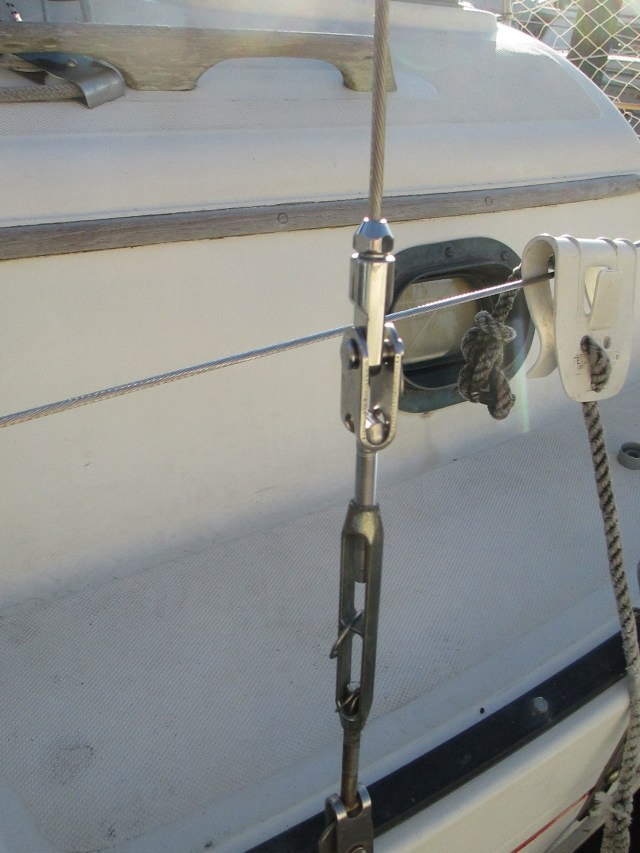
The other boat appeared to be fine. Its high, sharp angled rub rail protected it as it was supposed to, however Sampaguita fared a little worse. The slight scratches on the stantions were cosmetic and they were not pristine before. However the starboard main shroud had a bent swage fitting. This was the horrible screeching sound. I was instantly both amazed and alarmed at the force required to do this damage. Upon closer inspection, the chain plate also was bent slightly inward in the process. The lateral pointed load on the swage had maxed out the stretch of the wire until the stainless steel swage and chain plate were the most giving pieces of the rigging.

Flicka 20

Ugh.

My heart sank. It was my own fault and I quickly began to think about what I should have done different and the trip and how this would affect it. I very much needed to eat and step away for a moment so I followed through at the pub, used the long-lost internet,  ate a hamburger and drank a beer. These were all a success, so at least I had that going for me. Back at the dock I spoke to the woman who had given me the shower tip 3 days previously. We swapped sailing stories and debated the merits of the Vancouver Anchoring Permit system.

I finally settled down enough to get to sleep.

Stats: – TO – 32.51NM, MS – 7.2kts, MA – 3.7 kts, TT – 9hr 41min.

Misc.; Think twice more. Secure items better for more range of motion. Predict weather patterns better. Don’t break your boat.


In the morning I went for a paddle in the kayak out to English Bay. I ate a snack, window shopped at the Maritime Museum and checked out the boats tenuously anchored there. It was a good bit of exercise, paddling there against the northerly breeze but this meant the ride back was easy. It was fun to see all of the boats and shoreline attractions. It is just another form of the boaters’ gaze. Back on the boat, I ate lunch and worked on some chores. I tightened some of the bolts on the stern pulpit as they were a little loose, I think due to using the pulpit as a handle for getting in and out of the kayak. I took note of this and have since revised my technique. Getting tools for the job means moving some items stored on the settee, like water jugs and pots and pans so I could access the storage underneath. This quickly creates a bit of chaos on the boat. A small boat disadvantage is that you always need to move something to get to something. The small boat advantage is that it is easy to tidy up afterward.

English Bay, Vancouver, BC, Canada

A tenuous anchorage

During this chore, I was visited by Simon, a local Flicka owner who saw me anchored when riding his bike shoreside. He came by on his inflatable stand up paddle board with his dog. Unfortunately, I do not recall the name of his Flicka nor the name of his dog. Simon is a young Englishman who immigrated to Vancouver to work in the flourishing film business. He purchased his Flicka from Seattle a couple of years earlier. His boat was also a 1985, so we were able to compare features, layouts, and modifications, and talked about our travels with the boats. This turned into a lengthy and enjoyable meeting, and he invited me over to check out his Flicka. After he left, I finished up the boat chores, tidied up, and paddled over to Stamps Landing where he was docked. We have the same hull with vastly different features. I have an outboard with no head, he has an inboard with an installed head. He has a dodger, radar, roller furling and an anchor windlass. I have none of those. The previous boat owner invested quite a bit of money into his boat while my Flicka has had little modification since its initial build. Still, they are clearly the same boat in the era with, in my opinion, the coolest oval portholes of all Flickas.

Stamps Landing

Searching for Simon’s Flicka

Flicka 20

Sister Flicka

Flicka 20

Simon’s Flicka 20 foredeck Layout

Flicka 20

Simon’s Flicka 20 cockpit and stern layout

I took leave from Simon in time enough to get to the Granville Island Public Market. I wanted to get some provisions as I was running low on fresh food and was planning on leaving the next day.  I had decided I’d had enough of the False Creek anchor show and the urban lifestyle of Vancouver was reminding me too much of Seattle. Simon had mentioned there was a grocer a few blocks inland that might offer quality goods for a more competitive price, but I found the market suited me fine. The produce was fresh, so I picked up some carrots, broccoli, bell peppers, grapes and the like, all satisfactorily in my budget. I also picked up some cod-fish for the evening’s supper. The Granville Public Market is the Pike’s Place of Vancouver and provides a large number of shops selling a variety of foods and artisan wares, as well as a variety of wares and artisan foods. It’s nice to be able to kayak to the store, and they have temporary moorage for shoppers. Still, I locked my tender up while I was there as I have limited trust for leaving gear unattended in Vancouver.

Granville Market, Vancouver, BC, Canada

A birds-eye view of The Granville Island Public Market

Granville Market, Vancouver, BC, Canada

On Granville Island

And from the docks. The purple kayak is my tender.

Granville Market

Accessible by boat

And from the docks again.

Flicka 20 Outboard

Security is a consideration in False Creek

A New Anchoring Technique. Using the chain of my stern anchor for added outboard security in the city.

Flicka 20, Aire Kayak

Security is advised in False Creek

Bicycle Locks Doing Double Duty for Tender Security.


Leg #12

The morning was overcast and I awoke with a vision of Vancouver. I noticed there was a woman who seemed to be living aboard one boat and three men on another at the Govt. dock, so I thought to myself, “they must shower somewhere.” So I asked the woman and it turns out there are showers for the Govt. dock in Snug Cove. Who’d of thought? In Canada, the Govt. dock is a fairly common thing. Often they are used by fishing vessels, but in Bowen Island it is more used by folks coming over from the mainland on day trips to go to the Union Steamship Company Marina Resort, local restaurants tchotchke shops, and by water taxis. You pay by the honor system and it’s very economical with no amenities. For the head, you use the one provided nearby for public use and the ferry passengers. It turns out the shower was actually at the Resort, by the laundry room, but seperate from the facilities they have for their marina customers. It was rather nice so I enjoyed the hot water and my once a week shower.

I did some other chores and made ready to leave. As I was about to push-off, the ferry, the Queen of Capilano, came into the cove. It seemed prudent to wait for it to leave so as not to be subject to the prop wash that it was making and to not interfere with their operation. After it left, I started the motor but realized that I still needed the wash to settle down as it makes a tremendous amount of unpredictable swirling currents in the cove. While waiting, a Tollycraft with no fewer than 7 aboard comes into the Cove and was going to pull up to the dock on the opposite side. They saw me and asked if it was alright to dock there. In hindsight, I really wish I had said yes, but instead I explained that I wasn’t sure and that the signage said it was reserved for winter moorage a couple more days. So they aborted that spot and came over to my side. I said to them that they needed to wait until the ferry wash settled down, as I was doing, but they apparently did not understand.  They made their approach and the current had its way with them. This became my problem because the current carried their boat uncontrollably into mine. I was in a bit of an uncompromising position as I was on the dock with my bow line in my hand when this happened. The many crew managed to fend off for the most part with only their rub rail making contact with my port side stantion and hull. That annoyed me and I emphatically expressed that it was imperative that they do not hit my outboard on the way in. My wordage at the time was much different. They managed to get to the dock without any further contact and I tied back up and inspected for damage and decided there wasn’t any and to not take further action concerning liability. There were apologies and lots of playing dumb on their end and they asked if they could help me in my departure. My words said “In light of what just happened I would very much prefer to do it myself.” My tone said “I don’t like you very much right now and I trust you even less.”

Point Atkinson

Point Atkinson, From Satellite……

IMG_2587

…and From the Boat. Vancouver in the Background.

IMG_2588

Looking Back at Howe Sound

I got off the dock without further incident and motored out of the cove. Once out, there was an outflow breeze from Howe Sound and I raised the jib and the main and broad reached toward Vancouver. Once to Point Atkinson though, I started to lose the outflow and the wind became light and variable. I made it around the point but I could see how you might want to give it a wider berth as the currents here tend to push you in its direction. I  tried to work the boat the best I could in that light air, but finally gave in and motored through English Bay. I wanted to get into False Creek and secure an anchoring spot and permit before it was too late in the day.

English Bay

English Bay. A moorage field for large ships awaiting loading and off-loading in Vancouver’s ports. English Bay is called such as this is where Captain Vancouver moored his fleet while exploring the area. The shoal area in the lower left corner is called the Spanish Banks, because that is where the Spanish fleet was moored at the same time.

I have been to False Creek previously and have gotten an anchoring permit before.  Vancouver has implemented an anchoring permit system in an effort to keep live-aboards with unseaworthy boats from permanently mooring within the Creek. The permit is free and allows you to anchor 14 days out of the month in False Creek. Each month you can get a new permit. For the rest of the time, you must go elsewhere, which for the live-aboards appears to be out in English Bay near the entrance to the Creek. I assure you, that is a very exposed place to anchor and at times, terribly so. The gist is that if your boat can’t move, it would be considered unseaworthy and subject to a fine of $500 and/or impounding. This is the state of affairs and it creates quite a dynamic in the Creek. Once you observe it for a couple of days it is all very easy to understand.

The guide books explain that you must go to Stamps Landing to get your permit, yet the boating magazine 48 North had a current advertisement saying that there are three locations to get your permit. Go directly to Stamps Landing. False Creek Fuels is one of the faux locations. I stopped there first as I wanted to top up on fuel and was told I could get one at the Boaters’ Welcoming Center. After refueling I went to the Center, which also was on my way to the anchoring spot and the nice gentleman said I would have to go to Stamps Landing as they were the only ones to give out permits. He stated that I didn’t really need one as it was really meant for the live-aboards and that the City wanted me to be able to anchor here and visit. Without the Permit System, the live-aboards would monopolize the anchorage and visiting boats would not have room to anchor. While I did not inquire what a slip at a marina would cost, I suspect it to be a turn off to some thrifty Canadians (and myself.)


False Creek Anchorage

False Creek.

The image is not real-time, but you can see the plethora of boats anchored inside False Creek. Also visible is the park/green space surrounding the Creek.

I moved on to where I wanted to anchor and found a spot on the edge of the field. This was luck and strategy. Luck because there was a place for me, strategy because I wanted to be on the edge so as not to be completely surrounded by other anchoring and swinging boats. Once anchored and set, I pumped up the kayak and paddled over to Stamps Landing to get my permit. I had intended to play by the rules and get the permit as I “had no plan with the man” and it seemed prudent to do so. Seeing as I was only going to be there a couple of days, I really believe I did not need to have one and it appeared like many others did not bother. Still, it was free and easy enough. It is easy to tell the live-aboards from the tourists. The live-aboards have boats that don’t look like they are sailed often or ever (sailed, as in used to travel, whether sailboat or powerboat), and the tourists do. Because they do not travel, these aspects of the boat are typically neglected and this can be easily observed. If you are not investing in your boat, living at anchor is very low rent.

I locked up the boat, used an anchor chain to lock the outboard to the boat, figured out a way to lock the dinghy up and paddled ashore. Vancouver is notorious for vehicle break ins, so I figure that boats could also be subject to this. False Creek is surrounded by a park. This park provided public space, green space, bike and pedestrian lanes, water taxi docks and there are places to tie up your dinghy for free too. Tennis courts, monuments, historical information, benches and other curiosities are abundant. The Creek is surrounded by marinas and house boats and very little heavy industry. It appears to be well enjoyed by the inhabitants of the city on a summer day and gives the city a very European and progressive feel. At least in the park. In venturing out of the green space, it reminded me of Seattle and any other urban area, a money suck with noise and pollution and everyone on their cell phone running the rat race. Impressive, if you find those things impressive. I managed to escape the streets unscathed physically and financially, realizing it had nothing to offer me on this trip and retreated back to the green space and the Creek.

I paddled back to the boat and locked up the kayak. I checked that the anchor was doing as I expected, enjoyed the sunset, turned on the anchor light, ate some grub and watched the “circus” from the comfort of my own tiny, traveling, floating home.

Stats: TO – 11.31NM, MS – 6.1kts, MA – 3.4kts, TT – 3hrs, 50 mins, AD – ~18ft, AS – 60ft.

Misc.: 135mins of motor time, refueled, sussed locking up operations, reminded to not trust others and their boats.


Strait of Georgia

We weighed anchor at 9:50am after breakfast, more water runs and boat chores. The stern tie came off without a hitch and the handle I attached to the spool for cranking in the line worked well. Once the stern tie was safely aboard, I deflated the kayak as towing it across the Strait of Georgia should only be done in settled whether. The south wind was blowing pretty good so I wasn’t going to chance the painter separating on the Strait. The Strait of Georgia with a good wind can be a lot of fun, or a nightmare, depending on how you interpret it. There can be a lot of current in the Strait and if a strong wind opposes it, big, steep waves will occur. The fetch should be 100 miles. Crossing it is not be taken lightly. This would be my fifth time crossing it and I have seen conditions from 20kts to a dead calm. Personally, I prefer some wind as the boat and I like to sail better than we like to motor. It’s good experience as it can be one of the bigger challenges of the inside passage. I left Pirates Cove using the same range that I obeyed on the way in, but it was a little trickier as the wind was blowing from behind and the range was observed from behind. It is typically easier to maneuver a boat when heading into the wind and current and as you can imagine, easier to keep a range lined up when it is in front of you instead of behind you. I wasn’t particularly pleased on how it went, however, I didn’t hit anything, so it was a success.

Once out of Pirates Cove, I traveled east over Pylades Channel as my plan was to go through Gabriola Passage. I have never used this pass before, but like most of the major passes in and out of the Gulf Islands, it is safest to travel near slack water.  Currents can hit up to 8 knots on a spring tide. There were some tugs putting together a log boom, headed in my direction and my timing was right on, so I started the motor and got the jump on them.  To have not gotten in before them would have meant a wait, stronger current and more possibility for debris in the water. I met some boats coming the other way and they may have had to wait out the tugs as the narrow spot of the pass would not have allowed that kind of 2-way traffic. On the Straight side, there are some reefs to mind on the exit as well as the offshore rocks, Gabriola Reefs. It seemed as this would be easy at first, but I soon realized, not so much. The flood was stronger than I expected and I believe the Frazier River freshet was pushing me north, plus the wind was out of the south. All three forces were pushing me north, in the direction of the reef,  but I tacked a couple of times and used a little iron wind to just be sure.

Gabriola Passage

Gabriola Passage. Notice the log boom staging area in the lower left corner and the narrow bit in the center left.

Gabriola PassageThe Canadian Hydrographic Chart shows the reefs in the Passage and Gabriola Reefs in the upper right that you cannot see on Google Earth.

After that excitement, the wind steadily diminished as I crossed the Strait until there was not enough wind to keep the sails full in the still rolly seas.

Snug Cove

My original destination was intended to be False Creek in Vancouver, however the strong forces that drove me north put an end to that idea. I motored for a little bit, getting my bearings and trying to figure out where to go. The air was hazy and the Strait of Georgia is about 20 miles wide, so piloting can be a bit tricky. You can see land, but “which land is it?” I motored in the Vancouver direction until the seas settled a little and I realized that I was picking up some outflow wind from Howe Sound. Howe Sound is the fjord just north of Vancouver and it has its own weather patterns and forecast. Thermal winds play a big part in its weather and in this instance there was an outflow that I was feeling. I thought, “maybe I can make Vancouver after all,” but alas, this was wishful thinking. As I approached Vancouver the wind both slowed and backed as I moved out of the airflow. So I tacked over and decided to stay in the wind and see if I could make it to Snug Harbor, on Bowen Island, just inside Howe Sound. I had been to Snug Harbor on a previous trip and I knew there was a possible anchorage and a government dock.

Howe Sound

Slow progress against wind and current at the mouth of Howe Sound.

The wind was good, but dead ahead, and I did not have the tides on my side, so progress was very slow. I had expected to have some tidal help but I had it wrong. There may have also been some heavy fresh water outflow too, from Howe sound, as we were in the middle of the June mountain snow melt. In fact, there was a regular Securite on the VHF channel 16 from the Coast Guard warning mariners about the heavy amount of debris in the Strait of Georgia from the Frazier River runoff due to the heavy snows they had this winter. I can confirm it to be true. I was on the constant look out and often adjusting course to avoid floating logs and debris when I was on the east side of the Straight.

Snug Cove

I was running out of light, so I wanted to get into a port, especially with the debris around, so I finally gave in and motored into Snug Harbor. It turns out the favorable side of the government dock was still reserved for winter moorage, so I ended up on the ferry side of the dock. You are exposed to a bit more turbulence from the ferry wash but it was manageable and for $8US, expectations need to be low. The anchorage did not look too promising as there were a lot of permanent boats in there and I did not have the kayak inflated. Inflating the kayak is a good half hour production and I had my mind set on having a beer at the local pub and using their internet connection for some modern world communications. I got the boat settled on the dock, paid my fee and headed to the pub. After my beer and internet, I headed back to the boat, tidied up and settled in for the night. It had been a 12 hour day of boating, which was long for this trip so far. Flicka 20

Sampaguita and the view out of Snug Cove.

Snug Cove

The Queen of Capilano comes and goes quite regularly to the mainland during the day. Their propeller sound resonates throughout your boat.

Stats: TO – 40.4NM, MS – 6.6kts, MA – 3.5kts, TT – 11hrs 54mins

Misc. : Motor time – ~180mins, govt. dock moorage – $12CAN, Beer and Internet – ~ $8 CAN

Trincomali Channel

Sorry, no Johnny Depp stories. I left Annette Inlet with a subtle south wind and I jibed out into Trincomali Channel. The tide was ebbing, which was not favorable for my direction, but the wind was adequate to make good headway. I was not sure where I was destined on this day as there are lots of options in the Gulf Islands. I have been through here several times before. The downside is I have seen much of it, the upside is the anchorages and possibilities are not a mystery. I wanted to go to a new spot, but knew I could seek shelter in an old one if necessary. I would wait and see how the wind behaved before I settled on where to go.

The sun was out and the south wind continued to build. After two long legs in Trincomali Channel, I decided I would try wing and wing. The wind needs to hit a certain velocity before this works well with my boat, otherwise the going is slow, the steering is tedious and the sails are floppy. It has to do with the apparent wind and you want the sails to breathe, which is to have the wind overflow from the main and spill into the jib. Then the boat will go at a steady 4 knots and more. The advantage is I can sail dead downwind in a straight line. The disadvantage is it takes every bit of my concentration, all of the time, to make sure that no accidental jibes happen and you keep both sails full. I rig a preventer, which is a line connecting the boom to the sail track on the same side of the boat. This prevents the boom from suddenly swinging across the boat if the wind catches the back side of the sail. If it weren’t to take my head off on the way across, it can put shock loads on the hardware and attachments from the uncontrolled sweep.  It also keeps the main sail from pumping, which is caused by the boom moving up and down from wind gusts and rolling seas, which changes the sail shape, causes the sail to chafe on the shrouds, causes weather helm and slows the boat down. It doesn’t however, keep the boat on course, which is up to the helmsman.

Trincomali Channel

Wing and Wing Course

The are a couple of below the water obstructions in the middle of Trincomali Channel, chiefly, Governor’s Rock and Victoria Shoal, but these have buoys marking them and my path goes near them, but not over them. When sailing wing and wing, you don’t have much directional option unless you flip a sail over for a broad reach which means a 30 degree course change in order to keep the sails full.

Flicka 20

Wing and Wing

The south wind continued to build while on wing and wing and the boat was going at nearly hull speed. To boot, the ebbing tide and opposing wind were building up a choppy sea. I was very exciting and very intense. No snacks or ducking down below for a moment as the helm needed constant attention. However, the heading was straight where I wanted to go, so I was making the most of it. I kept asking myself if I should reef, which is usually a sign that you should, but I was holding off with a balance of fear, speed and hunger. I had decided the wind would likely hold through the day and getting to Pirate’s Cove became a solid destination unless it built so much I chickened out and ducked in somewhere for protection. There were large ships at anchor inside the Islands off of Porlier Pass and I decided to avoid them by heading to the west side of Hall and Reid Islands. In prep for this, I ended the wing and wing and moved to broad reaching. I put a reef in the main as the wind had built to the point of discomfort. I increased the length of the kayak painter so that it rode a little better in the waves, I was towing it, and once behind Hall Island, I put the second reef in the main and the boat seemed to like this.

Porlier Pass

Broad Reaching and Reefing

Ironically, once beyond Reid Island, the wind began to let up a bit and I broad reached back across Trincomali Channel, headed to Pylades Channel. I needed to shake out the reefs to keep the boat moving. I was happy to have a bit of respite from the wind, but the cost is a slower moving boat which can mean going from a joggers pace to a walkers pace. This does matter and the slower pace can double your ETA.  After some more wing and wing with wind that was barely strong enough, I cruised up Pylades Channel and made my final approach to Pirates Cove.

Pirates Cove

Entering Pirate’s Cove

Pirates Cove

Line Up the Arrow and the X

I don’t know how Pirate’s  Cove got its name but it has a tricky entrance between submerged reefs. As you approach the entrance, you need to line up the range, a painted arrow and a painted X you see on shore. These do not seem like official navigation aids, but it is correct and you best mind it coming and going.  Once to an undefined point between the parallel reefs, you make a 90 degree port turn and then aim for the center of the entrance buoys. Once through the buoys you are generally OK and then you find a spot to anchor and preferably stern tie. The cove is small so a stern tie gives more room for others and guides say that the holding in the center of the cove is not so good. With the ride I had earlier in the day, I wasn’t going to chance that. A stern tie line, which is a line you attach to the back of your boat and then take ashore. On shore you attach it to a tree, or in this case, to iron rings in the bank set for just this purpose by the Canadian Provincial Marine Parks, and then back to your stern. Thus the name, stern tie. This, in opposition to the anchor you set off your bow, keeps your boat positioned in one spot. Otherwise, with just an anchor off the bow, your boat could swing in a full circle depending on wind and current. A stern tie keeps you from both swinging into undesirable, immovable, hard objects, and other boats. More boats can squeeze into the same anchorage, so it is a polite thing to do too.

I was excited to try out my new stern tie creation as well. Many folks keep their stern line in a spool permanently attached to, you guessed it, the stern of their boats. My small boat has limited room for a permanent installation, especially considering that it is 300ft of line. I keep my spool, which was an empty freebie from Fisheries Supply, stowed below the v-berth. While it takes a little forethought to use, I do not use it often, and it keeps the polypropylene (because it floats) line out of the sun’s UV radiation and is one of those small boat consequences. I whittled a piece of wood to fit in the top of my sheet winches and then I put the spool on that. This allows me to get in the kayak and paddle with the line to the shore as the spool turns and lets out the line. While the invention works like a charm, it took a few tries to judge the distances, get the anchor rode length right and keep the line untwisted. I used most of the 300ft of line. You take the line ashore and back, so that when you are ready to leave, you do not need to go ashore, but rather untie one end and pull it through while still on the boat. You use a floating line so that 1) it can be seen, so other boats know it is there, and 2) it is less likely to get caught in your motors propeller when you leave.

Once settled in, I took a hike on the trails in the small Provincial Marine Park, stock up on water from the well and eat some dinner. The water comes from a hand pump like my neighbor had in the 70s in rural upstate NY and the trails, while short, go over some rugged rocky terrain. There is a Pirate’s chest full of children’s toys by the Park sign and a light rain kept the air fresh and cool.Pirates Cove

Booty

Pirates Cove

A Light Rain.

Sampaguita is the little boat in the middle on the far shore.

Stern Tie

Sampaguita set to anchor and a stern tie.

Stats: TO – 24.92NM, MS – 6.4kt, MA – 3.9kt, TT – 7hr 3 min, AD – 20ft, AS – 70ft, SL – 280ft

Misc. – Motored into Pirates cove and then had motor idling a bit while I fussed with the stern line. Wind likely went to 15-20kts on trip.


Annette Inlet

O Canada! I left Sucia in a nice SE breeze, sailing off the anchor and out of Shallow Bay. The wind was fitful in the bay, as to be expected, because it provided good protection from the SE, but once clear, progress was great. Fair winds as they say. I guided the boat through the islets just north of Waldren Island and dodged a couple freighters heading across Boundary Pass. This is the strip of water that separates the US San Juan Islands from the Canadian Gulf Islands and is a major shipping channel. Beautiful skies and clear visibility made it a safe crossing. I headed to Bedwell Harbor in South Pender Island, a Canadian customs check in station. This will be the third time that I have used this station so its old hat for me and I decide to see if I could sail up to the customs dock. There are already three boats on the dock as it was a busy day. I make it into the dock area, but the winds, blocked by the surrounding bluffs, become variable and unpredictable, so at the last moment I lower the motor and start it up. The landing required a quick burst of of reverse to stick and and I hopped off and secured the lines.

Bedwell Harbor

Bedwell Harbor

Canadian customs check-in has always been a fairly easy affair on my boat. When you land your crew can get off the boat to help with the lines(I have no crew) and then they are supposed to get back on the boat. Only the captain (that’s me) is allowed to leave the boat with everyone’s passports, info (only mine)  and ships papers and proceed. You go to a designated check in station ( I’m there already) and you pick up one of the telephones marked for this purpose. It automatically dials Ottawa and connects you to an agent. They ask a few questions about who you are, how many people on board, your purpose, how long you plan to stay, do you have any alcohol on board and your boats registration number. I can tell I am in there data base already by the brevity and then they ask if I am bringing in any live plants or animals. The answers are short and correct. “Enjoy your stay.” The conversation lasted about a minute. There is always the possibility they will ask you to wait while officials come out and meet with you. The officials may be there already or they may need to come in from who knows where by skiff. I have never had this happen on my boat. In fact, if there are officials there already, they will tell you to use the phone process and Ottawa will inform them if they need to speak with you. Its all very awkwardly simple.

So, after my one minute phone conversation, I hop back on the boat, start the motor and pull off the dock. I have the sails up in no time and beat my way out of the harbor. I go through a strange lull in the breeze where I am bounced around in the rip and chop while trying to prepare and eat a lunch of cheese sandwiches. The wind fills in and I broad reach my way up Swanson Channel with the jib and a reefed main at 4.5-5 knots. It is Friday, so I consider going to Ganges on Salt Spring Island as I have heard from multiple sources that they have a great Saturday Farmer’s Market. I think it through and decide against it because, a)the wind is blowing good from the south and the anchorage there is very open from that direction so I am likely to be exposed to a bit of chop and discomfort. b) I do not want to stay in a marina and I prefer to not be in the crowds. c) I do not need provisions at this time and since I do not gravitate toward the shopping experience, the utility and entertainment is lost on me.

Annette Inlet

Annette Inlet

I decide I will give Annette Inlet on Prevost Island a go. It looks well protected and shallow. The entrance has a couple of difficult to see obstructions to look out for but the tide is on the rise so I am feeling confident. I am not bold enough to sail into this narrow and shallow inlet, so I start the motor at its entrance. There are a few boats in the inlet already but I easily find a place of my own and I anchor in about 15 ft of water and put out 70 ft of scope. The kayak is in tow so after I go through my post sail routine, I go for a paddle to the head of the inlet observing the geese and herons and getting some exercise. There are a couple more boats anchored further in that can’t be seen from the Flicka, so my spot is both good and as good as it gets. Another boat comes in while I am out and there are a total of 6 boats for the night.

Annette Inlet

Looking In

Annette Inlet

Looking Out

Stats: TO – 27.61NM, MS – 6.3kts, MA – 3.6kts, TT – 8hr 23min, AD – 15ft, AS – 70ft

Misc: Motor Time – 45mins (A little bit at the customs dock and getting into Annette Inlet)

Sucia Island

I highly recommend a visit to Sucia Island in the San Juans Archipelago. This was my first time and am glad I finally made it. Its location on the northern border of the San Juans has been a deterrent for me in earlier trips as it was not in route to my previous destinations. I also read that there can be up to 700 boats here which is not the density I am searching for. June is early in the season, it is midweek, the weather forecast may be a deterrent, and curiosity has won out over stubbornness.

I first went ashore for a hike to Fossil Bay, the southernmost bay on the horseshoe-shaped Sucia Island. This is a more popular anchorage and the center of services including water, restrooms, docks, pavilions, and campsites. Shallow Bay, where I was anchored, has an outhouse but the closest fresh water is at Fossil Bay. I was sussing this out for future needs.

My walk took me up on some bluffs which provided good exercise and a great view for my lunch of cheese and hard-boiled eggs. One of the tricks for hard-boiling eggs is the rinsing technique which makes them easy to peel. On a boat with limited water supply and a hand pump, the amount of cold water necessary to rinse and cool the eggs quick enough to separate them from their shells is impractical. I suppose dipping them in the sea is a possible solution that I have not yet tried. For now, we’ll add this to the list of small boat disadvantages.

I witnessed some crows being opportunistic on a kayaker’s unguarded provisions. This is quite a common occurrence in Washington State Parks. Crows are smart and quickly learn that bright packaging can mean tasty treats. I learned to guard against this several years ago when canoe camping on Vashon and Blake Island in Puget Sound. To a crow, twelve cent ramen can have million dollar packaging.

Sucia Fossil

A fossil I found lying on the beach

Sucia Fossil

A Fossil in the Bluff

Fossil Bay

Where the Fossils Are

As I came down off the bluffs and got over my tunnel vision for exercise,  I read some interpretive signage the park offers. It explained the different geological eras that made up the island. The southernmost strip of land, which I was just hiking on, was 70 million years old. The rest of the island is made of rock only 50 million years old. The earth has been folded and lifted, which explains the different ages. The older area of land incorporates Fossil Bay, aptly named for the fossils that can be seen in the cliffs and on the ground. I was very excited because fossils are cool. Thinking about life 70 million years ago, in comparison to now, sends me down a heady philosophical path.

Since the tide was out, the best part was accessible. I was able to walk along the inside shore and what I found was pretty awesome. We all know that when we hold a rock, it is likely millions of years old. To put a specific number on it is even headier. It took quite a bit to resist the temptation of taking one, which, of course, would be illegal and unethical. Luckily, I have a small boat with limited storage to keep me honest. We’ll call that a small boat advantage.

Shallow Bay

Re-anchoring

Sucia island

Water Runs

After my geological survey, I filled my water jugs from the fresh water tap and headed back to the boat. With a storm in the forecast, I was contemplating re-anchoring the boat further into the southern part of Shallow Bay. This was finally decided by Cliff and his family who picked up the buoy that Sampaguita was relatively close to. They were up from Portland and chartered a sailboat out of Bellingham for the week. They had stopped in Shallow Bay for the night before heading to the Canadian Gulf Islands the following day. So I got into the kayak and did some leadline depth sounding and tidal height sussing. I then moved the boat (by the motor) into a new location, for better protection from the predicted SE winds.

While anchoring etiquette follows a “first arrival” protocol, this doesn’t apply to permanent moorings in the State Park. My choice to anchor rather than pick up a buoy was two-fold. First, I did not know the integrity of the mooring buoy set up, while I did know my own ground tackle. I have read stories about boats adrift, attached to a WSP mooring buoy. Second, mooring buoys incur a fee and anchoring does not. I have already invested in my own tackle. I also want to test my gear and my choices for future confidence.

In the evening I took another hike, this time to the north side of the island. Then, I did some wildlife viewing from the kayak in the bay. Herons, otters, and eagles top the list. As the sun sets, I paddled by Cliff’s boat, and he invited me aboard for a Scotch. While not typically a Scotch drinker, I suspected it would be good. I accepted, and he, his family, and I chat about boats (of course), border crossings, dentistry, and the game, Magic: the Gathering.

The last comes from the unfortunate question of what I did for money. If they don’t know the game already, I find it nearly impossible for people, especially older ones, to comprehend what it is. Personally, I prefer questions like “what is it you do when you are not sailing?” This way, people are not defined by what they do for money, which for many, is whatever they have to. It opens up the conversation to more personal interests and passions. You’re odds of getting more interesting and excited answers increases. If they decide to talk about their job, that is their call. Not so coincidentally, this is a technique I use while talking to clients at my, would you guess, job.

Shallow Bay lends itself to warming in the summer sun and is a good place to see bio-luminescence. This is caused by tiny organisms in the water that, when agitated, give off a glow. On my kayak trip back to the Flicka from Cliff’s boat, moving through the water easily set it off, as did swimming fish. Pretty much anything moving in the water does. I have heard of people seeing it in their boat’s head when flushing too. The warmer the water, the more you will see. The most extraordinary bio-luminescence experience I have witnessed was in Mosquito Bay on the island of Vieques, in Puerto Rico. You can rent a kayak and paddle in the bay. It is like being in water that is on fire. It is incredible. If you are ever there, GO.

Fossil Bay

Fossil Bay during the Storm

Shallow Bay

Shallow Bay during the Storm. Sampaguita is to the left.

I awoke the next morning to building wind with maximum speeds predicted up to 30-40 mph. My plan was to stay on the boat and ride it out while keeping an eye on the anchor, doing boat chores, reading, and napping. The least successful of these was napping, but this is not surprising. That would mean I was relaxed about the anchor part.

I sewed my mainsail cover whose stitching was rotting out from the sun, mildew, and age. This time I used a wax thread for whipping line and hand sewed it with a sail stitching needle. It will likely outlast the cover now.

I boiled all the eggs I had and cooked all the potatoes I had. My next stop was Canada where uncooked eggs and potatoes were prohibited to import. The eggs, due to avian influenza and the potatoes, because of competition.

I did the dishes, tidied up, and adjusted the riding sail on the stern of the boat. This is a small handmade sail that I attached to one of the backstays. Its purpose was to mitigate Sampaguita’s “sailing” at anchor. Because of her high bow, low stern, nylon anchor rode, the currents and whatever other windage factors that come into play, she won’t sit steadily with the bow into the wind while at anchor. This means she is constantly in motion back and forth across the wind. The riding sail adds more windage area to the stern, acting as a weather vane.

The wind was gusty, but the anchorage a good choice. I had out plenty of scope and the boat, while sailing back and forth, is still firmly anchored to the seafloor. After hours of chores and worrying about the boat, I got cabin fever and decided to head to shore. I went to the south side of the island and checked what the weather looked like there, and to top up on water. It’s a “get while the getting’s good” philosophy. I do this with gasoline too, which I call “fuel anxiety.”

The pictures show that I made a good anchorage choice. The boats in Fossil Bay were pitching. I certainly wouldn’t have wanted to be docked or anchored there. I think I would have survived, but with extreme discomfort. Earlier, I watched Cliff and his family motor out across Boundary Pass on their way to South Pender Island. They were very exposed to the wind and waves. They had a 40ft (or so) sailboat, but they didn’t raise the sails to steady the boat. I could see them rolling back and forth. As helmsman, Cliff was probably alright, but I felt for his crew who were likely holding on tight. White-knuckled, I’m sure, and the odds were high that someone was getting sick too.

Stats: AD~15ft, AS-130ft