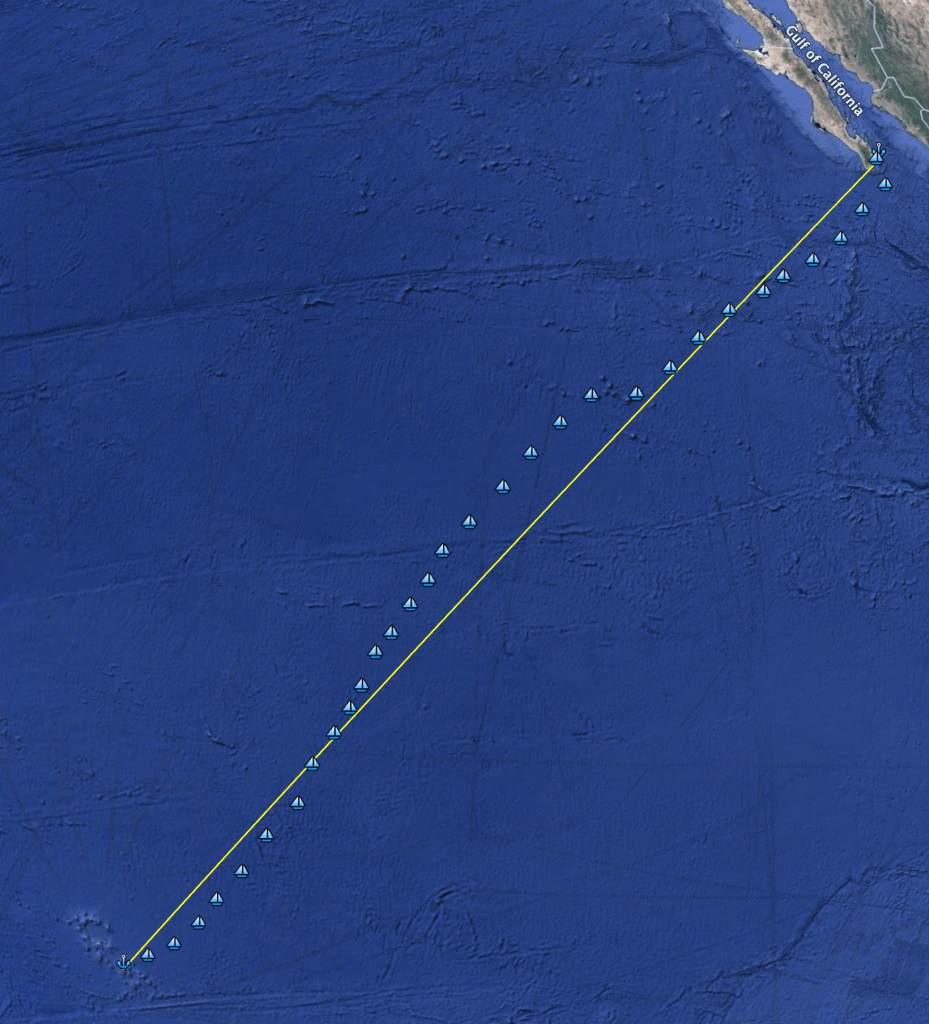
39 days from La Paz, Mexico to Hiva Oa, Marquesas.
Thanks to modern GPS navigation, it turns out to be pretty easy to navigate to a small Island in the middle of the ocean.
Definitely the most physically and mentally grueling thing I have ever embarked on…so far. It’s a bit masochistic. I can’t say I would recommend it.
It’s like a carnival ride (Tilt-a-Whirl?), or a bucking bronco, that never stops. Add in some intense tropical sun and heat, and some Chinese water torture to boot. I couldn’t predict when the next dollup of salty water would land on my head, but it was absolute that it would. I almost always flinched when I saw it coming. And it wasn’t even cold. I made some makeshift weather cloths from some acrylic canvas I rescued from the Ballard Mill Marina dumpster. This mitigated the splashing some. But on a small boat with low freeboard, the splash comes right over the top. And since I’m standing or sitting only two feet beyond, I get to taste the salty spray. Kind of like Yukon Cornelius tasted his pick axe. I also improvised a bimini for the sun that worked OK for sitting in the supervisor’s chair. There was nothing I could do about the bronco.
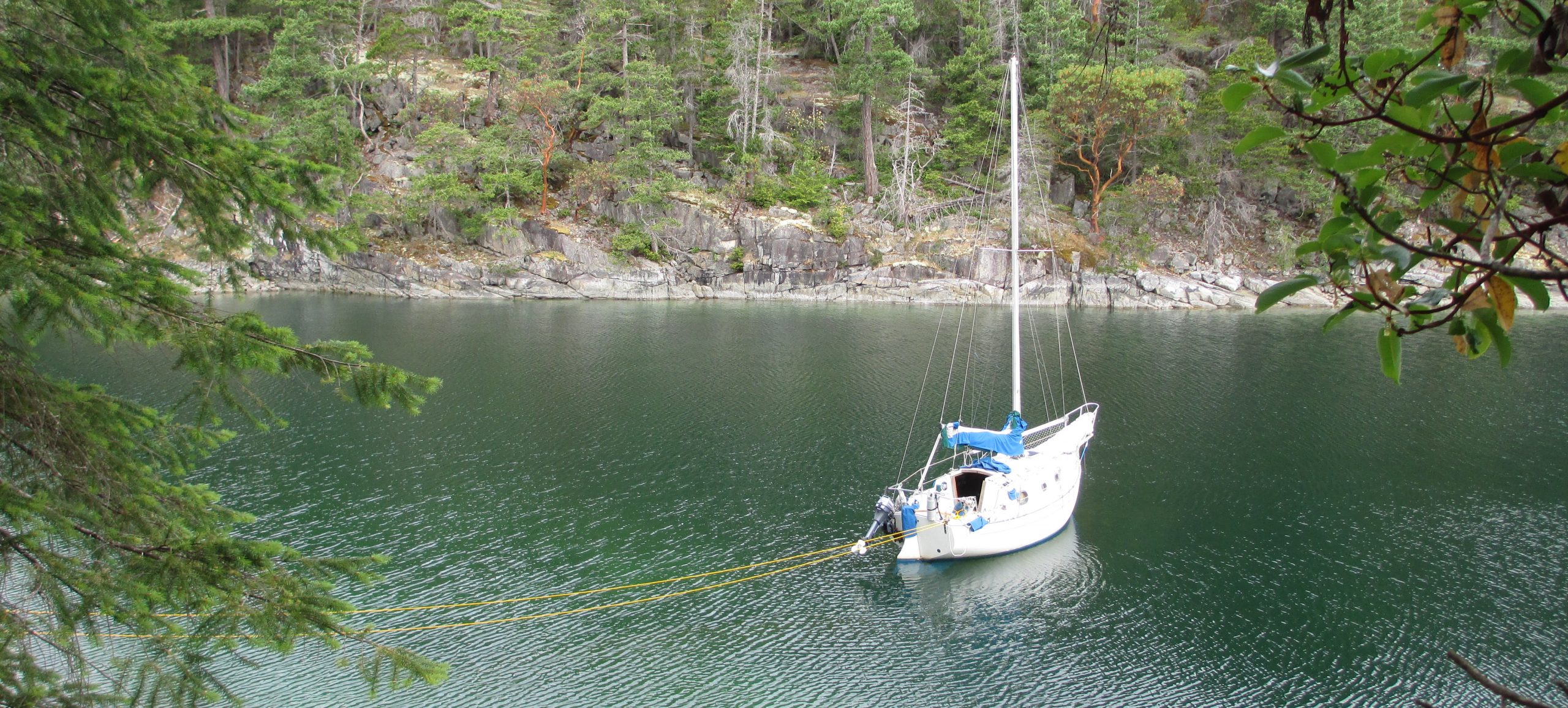
The real star of the show was Sampaguita. She just bounced along like a cork. I won’t say gracefully, because the sea makes that impossible, but if canvased properly she was unphased by the water torture, charging ahead despite the accumulating barnacles on her bottom. She only complained when her lackey supervisor wasn’t quick enough to make adjustments (or was sleeping.) within 24 hours of being anchored, most of the goose branches just fell off. I guess they like the boat to be moving. When I was entering the anchorage I was noticing the look of an ocean crossing vessels. They have a certain waterline grubbiness to them. When I got the dinghy sorted out, I realized Sampaguita was the worst of them all. You just can’t see it from the deck. Ha.
Arrival in the anchorage was very stressful. All the literature and Navionics reviews said to be ready with a stern anchor. So I was. It also said there was very restricted anchoring. Reality was much different. So many boats. So much swell. And hardly anyone was stern anchored. Where will I go? Sampaguita’s shallow draft meant she could go back in the bay. There were two spots left. I chose the most protected one. Yes, I stern anchored. Needed to. But we’re in a good spot. Most of the other boats will have to skidaddle when the supply ship arrives in a couple days. I think. Yes, Sampaguita is the smallest boat by far in the anchorage. Note: There is a certain kind of people who write reviews on Navionics, so the information is biased to that club.
I’m not officially checked in yet, but I hear it’s easy. I tried today but the Gendarmerie was closed. That’s like saying the police station is closed. I think because most of the staff was out in the boat. It’s a long walk to the station. I’ll go in the morn before it gets blazing hot. It’s not a big deal. Last night I went to a restaurant and had goat with coconut sauce. A local cuisine. A couple beers and strawberry ice cream for dessert. 2nd desserts was birthday cake from a locals birthday party. The family gave everyone in the restaurant a piece. You don’t see that in America.
I love this small Island stuff. Everything is closed in the afternoon because it’s too hot to do anything. Nobody’s stressing about anything. Except the tourists.
I’m amazed I haven’t broken any part of my body yet. My thighs were bruised from sitting in the supervisors seat bracing against the companionway and the perpetual side to side roll. I got sat down so hard in the cockpit one day I worried I had given myself a concussion from my brain slamming down in my skull. I gave myself a nasty blister on my palm trying to remove a thu-hull hose. I’m super surprised I still have any front teeth left. Sweaty, salty, dirty, and dehydrated, while oscillating between awe and apathy.
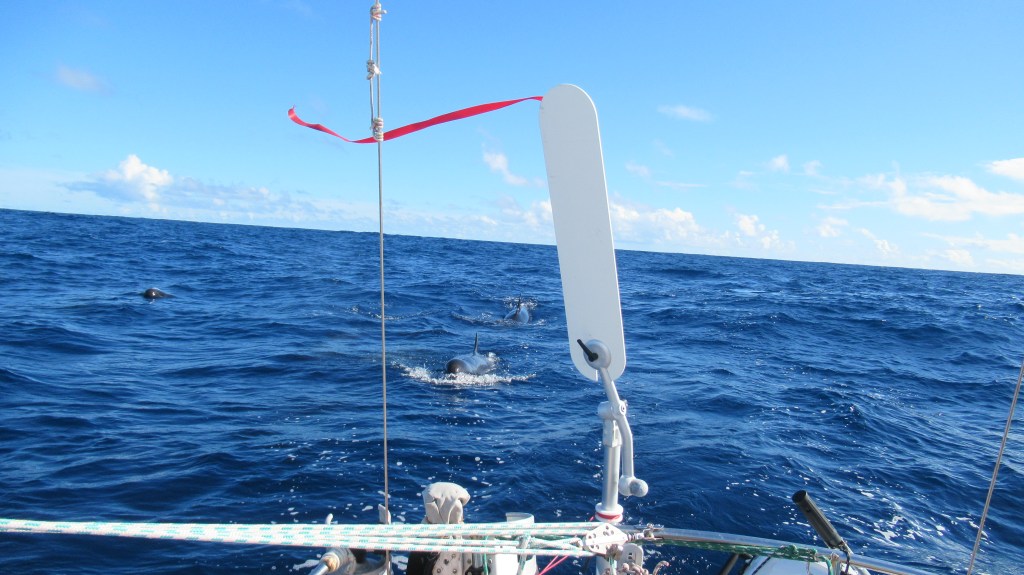
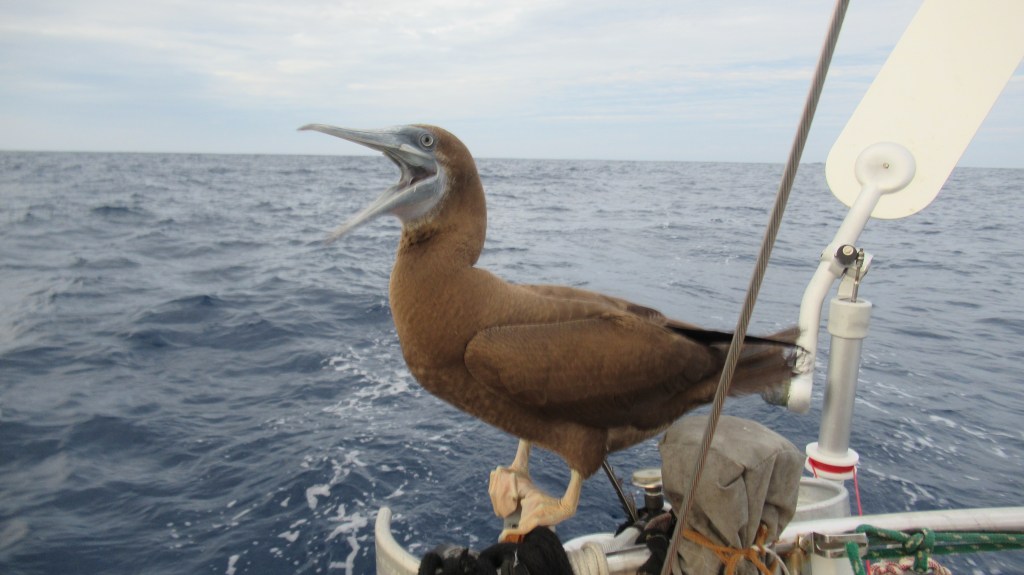
The pod of pilot(?) whales was cool. When I went below to grab the camera I could hear the high pitched speech of their sonar through the hull. The birds were ever present. I could sometimes see the shadow of pelagic fish below the surface. And so many flying fish! They smell awful. A whole fleet takes off and flies in unison, I suspect spooked by the onrushing Sampaguita. Though not as much marine life as I expected to see. The sea is so big and bubbly, it must hide it.
Once in the ITCZ and south, the conveyor belt of rain clouds began to appear. Warm enough to stand in the cockpit and allow the water to come down on your mostly naked body was refreshing. While the same cloud’s squall effect was demanding you tend to the sails and adjust the self steering gear. Add to this the simultaneous attempts to collect rainwater with a bucket hung from the boom below the fold of the reefed main sail. Mostly in vain, as the bursts were hardly long enough to rinse the sails of the salt first, and Sampaguita’s movement sent the bucket swinging around wildly, spending scant amounts of time underneath the stream. Then getting the water you do collect into a jug before dollups of onboarding salt water taints the catch or the rolling sloshed it from the bucket. All while holding on with two hands? This seemed to happen more at night than during the day.
A daily jig of whiskey turned out to be a blessing. Not that I’m much of a whiskey man. But alcohol in a concentrated form seemed the best option when space and weight were major considerations. In small amounts, it offered a needed attitude adjustment. Originally for a cross equatorial celebration, it took on a different purpose. As for the equator party, that was delayed an hour and a couple miles due to an above mentioned squall. Pretty anticlimactic. I had a bottle of Jameson which was palatable, and a bottle of Edward Lawson, which was not. After many attempts at mixers for the Lawson, by the last three drinks I discovered mint tea to be the best.

The bunk was the only safe and comfortable place to be. Movement there was minimal, and if I lay on my back, the position was stable. Sleeping was generally too easy. Who’s driving that boat, anyway? Flopping or flogging sails got me up pretty quickly though. In the heat of the day I would lay down just to cope, dozing and sweating, with a towel underneath me. However, a trip to the bunk meant considering sail trim and steering gear adjustment first. In a small boat, your body is ballast and that extra weight on the starboard side made a difference. Super annoying when you don’t get it right the first time. I lay there asking myself “Do I really need to get up again or is it good enough?”
Hands down, the most valuable piece of gear was the self-steering wind vane. A remarkably simple and effective use of physics. I had to do a repair because a screw came loose and was lost. I can’t imagine having to steer myself the whole trip! Luckily I MacGyvered it and had just enough metric fasteners on board to make it work.
Would I do it again? Do I have a choice? Considering where I’m at, death or shipwreck may be the only other options.
Lots to think about and consider. Still getting my bearings. Thanks for reading.
Thanks for checking our position. Due to a technological universe far bigger than Sampaguita and Sailing With Josh, it takes a little effort on your part to locate us.
Presently we are travelling to French Polynesia. Follow the yellow triangles
One day we may figure out how to make this easier for you, but at the time, it is beyond out technical savvy. And the trying has not been any fun at all.
I believe in you.
share.garmin.com/SailingwithJosh
If you would like to support Sampaguita in her voyage, she’s a boat, and always demanding something.
Donations can be made via PayPal or Zelle: wheelersf@hotmail.com
Thank you.
“Tack,Tack,Tack.”
A friend, reader, and donor commented: “I just don’t know how you provision for so many days, on a 20 foot boat. I’ve never gone more then 7-10 days, that was a catamaran 45′, in the BVI where we moor every night, and island hop.”
It sounds to me they have a pretty good start. I didn’t buy a boat yesterday. I started out small and short in my sailing trips and slowly and systematically increased the times and distances and challenges, gaining experiential learning and confidence. Even with Sampaguita, I spent the first two years staying at docks before I gained enough confidence to anchor. The third year I got my feet wet and the fourth year I improved my tackle and never looked back. Everyone has a different approach and pace to planning and doing. Some people jump right in on something and just do it. While I envy them at times, I know I have to do it my way. While an ugly aspect of life is that we are pressed into competing, there are different ways to winning and losing. (And ironically, winning sometimes turns out to losing and vice versa.) Don’t worry about how others are doing it. Figure out what’s best for you. That’s part of the fun.
Planning is simply academic. I know I’ll sound antiquated here, but lots of great books have been written about preparing your boat for cruising. They are still likely available from your public library for free. While of days gone past, they are still very relevant, because they provide the basic fundamental knowledge you need about preparing your boat and survival at sea. The good books provide systematic, focused, proven, and vetted information. Start there and then supplement that with internet research. Be aware, the internet is a trap that can deceive you, lead you astray, blind you with the bright and shiny, rob you of your focus, and worst of all, it’s mostly about selling you something. A good book doesn’t try to sell you anything and stays on target. Get the fundamentals first and use the internet to build on them.
Guidebooks are available for most of the cruising grounds of the world, and are written to not only help you succeed, but in holiday fashion. In the Pacific Northwest, I particularly liked the Dreamspeaker guidebooks. The information in them came from a credible source and I used them to circumnavigate Vancouver in 2018. They never steered me wrong and gave me confidence about destinations and anchorages. In fact, I had no depth sounder at the time, but the anchoring information allowed me to confidently know where to anchor without it. A good guidebook will hold your hand through the journey.
That said, my 2023 circumnavigation of Vancouver Island for my shakedown cruise, I did not use a guidebook at all. I already had a bunch of local knowledge. I did use Navionics which offers some crowd sourced anchorage info that needs to be taken with a grain of salt. I specifically did not want the hand holding this time. Ditto for coming down the west coast of America. And while there are a couple go-to guidebooks for Mexico, I did not have them either. I do however, have a couple guidebooks for French Polynesia. We live in a time with so much information about everything at the click of a mouse, it takes some of the thrill, exploration, and discovery out of a journey. But that’s just me. Most people prefer to have everything at their fingertips and make the experience as safe, comfortable and as close to the land experience as possible. Starlink has really allowed this. If Captain Cook was able to have Starlink, he would have. Of course, then, his voyages would also have been unnecessary. Do what’s right for you.
Provisioning is also not that hard. If you shop for a family of four, six, or eight at home on land, then you can figure out how to provision a boat. You have to know how much food you need and can carry. You need to consider your refrigeration capabilities, if any. I have learned a lot of things that they say need refrigeration, don’t. You need to keep it simple. While at sea, you won’t be making any fancy meals unless at anchor. And then you have limited space. And too many dishes to do makes no one happy. Stick to the basics, but also have some fun stuff that you can properly ration for morale boosting and special occasions. This too comes with practice and trial and error. Start with shorter cruises and build up from there.
When you go to a foreign country, be aware that they will eat different foods and you may need to improvise with what’s available. They won’t have the same stores or cultural tastes. They may not have the economy of scale that people in the States are accustomed too. Maybe you can walk, maybe you’ll need to pay for transportation. This is all achievable stuff.
Some people like to spreadsheet out their provisioning so they know what they have and what they’ll need to buy. Personally, I don’t bother with that. It’s just me. That’s a bunch of tedious book work that isn’t necessary and I don’t have time for. But if it helps someone keep organized, go for it.
A watermaker is very common. I used to think it was driven by a fear of running out of water. It isn’t. It’s convenience. The chore of resupplying water after a long passage to an underdeveloped country can take a huge amount of labor and time. A watermaker might get you thirty gallons of fresh water for 105 amps. You will need to produce and restore that energy regularly which, along with the watermaker, adds complication, expense, and maintenance to the experience. But this is all addressed in the books you have read about the fundamentals. Ironically, if you depend on a watermaker, there may be a higher chance of running out of water if it fails. Just in time provisioning (or planning) has its dangers. Remember the pandemic?
So, sure, if you don’t practice cruising, like many things, fear of the unknown can be intimidating. Fear of the unknown is normal, and often unwarranted, that provides a challenge to overcome. So often the things I am intimidated by, once I learn them, I have to laugh at how foolish I was to worry about them. Allowing fear to paralyze you is sad. So many people don’t try the things they could because they are paralyzed by fear. They are so concerned they have to have every little detail worked out that they never get to the thing. That’s also part of how they manage not having to face their fear. You’ll never figure it all out until you start doing it anyway. So get at it.
Check out the nautical books page. This is by no means comprehensive but it can get you started.
PayPal or Zelle: wheelersf@hotmail.com
This was another M. Night Shyamalan moment. He had some great movies, however The Happening wasn’t one of them. The premise was great, the production was not. On the other hand, things like this always make me think of it.
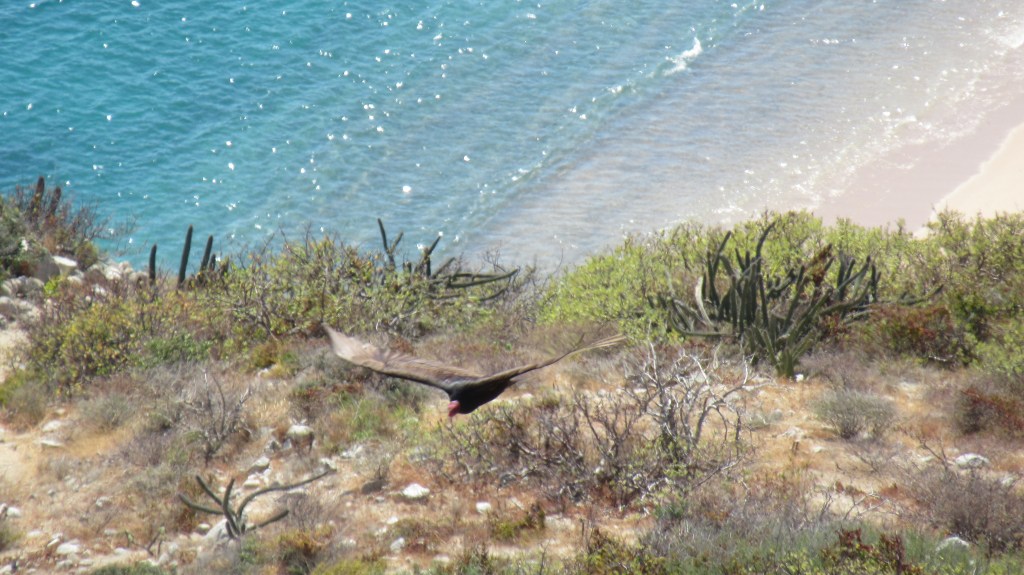
I don’t recall what I was doing, but I looked out Sampaguita‘s companionway and there was this flock of birds just soaring over this one particular spot of La Paz. There was some wind but it seemed more like convection heat holding them there. It has been very hot the last couple of days. I don’t know, it just made me feel something.
Thanks to Monica and Latitude 38’s ‘Lectronic Latitude for publishing another Resourceful Sailor installment. This one is about how I keep Sampaguita’s drop boards from coming out if I get knocked down or capsized. Not what you want to think about, but you better.
If you have your own version of how to secure your drop boards, feel free to comment at the bottom of the article.
Follow the link:
https://www.latitude38.com/lectronic/resourceful-sailor-drop-boards/
The dolphins were at it again in the bay this morning. The moon was full over La Paz this evening. In between, I 303’d the dinghy, cleaned some of Sampaguita’s bottom, had pork chops for lunch, grocery shopping at Chedraui’s, met Paola and talked bottom cleaning cost, had a beer with 81 year-old Richard from S/V Firewater on the Club Cruceros patio, congratulated Zach for his incredible dinghy score, hamberguesas for dinner, and hot lime water for dessert.

Richard, I’ve seen around but had never chatted with him. In actuality, he did most of the talking, but he is good at it, with lots of sailing stories. He apparently built his boat, Firewater, forty years ago. It’s an old salty looking ketch. I first saw it in Los Frailes, and it did catch my eye and stick in my memory so it must be cool. In contrast, I never remember a Beneteau, Jeanneau, Hunter, or a Bayliner. A petite man, with a lot of spring in his step and beer in his belly, with a propensity for reminiscing, but I think he’s the real deal. Good anecdotal information.
Zach, I just met today, but apparently, he’s been around a lot. I avoid the crowds so there’s no surprise I’m slow on the take. Kind of a young guy living in Mexico for seven years. I’m not sure if he’s a citizen or what. Not a native Mexican. He was given a Cal 27 recently but had been borrowing a 14-foot aluminum skiff for a dinghy and using a kayak paddle to propel it, which is super un-ideal. This is how I met him:
I was working on the computer on Los Cruceros patio after grocery shopping, not paying much attention to anyone. Then this young guy starts asking everyone on the patio if they knew the boat, Wanderer. He explains he just found this packet on the bulletin board that says Free Dinghy from Wanderer. In the packet is a picture, a key, a receipt for the motor and its manual, and a note saying it is on the 24-hour dock. This guy really needs a dinghy, but it all seems too good to be true. He sincerely doesn’t want to steal it and is looking for confirmation that he can really have it. After quite a bit of due diligence and agreement from various others than it sure seems real, he goes and claims it. A great score for him. The dinghy is aged, but it seems to be holding air. The motor is an 8-horse 2-cycle Mercury, bought new on 12/29/2023 for 31,000 pesos, a little over $1800US! I saw the receipt. Starts up fine. Fuel in the tank and everything. We are all in disbelief, really. Every morning on the Net there are people trying to sell and buy dinghies. Heck, I paid $600 for a motorless dinghy. In actuality, I don’t need to be envious, it is a hard bottom dinghy and the motor is more than Sampaguita can accommodate. My dinghy is right-sized for Sampaguita which is rare, but absolutely necessary. But I had to think that through. I was sitting right there. If I had looked at the bulletin board before I got on the computer, I would have seen it first. But no worries. He needed it and obviously could never buy it. I would have only been able to sell it. A 2-cycle is a good motor to have as an outboard outside the US, but it’s not a long shaft, so no good for Sampaguita anyway. That’s a once in a lifetime score. Never mind that this kid can’t put it on the deck of a Cal 27, or inside either. He isn’t going cruising anyway.

Now, Paola. Paola is this young woman you see about the anchorage and Marina De La Paz. Apparently, she lives on a boat in the anchorage. You will often see her going back and forth in her dinghy, which is actually a sailing dinghy with no mast, fitted with an outboard. It’s big enough to haul her dive gear and dog. She seems very industrious. Her gig is cleaning boat bottoms and everyone seems to have her doing it. I once saw her taking the dinghy across the channel, reach over, wet her hand and stroke her hair through. Then repeat. Salty by definition.

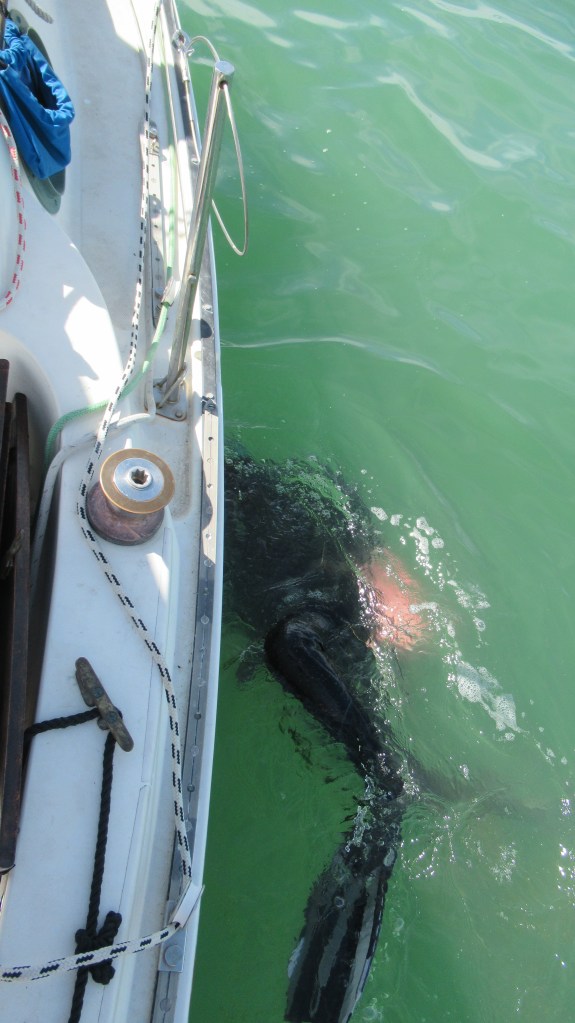
As I prep for leaving, Sampaguita needs a good bottom cleaning. Growth has really begun over the last two months. It’s important to me to understand all things Sampaguita, so I have done the lion’s share of it, but there are some challenges to getting the light barnacle growth that has begun. I would have to rig a line around the boat and free dive with a scraper. I’ve imagined how I would do this, but also recognize the challenges. It’s tough to do in La Paz because of the current and wind. And as far as swimming, the bay wouldn’t be your first choice. I don’t have shower access, and while I could do this, I know it would be difficult. (I think I will have to haul the boat in French Polynesia and put some fresh bottom paint on.) So, I asked Paola what she would charge. She has a formula based on waterline, so, (small boat bonus) she quoted me 650 pesos. About $40 US. Scheduling is current and wind dependent, but that’s for her to decide. She’s got the gear and can do a good, practiced job of it, so I’ve decided to let her finish the job. I’m particular about who I have work on Sampaguita and I think an industrious young woman making a good go of it in a tough Mexican economy, with a resourceful approach to a dinghy, fits the bill.

Now, I have set a departure date for March 9th, weather and formalities willing. I have scheduled Paola already and have the 650 pesos budgeted out. This is happening regardless. I have made a new page on the blog called Sampaguita’s Donor Page. Here I have listed the initials (for privacy) of the donors and what their funds have been attributed to. If someone wants to participate in Sampaguita’s voyage and also to a young Mexican woman’s entrepreneurial endeavors, the next $40 donation will be credited to this. How’s that sound?
PayPal or Zelle: wheelersf@hotmail.com
A friend, champion, and donor of mine expressed how he enjoyed reading my blog and getting to know me better. So, I have decided to follow that lead in this excerpt and give a little taste from before there was Sailing With Josh. This won’t make what ultimately brought me to this point in life clear. Personally, I’m not ready for that sort of vulnerability. That seems like a book anyway.
Some know my story fairly well, while others likely have no clue. If you’ve kept up on your required reading, you already picked up on my childhood chicken expositions. My teenage years through my mid-thirties were focused on drums and percussion. I pursued those endeavors with the same vigor I approach sailing now. Intensity and focus are my thing. Personally, I think sailing suits me better. Sailing I can do by myself. Drumming depended too much on others.
We all approach life differently, so therefore all have a different journey. Sometimes that journey takes a crazy path. Somehow all this led me to where I am now. Here are some photos I came across recently. It’s about all there is. I hope you get a kick out of them.
I apologize, all photo credits are unknown.


Greetings fellow humans,
There is something called the La Paz Waltz. It’s a cheeky way of describing how different boats swing at anchor here in La Paz, Mexico. The music starts when strong wind and current oppose each other. While dancing is fine, kissing is a bit more risque. My neighbors this past Sunday were at it. They may have been smooching. It was a little difficult to tell from my angle, but they were close enough to be suspect. Not that I’m a puritan, but Sampaguita doesn’t want her delicate parts fondled in the anchorage.
No, I didn’t acquire a drone. I’m too old school for that, plus their invasive nature (and now common use in warfare) creeps me out. This is from atop of Sampaguita’s mast. I went up on a calmish, low current day to inspect before heading into the sunset. Everything looks as it should. I use a Top Climber to ascend and descend, allowing me to go it alone. It gets easier and less daunting the more you do it. Relaxing at the top in fairly calm water affords a moment for video. And Sampaguita’s top is only 31 feet up.

What’s the best nation in the world?
A Donation.
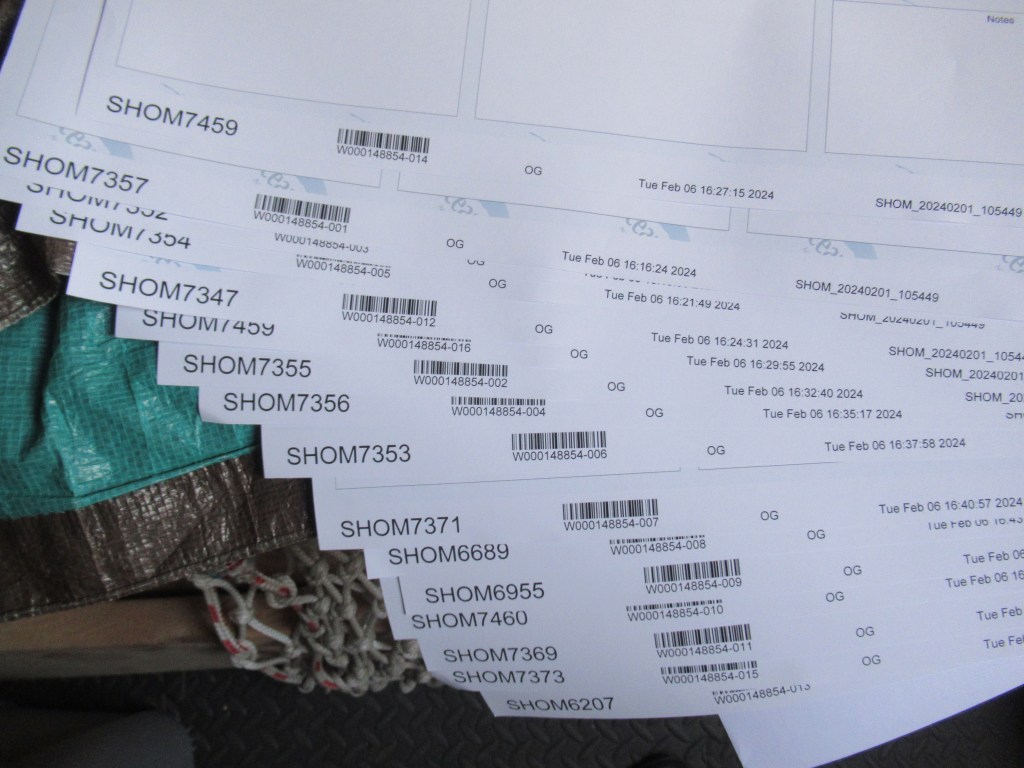
I received my French Polynesia paper nautical charts yesterday. But don’t worry, you can still contribute, they were bought on credit. I’ve attached a couple pictures so you know they’re real. Plus, it’s hard to top the romance and dreaming for an armchair sailor of studying nautical charts of distant lands. Sampaguita does not have an electronic chart plotter. I do have Navionics on my phone, but many (most?) of us have broken a phone or dropped one overboard, so that’s a risky dependency. I have charts on Open CPN, a free crowd sourced program, for a back up too. But computers also die and the salt water environment can easily make all electronics stop working forever. I know this from experience. I have GPS devices, but I also have a sextant and the tools to celestially navigate. Plus, focusing on electronic devices while trying to have a natural sailing experience removed from the burdens of a modern, high tech, and complicated world is too painful for the spirit. So, I bought some French charts, because they will be the most up to date. And whether you’re analog or digital, it all costs.
If that is all over your head, I will also be purchasing some travel health insurance soon, as I understand it is a requirement for entry into French Polynesia for the time I need to be there. I’m certain that can resonate with everyone. It will be of the minimal variety, enough to suit them. I am presently uninsured and I am well aware that a single-handed sailor suffering a medical situation at sea doesn’t stand much of a chance. No insurance will help at that time. Someone asked me once if I was afraid of pirates. I explained that the chance of choking to death was much more real.
Sampaguita is paid up on her registration through June 2025. I had to have those documents Expressed to me which cost nearly as much as the registration. My kayak warranty parts were sent snail mail, not priority as I was told they would be. They landed in Mexico City on January 12 and haven’t been heard from since. They offered to resend them, but I would have to pay for the Express shipping. So that was done yesterday.
Google Fi shut off my data, but my phone still works and my SMS texts began coming through, so that’s good for now. I joined Club Cruceros de La Paz for $10 which was a bargain to be able to use their wifi. So that’s how I’m posting this right now. That’s where I have been doing my marathon researching. I may move to the Tossible Digits service before I depart for Marquesas. Paying for Google Fi without data access isn’t a very good deal. Plus, I’ll be at sea where it won’t work anyway. Tossible Digits will allow me to keep my number and I will receive messages and SMS texts (no pictures or emojis or I won’t receive them) via email and their website. It will cost considerably less. Then I can get a local SIM card (I read that Vini will be the best in FP) which will give me data through any towers and calls can be made via Whatsapp. That is if I understand everything correctly.
There is no shortage of ways to make your contributions count towards the heart of the expedition. If you like to help those who help themselves, I have been writing and submitting stories to publications too. ‘Lectronic Latitude presently continues to publish some of my Resourceful Sailor pieces, which I am thankful for, but payment amounts to about $600 a year, if I’m lucky. (About $5 per hour.) I have asked for an increase multiple times, but to no avail. I have submitted some pieces to other, better paying publications but they can take up to 60 days to even say, “Thank you for your submission, but we are declining to publish.” And they all demand you do not submit to other publications simultaneously. It’s a bit of a power play. So that progress is slow and therefore, not very profitable. In talking to cruising veterans, they have explained how writing is considerably less valued than it was in previous times. I get it, the world is ever changing. It’s tough for us dinosaurs. Such is the way of a struggling artist, or in nautical terms, a sinking artist.
Think of sending a few dollars as similar to tipping your wait staff. You are feeding on the content and subsidizing the publication in return. I realize it’s easy to avoid as an anonymous and distant reader, but I appeal anyway. If you’re keen to support a writer, an explorer, and a sailor who is not doing it in the modern cookie-cutter style, this is an opportunity to be part of something fantastic and out of the ordinary. Thank you so much.
And as always, a huge thank you to those who are already participating.
PayPal or Zelle: wheelersf@hotmail.com
And now a missive:

Carnaval in La Paz
I did a walkabout of Carnaval in La Paz on Sunday night. I had been through on Saturday afternoon on my way to grocery shopping, but it turns out to really be a night time thing. Out at anchor you can hear and see it going on until one or two in the morning every evening.
In La Paz, Carnaval takes place along the Malecón. The Malecón is the waterfront. There is the beach that stretches for a couple miles (excuse me, a few kilometers), and then there is a wide sidewalk/park along that. There’s usually a queue of people waiting to get their picture taken next to the big block LA PAZ letters that are characteristic of Baja towns. I have a few of pictures from other towns in recent blogs and then I got bored with it. Then there is the street and on the other side of this are the restaurants, hotels, and shops where you can get souveniers saying “My mom went to La Paz and all she got me was this stupid t-shirt.“ But in Spanish. Just kidding, I don’t know if that’s a thing, but you now know what I mean. In San Francisco you have Fisherman’s Wharf. In New York you have Times Square. In Seattle you have Pikes Place. In La Paz you have the Malecón.
For Carnaval, they shut down the street and line it with games, concessions, and carnival rides. Very similar to the midway of the Otsego County Fair in central New York that I used to show chickens and sheep at. Except way bigger. Two kilometers bigger. The games are very similar. Shoot the bottles, roll the ball, win big soft toys and tapestries of your favorite pop artist as prizes. The concessions are similar to, but with more Mexican flavor. Pun intended. Meat on a stick. Corn on a stick, Cotton Candy, Papas Fritas. And a bunch of other things I’m not sure what they were. The concessions were mostly run by regular people, while the games and rides were more operated by what we used to call “carnies.” You can tell by the hard living look they have. It’s not an easy job. Pays crappy, you work all night. Showers are few and your bathroom is always a blue house. But you don’t need a resume, a degree, and your boss asks few questions. It’s kind of the Group W bench. They gotta live too.
Tecaté tents every two hundred meters offer canned beer for 35 pesos (presently a touch over two dollars US), but no worries, if you don’t want to overpay for beer, it turns out you can buy a twelve pack at the regular store and just take it in. There is no entrance gate. No admission. You come and go as you like. There are police around, but they seem to just make sure nobodies getting violent, or too outwardly brash, or trying to drive on the street, not to enforce a bunch of rules and behaviors. At least that I noticed.
And there were thousands of people. It is a family affair, but not puritan. There were lots of teenagers and twenty somethings involved in the classic mating rituals of these kind of public events.
The interesting parts to me and that really set it apart from the carnivals of my youth (because I totally steer clear of that stuff as an adult) is the volume and the music. It was loud. Every game truck had their own sound system and Mexicans tend to turn it up loud. I remember this at the baseball game in Bahia Tortuga too. And they seem to focus on the mid and high frequencies. (which are the most damaging) But that might also be because they don’t have the best equipment. There were about eight live music stages along the Malecón. These had your more “professional” acts which ranged between Mexican takes on the American/Brit pop music machine, or Ranchero, or some other genre I can’t name. More polished, costume wearing, popular groups. I didn’t see anything while I was there that was very interesting, but I’m over that schtick anyway.
What did spark my interest were the street bands interspersed between the stages. As soon as the volume tapered off from one group, you moved into the sound space of another. A few had costumes, but most were just wearing unpretentious street clothes. I don’t know the name of this genre, but it is the classic Mexican music you so often hear that is not based on the American/Brit music wave. But I hesitate to call it traditional, because I don’t really know what that is in Mexico either. They are also not all created equal, which is true anywhere. I love that they are made up of mostly instruments considered “uncool” in America, but obviously super cool in Mexico. My favorite group was a quintet. They were killing it. The bigger groups could be impressive too, but they also tended to get a bit sloppy, and were outstretching their talent pool, so they didn’t seem to be captivating people as much.
The quintet consisted of the following instrumentation, which seems typical of the genre. A Sousaphone player (which is the same thing as a tuba, except for standing), a clarinetist, a trombonist, a bass drum/cymbal player and a percussionist with a snare drum, set of timbales, a variety of cowbells and a cymbal. (The bigger bands would have trumpets.) The rhythm section was feeling it and it made all the difference. They were surrounded by people dancing and even the passing crowds were bopping as they went by. Who knows what they were called. They weren’t putting on any “stage show”, no costumes, no worries, no rush. Just making people dance. They would be checking their phones in between songs. (Yes, that plague is worldwide. Go by any shop and see the bored employees on their phones.) No taking themselves too seriously at all, which is so refreshing. But, I repeat, killing it. (Musicians where I’m from take themselves way too seriously and seem to expect others to as well.) They were the highlight of my abbreviated Carnaval experience. Out at anchor, I am a couple kilometers away, but you can hear the Sousaphones honking late into the night. So cool. Those guys (yes, guys) have some serious chops and mighty lungs.
The solar charging system is working like a charm with spares to boot. Thank you so much to those who helped to contribute.
I’ve ordered 16 SHOM (Service hydrographique et océanographique de la marine) paper charts of French Polynesia, printed on 02/06/2024 at $42US each on the credit card. They should arrive in a couple days. I mention this so you know how any near future donations will help Sampaguita and the expedition. (And to assure you you’re not buying cheap Mexican beer and prostitutes.)
PayPal or Zelle: wheelersf@hotmail.com
I’ve been working on a new Resourceful Sailor piece about Sampaguita‘s Self-Steering Wind Vane. I filmed this video today to accompany it. I thought I would share it. This one’s more for the sailors in the bunch.


 sailingwithjosh
 Sailing With Josh