
| Subscribe here for more The Resourceful Sailor Asks “Does Size Matter?” Thank you to Josh Colvin and Small Craft Advisor for publishing a Resourceful Sailor piece about considerations of choosing what boat fits your heart and soul, published on Feb. 5, 2025. Small is relative, though a Flicka 20 has always fit the bill. Follow the link above for the full article and thanks for stopping by. |
I have been sorting through some archival footage from my 2019 transit of the Northwest Passage aboard Oliver Huin’s Breskell. Maybe this will be fun for the armchair sailors. Maybe it will be helpful for those planning a future trip. Like Jimmy Cornell’s:
The High Latitude Challenge 2026-2027
I’ve heard it said that fewer people have transited the Northwest Passage by boat than have climbed Mount Everest. If true, I suspect that statistic may be challenged soon enough. Presently, only captains and vessels are acknowledged. I was only working crew.
These show the Royal Newfoundland Yacht Club of St. John’s, Newfoundland, Canada, where Breskell wintered over and refit for her 2019 passage. The RNYC is on the Conception Bay side of the peninsula. There are excerpts from Breskell‘s voyage from Newfoundland to Greenland, which was a staging area for awaiting the clearing of ice from Baffin Bay and The Northwest Passage. Our crossing of Baffin Bay was entirely under power with nearly no wind at all.
Sailing With Josh & The Resourceful Sailor Present:
A Flicka 20’s Pacific Odyssey
Wednesday, March 12, 2025
5:30pm – FOOD/SNACKS 6:00pm – SHOW 7:30pm – RECEPTION
FREE FOR EVERYONE!
@ The Port Townsend Sailing Association Clubhouse – Nomura Building – 385 Benedict St. (Facing the Boat Haven parking lot)
Host: PTSA Beverages: Admiral Ship Supply
Britannica defines an odyssey as:
1. literary: a long journey full of adventures.
2. a series of experiences that give knowledge or understanding to someone.


| Fostering seamanship and friendship for people with an active interest in offshore cruising. |
| Bluewater Cruising Association |
| Vancouver In-Person Club Night – Sailing With Josh: A Flicka 20’s Pacific Odyssey When: Wednesday, February 12, 2025 1900h Where: Scottish Cultural Centre 8886 Hudson St Vancouver, British Columbia Canada Contact: Heather Marshall vanspeakers@bluewatercruising.org Sailing With Josh: A Flicka 20’s Pacific Odyssey Wednesday February 12, 2025   Britannica defines an odyssey as – 1. literary: a long journey full of adventures. 2. : a series of experiences that give knowledge or understanding to someone. Britannica defines an odyssey as – 1. literary: a long journey full of adventures. 2. : a series of experiences that give knowledge or understanding to someone.In August 2023, Sampaguita, a Pacific Seacraft Flicka 20, and Joshua Wheeler embarked on an epic Pacific Ocean odyssey. Beginning and ending in Port Townsend, WA, they journeyed down the North American West Coast to Baja, Mexico, followed the trade winds to the Marquesas, and returned via Hawaii (sort of). Josh will share some of the lessons and experiences imparted by the sea, the land, and the people in this single-handed voyage of a tiny boat on a big ocean. Bio: Joshua Wheeler has lived and sailed on small craft for over 15 years and 25,000 nautical miles. Credits include a 2019 transit of the Northwest Passage, two solo circumnavigations of Vancouver Island in 2018 and 2023, the Inside Passage to Alaska in 2022, and a Pacific tour in 2023-24. He’s held a USCG Master license, has a recurring column in Latitude 38’s ‘Lectronic Latitude called The Resourceful Sailor Series, and enjoys local small boat racing. https://www.youtube.com/@sailingwithjosh https://sailingwithjosh.com/ Meeting Format: Doors open at 7:00 and meeting starts at 7:30. Cost: $5/Members, $10/Non-Members, payable at the door only. Note: This Club Night Is An In-Person Event Only |
This was pretty sweet of Monica, Latitude 38, and ‘Lectronic Latitude to post:
“News is free. Journalism is not.” – The Associated Press
Please consider a donation to Sailing With Josh if you find any value in this website and its coinciding YouTube page. I assure you that they come nowhere near the required thresholds for monetization. I attempt to provide free and equitable access to this site and YouTube page for all races, and economic and social classes. A DONATE button is on this site’s home page. Thank you for your thoughtfulness.
I have been sorting through some archival footage from my 2019 transit of the Northwest Passage aboard Oliver Huin’s Breskell. Maybe this will be fun for the armchair sailors. Maybe it will be helpful for those planning a future trip. Like Jimmy Cornell’s:
The High Latitude Challenge 2026-2027
I’ve heard it said that fewer people have transited the Northwest Passage by boat than have climbed Mount Everest. If true, I suspect that statistic may be challenged soon enough. Presently, only captains and vessels are acknowledged. I was only working crew.
Sisimiut, with a population of about 5,500 people, is the second-largest city in all of Greenland. You will see it is quite small. I liked Greenland very much. The crew of Breskell was invited to a humble apartment in a humble apartment building by a three-generation Greenlandic Inuit household we had befriended. They wanted to share some of their heritage with us. For dinner, we had boiled seal meat, prepared as their ancestors had. I recall it tasting like beef, smelling like fish, with a propensity to get caught in my teeth. They performed a traditional song and showed us traditional dress. We talked politics. I treasure that experience.
All of Qeqertarsuaq, Greenland (Disko Island) – Population – 1,100
All of Bylot Island, Canada – Population – 0
I have been sorting through some archival footage from my 2019 transit of the Northwest Passage aboard Oliver Huin’s Breskell. Maybe this will be fun for the armchair sailors. Maybe it will be helpful for those planning a future trip. Like Jimmy Cornell’s:
The High Latitude Challenge 2026-2027
I’ve heard it said that fewer people have transited the Northwest Passage by boat than have climbed Mount Everest. If true, I suspect that statistic may be challenged soon enough. Presently, only captains and vessels are acknowledged. I was only working crew.
These are of Greenland and Pond Inlet. They are observational and educational videos. Entertainment, heavy editing, talking, and music are not Sailing With Josh’s thing. More to come. Meanwhile, check out some of my other videos on Youtube.
A special thanks again to Monica and ‘Lectronic Latitude. This installment was inspired by her. When I was voyaging Monica was kind enough to take me to the grocery store and out for a beer in Sausalito. (With her partner Jay.) She stopped by Sampaguita and the first she said was something like “Hey, we had a curtain too on our boat.”
Click the link below to be directed to the article. Thanks for stopping by.
The Resourceful Sailor — Behind the Curtain

The following Resourceful Sailor piece was meant to compliment another, previously published by ‘Lectronic Latitude on April 19, 2024, called The Resourceful Sailor Talks Whisker Poles — the Good and the Better.
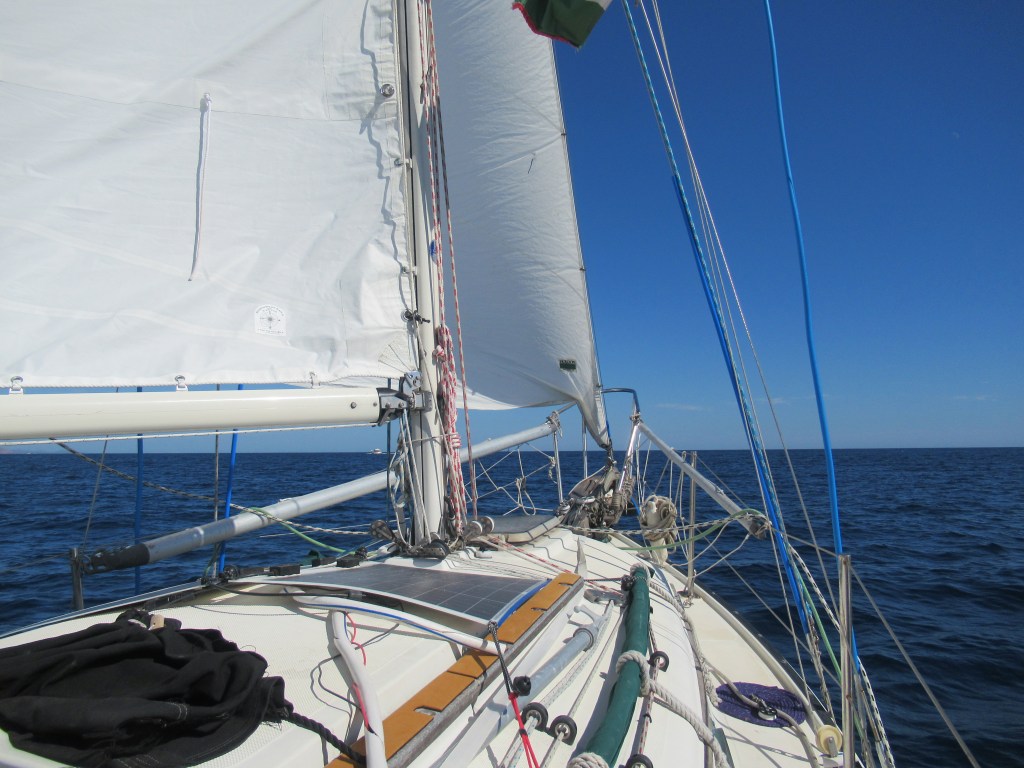
A question often arises about the proper way to use a whisker pole. Does it go on the sheet? Can you attach it to a soft shackle? Can you attach it directly to the clew? The Resourceful Sailor is not here to give that kind of sailing instruction. There are better people for that. The comment section below awaits you. He has used all three of those methods at one time or another. However, for single-handing on Sampaguita, a 1985 Pacific Seacraft Flicka 20, for various reasons of efficiency and control, he trended toward attaching the pole to the soft shackle or the clew. When it was the clew, it required some chafe protection.

The 100% jib and the 140% drifter had end rings at the clew. These were larger than a traditional clew ring and easier to hook the pole to and from. I added chafe protection to the inside edge where it met the sail. In true RS fashion, I wedged a small piece of blown-out water hose cut lengthwise in and stitched up the top corners with waxed twine, securing it. It took less than ten minutes for each sail. The stitches were non-destructive, meaning they didn’t go through the sail, and this has proven to be very effective and durable, though not elegant. Luckily, Sampaguita and I are not that type.
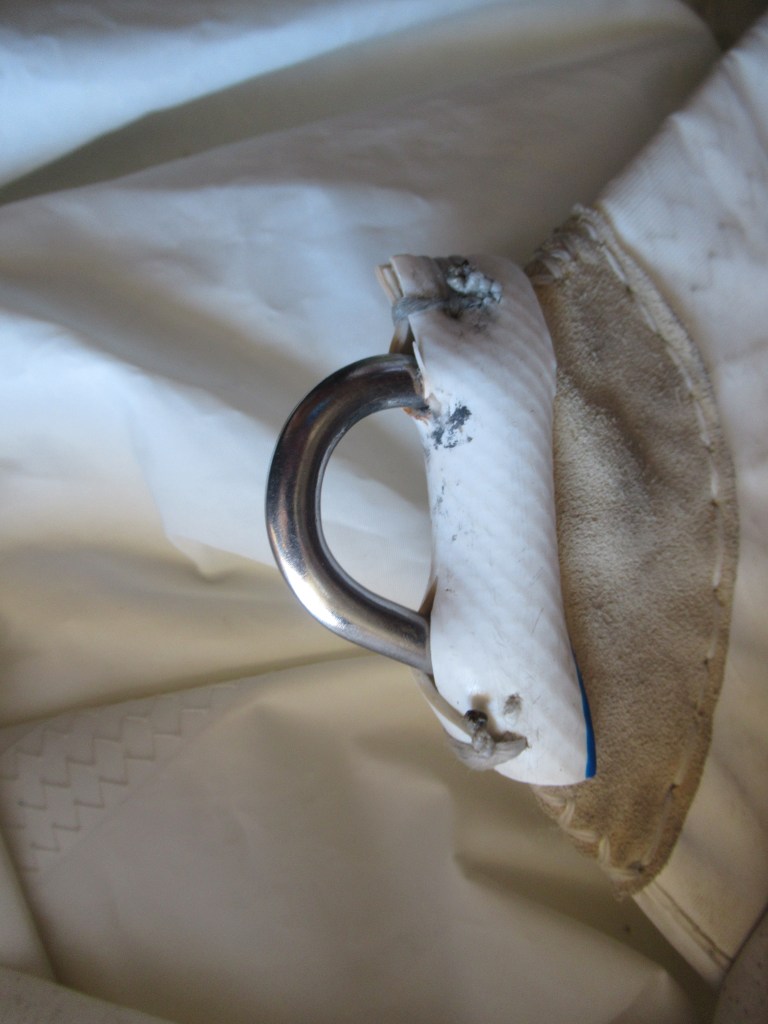
The genoa had a traditional ring at the clew. The chafe was going to occur on the outside corner of the sail. While using essentially the same materials, the approach was slightly different because of the sharp curve, requiring extra snips in the hose to accommodate it. I used thicker twine for durability and seized it around the clew to hold the piece of hose in place. It was still non-destructive. This one took about fifteen minutes.
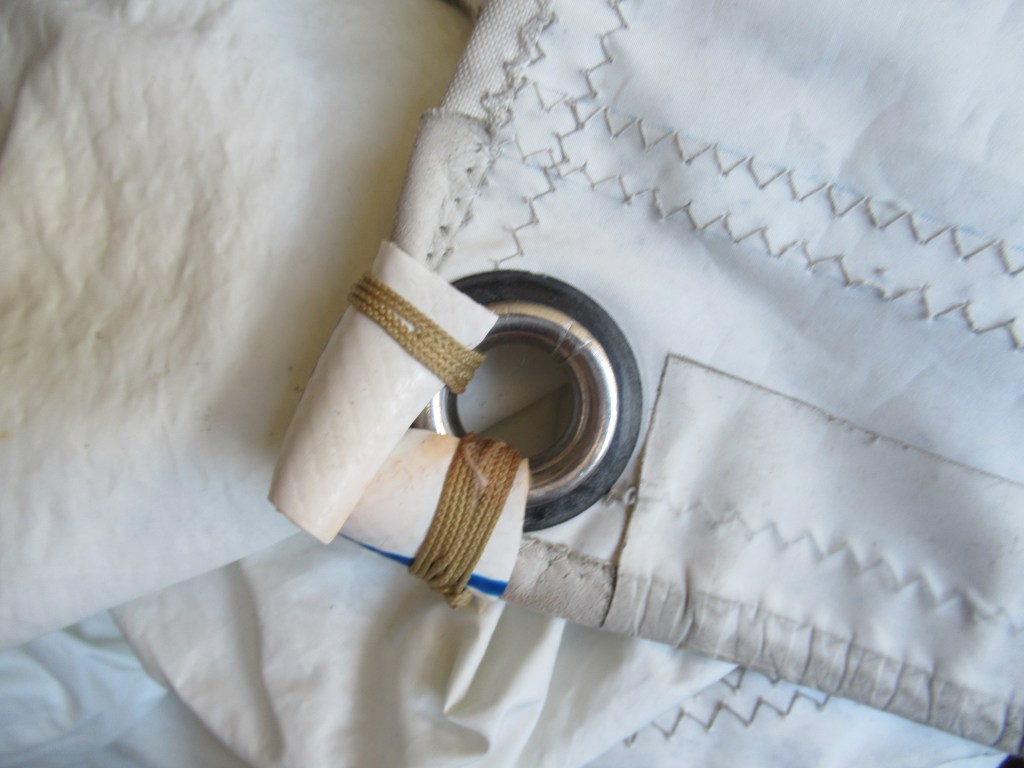
The 80% and the storm jib also had traditional rings at the clew. However, for these, I attached the pole to the soft shackle. These sails are small enough that the pole kept the sail extended and tight enough, even with play in the shackle. With the genoa and the drifter, the pole was a bit undersized, and by attaching it directly to the clews, I maximized the extension of the pole. Add this to the list of small boat compromises.
As an aside, I added a snip of hose to the mast ring that the pole’s inward jaw clips on. I could hear it squeaking when I was down below. The ring is stainless steel, while the jaw is aluminum. So not only did it stop the squeak, but it protected the softer aluminum of the jaw.

The Resourceful Sailor advises never to throw away that old water hose. Not only does it work for sail clews, but it also works for chafe guards on dock lines going through chocks, anchor rode that wants to rub on bobstays, provides UV protection on wires at the base of the mast, for solar panel cables, and propane hose. With a close look, you’d see Sampaguita sport it from bow to stern. It was a function over fashion approach, free, readily available, and provided a second-use purpose for what would otherwise be garbage. If aesthetics matter, this solution won’t suit you. But it’s nice to have some old emergency water hose in the cockpit locker when things get chafed. You’ll be surprised how far you can go with a little resourcefulness. Remember, keep your solutions safe and prudent, and have a blast.
The Vendee Globe Race has little appeal to me, but the Mini Globe Race is another matter all together. If you are visiting this site, there’s a good chance you too are a fan of small boats. I have been watching this race develop for a few years now, and it’s an undertaking after my own heart. I am not participating as I just recently finished my own Flicka 20 expedition from the Pacific Northwest to The Marquesas and back, but part of me definitely wishes I was. You are invited to peruse this website if small boat sailing and expeditions put a twinkle in your eye. If you’ve never sailed across an ocean in a 20-foot boat before, you have no idea. And if you have, you do. The club is very small. (Pun intended)
And here are a few links about the Mini Globe Race to give you a wormhole to descend into. (In case you don’t already know.):
https://www.latitude38.com/lectronic/2024/12/30/#mcintyre-mini-globe-race-qualifying-leg-underway


 sailingwithjosh
 Sailing With Josh