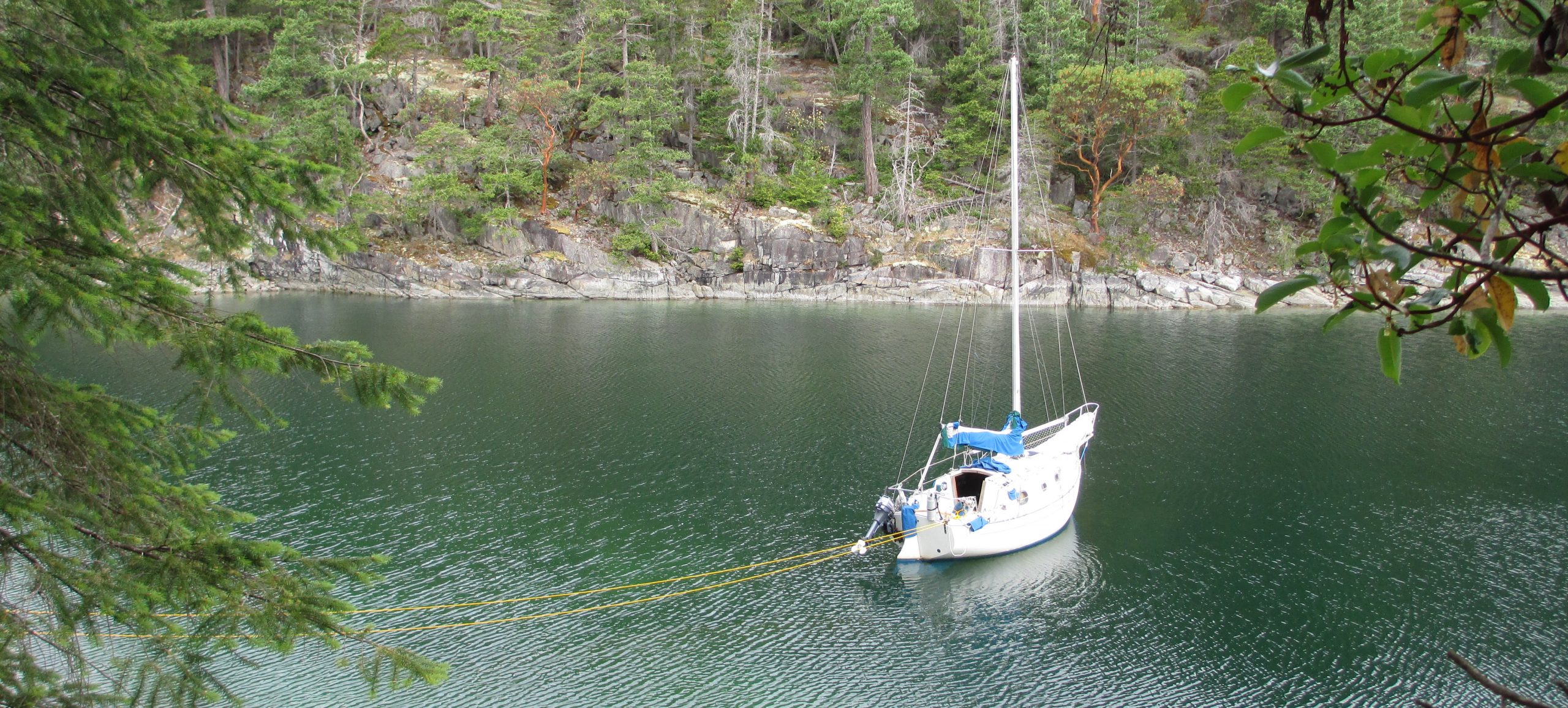
This is a pretty rare occurrence:
- Being close-hauled with full sail is not fair winds and following seas.
- It only works when there is a light wind and very low seas….so, usually after a calm.
- I am using the full main and the 140% genoa….which means the wind wasn’t light enough to call on the 140% drifter.
- If I cracked off, the sails would have probably started flopping. I needed to be close-hauled to keep pressure on the sails.
The thing about amateur video is that you don’t see anything really exciting. Because then the equipment would get ruined from salt water exposure. And if it’s amateur, who can afford that?
So what you get is boring video like this.
This video is from the Southeast trades, headed north. My goal was to make as much easting as I could in the more easterly blowing SE trades. The further I could get, the better set-up for getting across the Northeast trades, which are truly NE, to Hawaii. I made about 120 NM easting over the SE trades. This proved to be enough.
Sampaguita had a couple Fin whales(I think) swimming with her for about a half an hour a few hundred miles west of Washington State. They clearly knew what they were doing and would get very close. In this instance I didn’t worry. No tails came up and they were clearly swimming WITH Sampaguita and fully aware of her. Unfortunately it was dusk, so no video. You’ll have to take my word for it.
I do have a video of fish escorting Sampaguita, north of Hawaii in the Northern Pacific, so I hope that will suffice. It can be mesmerizing.
Sampaguita sits quietly at anchor off the bell tower in Port Townsend. Arriving at 1800 local time, July 8, she sailed up to anchor in a light west wind. A few local boats were passed setting sail for the evening breeze and the PTSA’s Committee was setting up the course for Monday night dinghy racing.
A Salute
I learned today that John Hazen died while I was away. John was my original inspiration regarding Flicka 20 voyaging and ownership. I met him in 2012 in Port Townsend while I still had the leaky Columbia 26. He told me his story and it was relatively easy for me to imagine doing his trip. His Flicka was Windward Pilgrim. He bought it in Hawaii, sailed to Tahiti, back to Hawaii. Then to Port Townsend. No head and an outboard motor. Just like Sampaguita.
Apparently John died in his sleep aboard Windward Pilgrim. Which is fitting for him. Fair winds.
I decided to climb the mast in the North Pacific Ocean. There were light seas and wind. I was under full sail. Here is some video and the lessons learned. It was harder than I expected. I’d done it in a rolly anchorage, but this was a whole other level of sway and swing. (It don’t mean a thing if it ain’t got that swing, right?)
People ask what I eat on a Flicka 20 with no refrigeration. This is a Sampaguita classic. Thanks to ‘Lectronic Latitude for publishing this on June 17, 2024. Thanks Monica.
Click here for the full article.

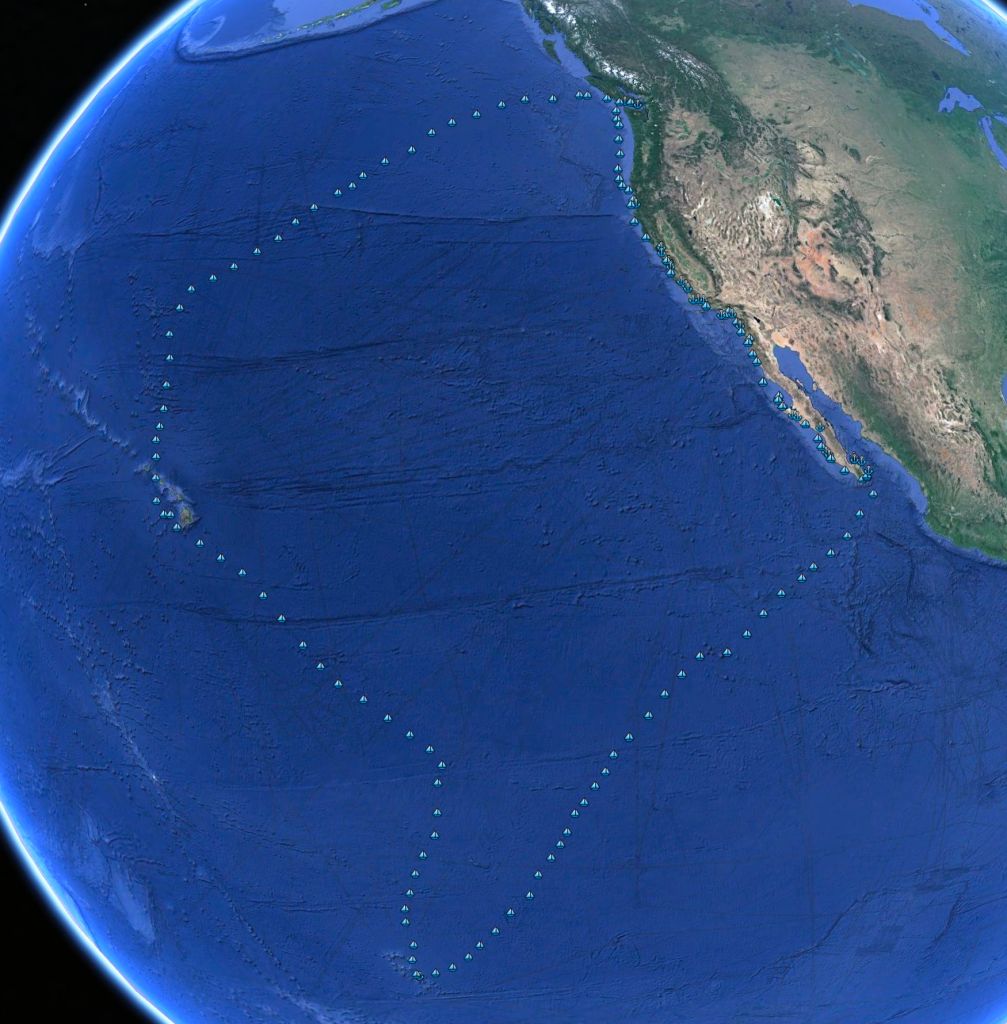
A reader is calling it 60 days. Really, 59 days and 13 hours and 15 minutes. Rounding up seems legit enough for me. Taha Uku Bay to Port Angeles? Maybe the longest Flicka passage ever?
Here’s a Google Earth rendition of the trip created by a fellow Flicka 20 fan (and record keeper?).
Port Angeles to Port Angeles closes the loop, though I will continue on to Port Townsend and close that loop too. First, time for cleaning and ice cream/juicy meat/salad/vanilla cake.
Lots to report about everything, but that will have to wait for now.
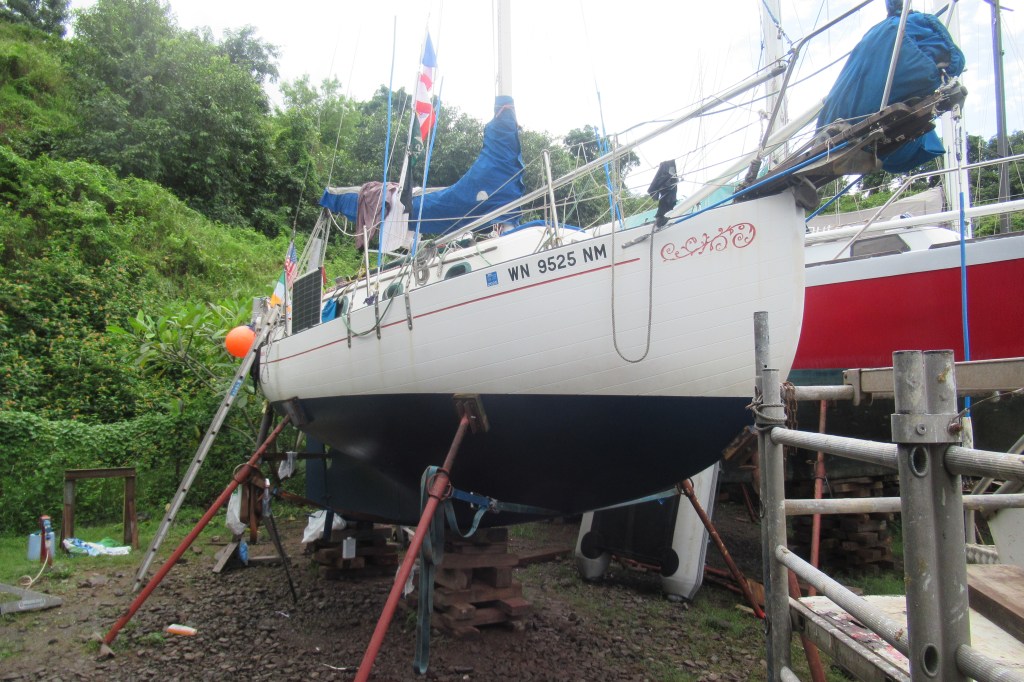
Are the chickens in the boat yard or are the boats in the chicken yard?
Why did the chicken cross the Pacific? To get to the Hiva Oa boat yard.
Which came first? The chicken or the boat?
Thank you. Thank you very much.


One of the first things people seem to ask, “Why don’t you have roller furling?” Really, it’s just another questionable decision I’ve made over the years. Here’s a fools thought process:
With hank on sails it means I have to go forward whenever a headsail change is required, or even dousing a sail. The plus side is it’s not very far. I wrote a piece about working the foredeck of a Thunderbird which helped me get more comfortable with it and I have been doing it for over 14 years. Granted, not on the open ocean.
My decision regarding this choice, whether sound or not, was this. I have always had a full suite of headsails on Sampaguita. They have always been hank-on. I bought a new 100% jib in 2023, but the 80% jib and the 140% genoa were still very serviceable. I also bought a 140% drifter in 2023, as well as a storm jib. I could have ditched all the hank-on sails I had, put on some roller furling gear and basically settled with a one-sail-does-all approach. This could have been operated from the safety and convenience of the cockpit with no apprehension and quick decision making as far as headsail size with lots of variability. Seems like a no-brainer, right?
Here’s the thing. That one sail approach means it is most efficient when it is fully extended. In most other positions, the cut isn’t right. A Flicka 20 goes to windward, but you won’t win any races in that direction. So optimal sail efficiency is best. (When I played drums, cymbal makers came up with something called the crash/ride. Really, it was neither. It was a marketing gimmick for those who couldn’t afford two cymbals.) So I can put up the right sail for the job and Sampaguita will perform her best. I get an optimal foil, as long as I set the sail trim correctly. Also, if something bad happens to one of my sails, I have others. Any change you make on a boat always has its surprises as far as performance, hardware and application. It’s never simple, no matter what the salesman says. This was part of my simple approach, and even it had a couple surprises and alterations required. Plus, it’s just me, and safety hasn’t been my first priority. If that were the case, I would have never left the dock.
My experience with roller furling sails is they also require a heavy acrylic cover on the leech for UV protection. That really messes with its light wind ability and set, with sails flopping around more. No wonder sailboats motor everywhere. Light wind is far more common than heavy wind. Also, both at the docks in Ballard and Port Townsend, and at anchor in Mexico, I have seen sails unfurl and shred due to inattentiveness and jamming. I have heard accounts from people I’ve met about there furlers jamming at sea. Or wearing out at an inconvenient time and coming out of the slot. Admittedly, if you are sailing downwind in the trades, it’s mostly barn door sailing so an efficient foil isn’t required, but you can see there are trade offs. It’s another one of those must-haves I passed on. It keeps me engaged at least. And keeps my fool schtick consistent.
Here are a couple videos of me changing headsails on the Pacific passage. They are sped up because, well, it’s a little like watching paint dry. Whatever. It is what it is.


 sailingwithjosh
