If you find any value in this, whether informational, entertaining, or thought-provoking, (otherwise, why are you here?) please consider a small donation.

PayPal: wheelersf@hotmail.com

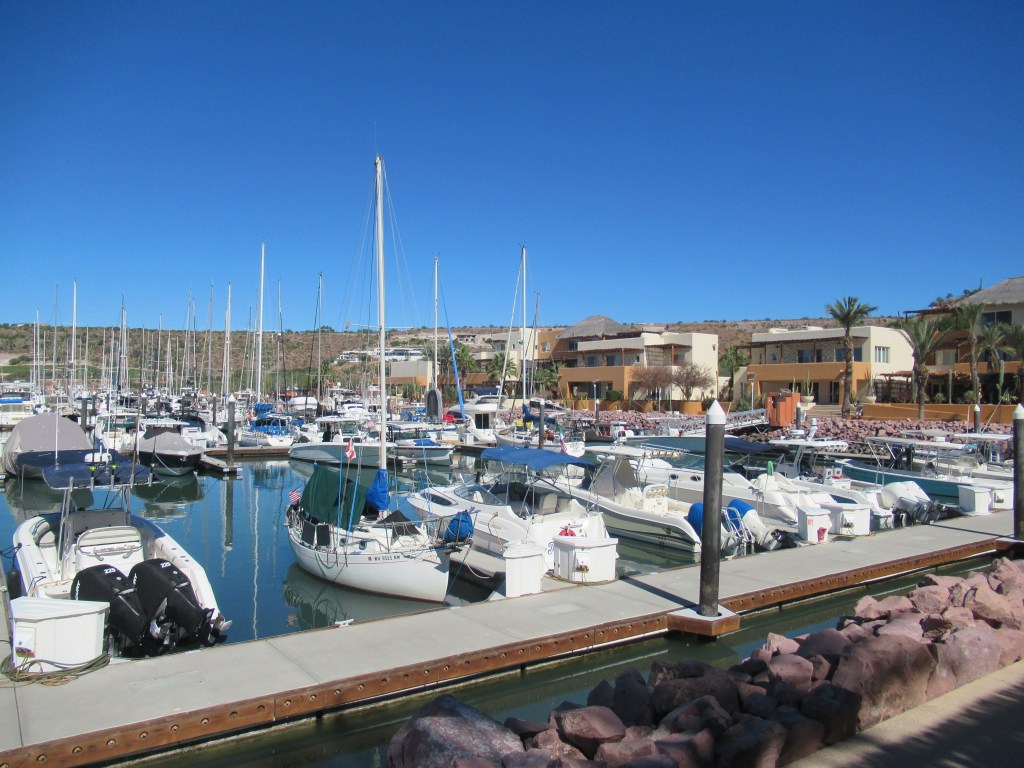
Sampaguita sits in slip L09 at Marina CostaBaja situated at the entrance of La Paz channel. It’s a nice marina. Nicer than we need, but under the circumstances, the only place we could get a reservation. I was in Bahia De Los Muertos trying to solve my solar panel issues, establish a place to receive packages, and have a place I could be grounded to take care of logistics, clean, and reorganize the boat. I only had Restaurant 1535’s internet available for communication as my Google Fi cell phone had no reception, with no real local knowledge of La Paz. My marina inquiries either fell on deaf ears, had broken websites or emails, or had no available space. Marina CostaBaja was the only place that offered anything. Having caught wind from other cruisers of the difficulties, and marinas preferred longer-term stays, I threw out a two-month window of January and February. They responded, saying they could only offer a right-sized space from January 13th through the 26th. I’ll take it! Then came the challenges of reserving the slip, emailing the digital pile of required paperwork, and electronically signing the contracts. Our email thread was something like 26 messages long. But we did it, thanks to an incredibly patient and unbreakable young office staff. Luckily, we’re in Mexico and they do not have high technology expectations, so photos of documents and a super-janky, finger drawn signatures on an unfillable PDF with none of the details included were sufficient. I pay about $46 per day, which is close to $2 per foot. I am the only sailboat in a 30-foot slip, the smallest available (and by the looks of it, the only available) in a row of small power boats. All marinas in Mexico in La Paz are tourist marinas full of gringo boats. So, you pay first-world-and-above pricing, but they are very accommodating. Granted, plumbing is still Mexican, meaning you still have to throw your toilet paper in the waste basket, but there are free showers with hot water (I’d forgotten what both of those things were), there is potable water available at the dock for $.07 per gallon, metered electric hook-up (which I have yet to use), and black water pump-out (also which I don’t need.) The marina is very isolated though. I am surrounded by restaurants, all American priced, which is to say, I steer clear. The mini-market is also over-priced. It’s set up for affluent cruisers and ex-pat locals. There are hotel complexes adjacent to the marina I have access to, some for free, some for a fee, but you can’t really walk anywhere beyond the compound. I say compound because that is what it feels like. If you are on holiday with plenty of money at your disposal, you have everything you need for a luxury time. And then there is me, a dirtbag sailor on his tiny boat (luckily, she puts up a good appearance) getting my ducks in a row. There is fencing and a security gate for going in and out. They do offer a free shuttle to downtown La Paz which I have used a couple times for grocery shopping, but you only have a couple times per day to catch it. I misinterpreted the schedule and had to catch a taxi back the other day. In hindsight I saw my error.

My taxi cab ride was anything but luxury. Luckily the shuttle pick-up/drop-off downtown was in a fairly touristy spot so a taxi line was close by. I did the proper thing of asking how much it would cost before I got in. $150 pesos. Great, I’ll take it. The car was painted like a local taxi cab. It was an old-model Nissan Sentra type car. The driver spoke no English. The suspension was completely shot and the smell of gasoline was intoxicating. The driver must be completely high from it. And we actually stopped for fuel on the way. None of the gauges on the dashboard worked. He actually shut the car down going through the compound security and tried to then pop-start it when continuing. It was a manual. My older readers still know what a manual transmission is. (I sold my manual transmission Subaru, the day I left Port Townsend.) Upon arrival, all I had was a 200-peso bill. I was not prepared for a taxi ride and this was actually the first of my whole trip. He tried to communicate he had no change and the fee was only 150, which may have been a BS, but maybe not considering the piece of junk he was driving, so he got the whole 200, which from an American point of view was still a bargain for a taxi ride of that distance. I didn’t stress over it. I had bought some beer, Magna Carta, the cheapest beer in Mexico, and some pork chops, the cheapest real meat you can buy, and a couple days’ worth of produce, (without refrigeration, few things last) and I was happy to have gotten back to the boat easily enough after making my scheduling mistake. It is what it is. I’ll make up for it with some other economy efficiency. I’m good at that kind of sacrifice.

The produce looks fine in the store, but get it on the boat and it quickly goes off. Carrots go limp within two days, avocados go off in a few days. Tomatoes and peppers too. Cucumbers last a little longer and so do apples and onions. I’m time-testing keeping the yams and the potatoes in the storage lockers, but in the hanging net, only a couple days. Food is a bit pricey here with none of the economy of scale like the US. I have had to rethink my entire approach to provisioning and tastes. I found a produce market I like. I pass by it on my way to the Grocery, noting prices, and hit it on the way back for the things it wins at. My last clerk there was a lot of fun. And she offered me a special on avocados. Three large ones for 20 pesos. Yes, I said. I was worried they would be off, but they were perfect. A lot of guacamole gets made.

I meet few white people I enjoy talking to. Most are so full of themselves and come from a culture of excess and entitlement. You notice it less when that’s what you are immersed in, but spend an appreciable amount of time trying to avoid it, and you begin to take more note. In the marina, I speak mostly to the Mexican captain’s hired to drive and maintain the gringo boats, and the security and maintenance staff. If you get them off the posturing, they are down to earth and interesting people and fun to try to communicate with. The guy taking out the trash might turn out to be a geologist.

I’ve listened to the La Paz cruiser’s morning VHF net exactly once. There is so much hype about it, the reality was a disappointment. Club Cruceros based at Marina De La Paz is a community and vital spot. However, again, a disappointment. (I know, I am terribly difficult to please. Classic single-hander.) The vibe is either a passer through like myself, desperately trying to get information or services, or elderly retired people playing “living on a boat” in an unregulated and less-expensive “exotic” environment. But never going anywhere. It serves a purpose, but I find it a bit depressing. I suspect the anchorage is also full of people who have been leaving for the Marquesas for years.

Here’s a couple wanker situations I’ve had to contend with. On my “newbie” arrival to La Paz, I wanted to anchor near the dinghy dock because my dinghy is motorless. Distance and sea-state might be challenging. There is limited space there, so I anchored on the fringe. A so-called “Los Cruceros representative” approached me and explained that while the anchorage is unmarked, I was in a restricted area. The Mexican Navy beelines their boats to the nearby channel marker when on rescue missions and that I was in that path. OK, I said, wanting no trouble and still learning the ropes. He explained I might fit a little over yonder and not to worry about that floating fender, it was attached to an abandoned fisherman’s anchor. And pre-faced it with the adage “You should never trust a cruiser.” OK, I said. I moved and after a couple re-anchors found the sweet spot clear of the fender and the neighboring boats. It’s the “La Paz Waltz” you really need to account for. I was fine for about 11 days. 11 days gains a lot of local knowledge in La Paz. First, I’d learned the “representative” had been there for nine years. One of those. And really, he wasn’t looking out for me, but looking out for himself and the Club. The Club, while a mainstay, really has no authority and could lose their “status” at any time. In classic Mexican fashion, there are no rules, or at least none advertised, and there is no enforcement, until maybe there might be. While I could see the Mexican Navy dock and boats, I never saw any interaction with them and any cruising boats.

On day 11, I heard an engine and a familiar voice outside Sampaguita. I look out to sea a 40-foot ketch picking up the fender mooring I had previously mentioned, completely ignoring the fact that we would definitely be too close to each other. The voice was familiar because I recognized it from Club Cruceros. A guy that talks too much and who I instantly labeled a wanker. I think I was right. Here is why. I explained in a very concerned fashion that we would be too close and he said yes. His explanation was that he had just bought this mooring and proceeded with his business. Naturally, I am perturbed but have realized my only option was to move. So, I did. First, I will say, I took a chance, though misinformed by the “representative,” by anchoring near the fender. I accept that was on me. What makes this guy a wanker is three-fold. First, he said he was sorry, which wasn’t true at all. He obviously was not. I find people who say that casually without meaning it are insincere and impolite, and a lower level of human. Second, he never came up to me and said, “You may not like this, but I bought this mooring. I am going to move my boat here regardless. I’m informing you so you have time to move, so that neither of our boats will get wrecked, because they clearly will when the waltz begins.” Third, he did it just before dusk, which limited my options for finding a new anchor spot. So that guy on Nashira with the crooked and forward raked mainmast will never get any respect from me. The “representative” couldn’t do anything about it either, of course, so he has lost all credibility with me. Self-appointed, but of no one you actually need to listen to. I found a spot after a few tries nearby, settling in just before dark. A concerned neighbor (for himself) came by, and also the “representative,” and I said I would be on the boat during tomorrow’s wind and keep an eye on it during the waltz, and would be leaving in a couple days. I always expect too much from people. It’s each yatista for themselves, the community is not very “deep,” and do what’s best for yourself. Everyone else will.

Now, the good people. I have met a few couples along the way who are not wankers. With the exception of Mundial from before, they are all veteran cruisers. They’ve been at this for decades. They know what’s up. There is the Austrian couple on Nomad who I bought the dinghy from. There is the French couple on Opale who I first met in the Northwest Passage. And there is a Canadian couple on Tillicum I met here in Marina CostaBaja. These folks recognize what I am doing, and that it takes heart, and that I am committed to it. This sets me apart from the others. They know the difference. They all are truly interested in my journey and success. These folks are also easy for me to spot too. The diamonds in the rough. If you know what to look for in their speech, actions, and demeanor, you can tell. These are the people who keep me connected to the community, otherwise I would disassociate myself altogether, or simply try to extract my needs from it. Like a wanker. I guess a point that I am trying to make, is the fraternity of cruisers as seen from the outside is BS. Cruisers don’t share any common bond. It’s like bikes and cars. Just because two people ride bikes, doesn’t mean they share anything in common. You don’t say to somebody “You drive a car, Wow, me too, we must be alike.” The same goes for boats.

On a totally different note. Speedy Gonzales was one of my favorite Looney Tunes characters. He has fallen by the wayside, assumingly because of the Mexican stereotyping. His character is so rare now, it took me weeks to remember his name. What brought him to mind was the fisherman on the west coast of Baja. Since it is so rural, and there is no Mexican Coast Guard (only the Navy), the seas are ruled by the fisherman. Listen to the VHF and that is almost exclusively who you hear. They converse on channel 16 often. Unlike in the US, there is no authority constantly telling everyone to keep the channel clear for emergencies. And it is not uncommon that they are screwing around and bantering in an animated fashion, and sounding a lot like Speedy Gonzales. I kid you not. Not everyone, mind you, but often enough to represent his stereotype. If it weren’t so, it wouldn’t have come to mind. It also reminded me of the Looney Tune drinking glasses my family had in the 70’s. I was very young, but I think they came from McDonald’s. This was when they made glasses that lasted. We had them a long time because they were so thick and difficult to break. I miss that kind of quality. And you didn’t have to overpay for it. In our infinite wisdom and capitalism, items are cheaply made and disposable, or impracticably expensive.  The faster it breaks, the more you buy. If it lasts, you better charge a lot for it because you won’t get the repeat business. Sound business models? Or use less material to be more environmentally friendly. But then make twice as much? I have some clothespins that fall apart so easily. Nothing like the clothespins the family had growing up. Those things actually worked and lasted forever. Now, in an effort to use less wood and metal for the spring, they are hardly functional. Add water to the clothes and they hardly stand a chance. Maybe clotheslines are a thing of the past? Being at sea, I didn’t want the plastic ones. So, I bought the useless ones instead. Sucker.

A word to the wise. If you want to go cruising, do it now. The world is changing rapidly and it will get both easier and more expensive. Here is what I mean. The Emperor is changing the world with Starlink. Starlink has made it easier to go cruising. The RV version is affordable and the most used. It adds the whole world of internet to your boat. It’s like never leaving home. This means more people will go cruising. If they can work remotely, they can go cruising too. Weather forecasting is no longer a mystery or an art. The more people who go cruising, the more cruising will cost. (Or even look what’s happening regarding boating locally.) There will be more strain and competition for services. For example, here in La Paz, you have to reserve a slip well in advance to get one. And you will pay. Demand outweighs supply and build-out. Delaying your cruising will add to your expense. Places like Bora Bora are limiting tourists. In order to preserve the experience, they want to charge more, making the financial barrier of visiting higher. Quality over quantity. The more environmental hype, the more population increases, the more this will occur. Galapagos. Same thing. Drop the romantic notion of electric engine conversion for long-distance cruising. Get on with it. You will want that diesel power plant unless you are a true sailor. There are lots of cruisers and few true sailors. This message isn’t for the wealthy. They can do what they want, when they want. They don’t visit this site. This message is for the romantics and the people on the edge.

These are just observations and interpretations of a fool on a twenty-foot boat with a microphone. Remember to make a donation to keep this fool at sea. Otherwise, I might end up in your community. Think about it. An ounce of prevention is worth a pound of cure.

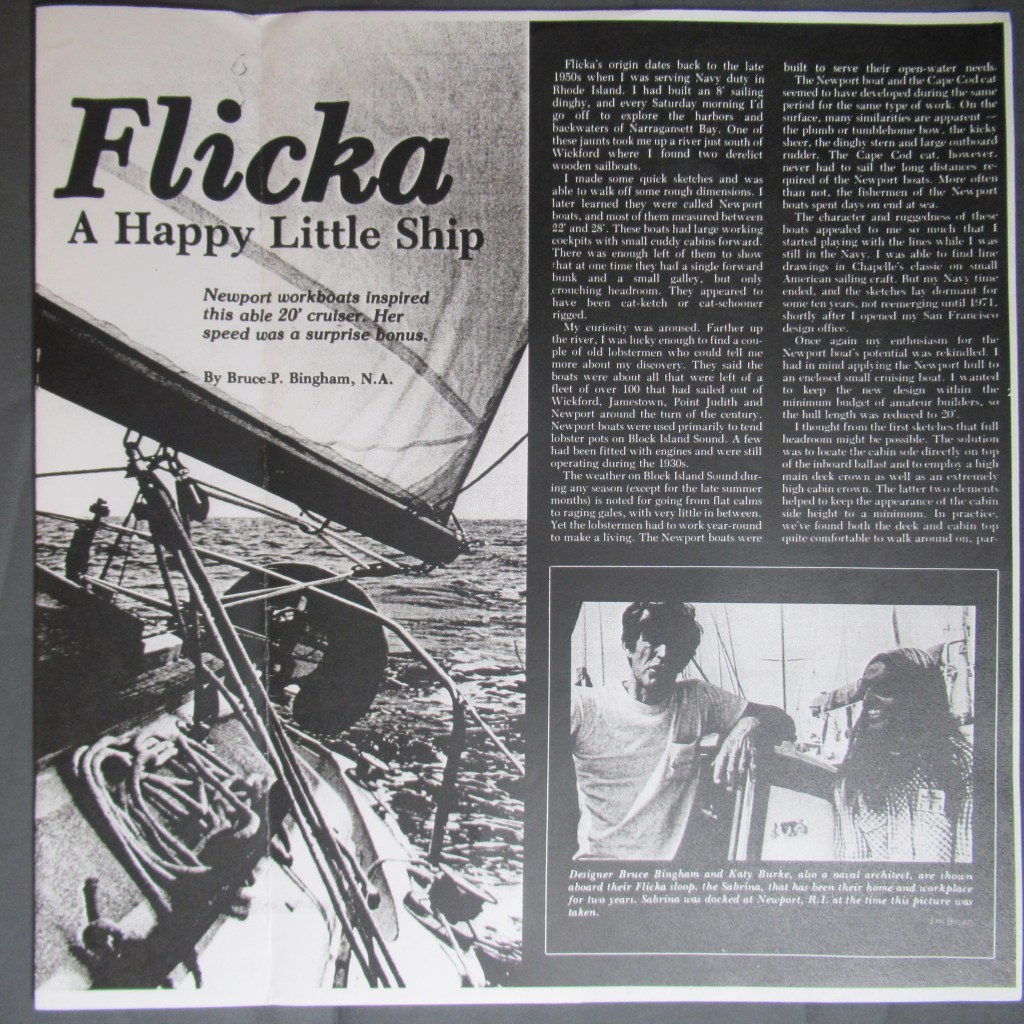
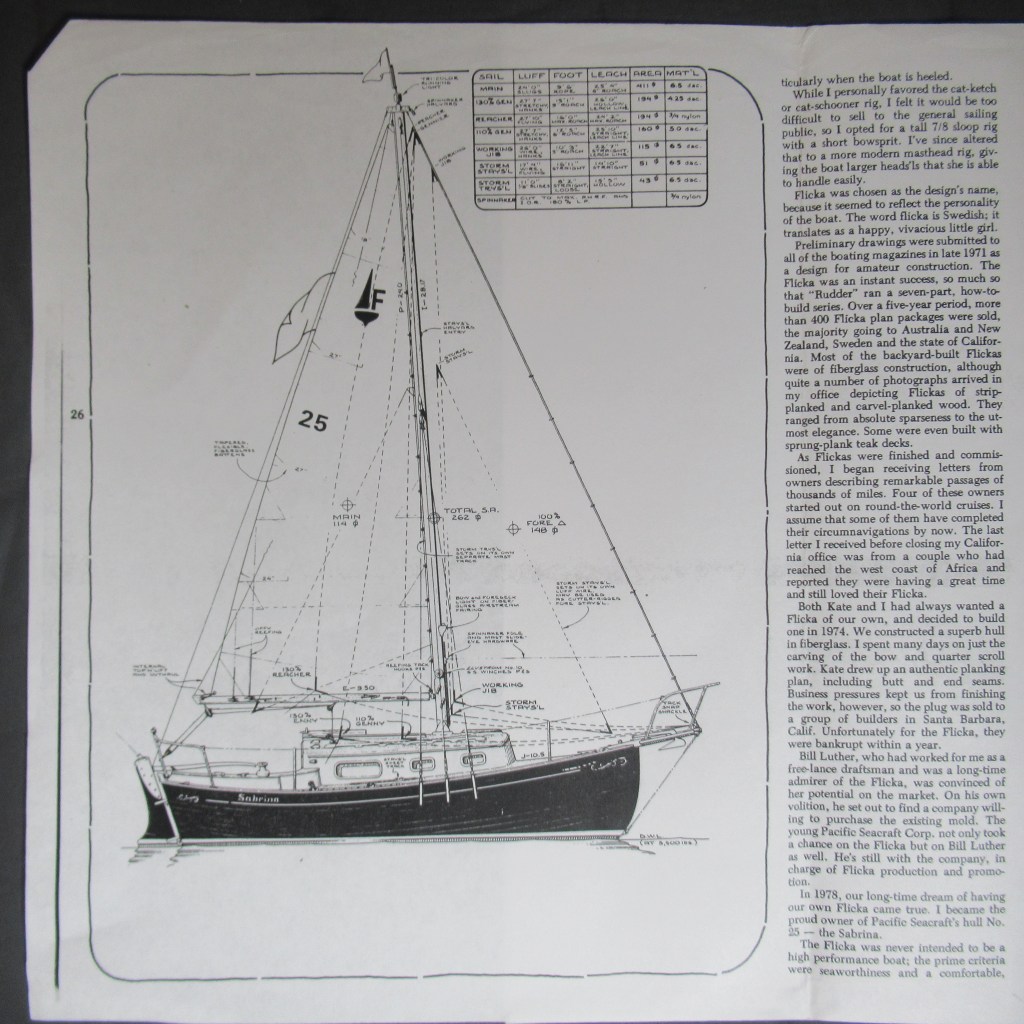
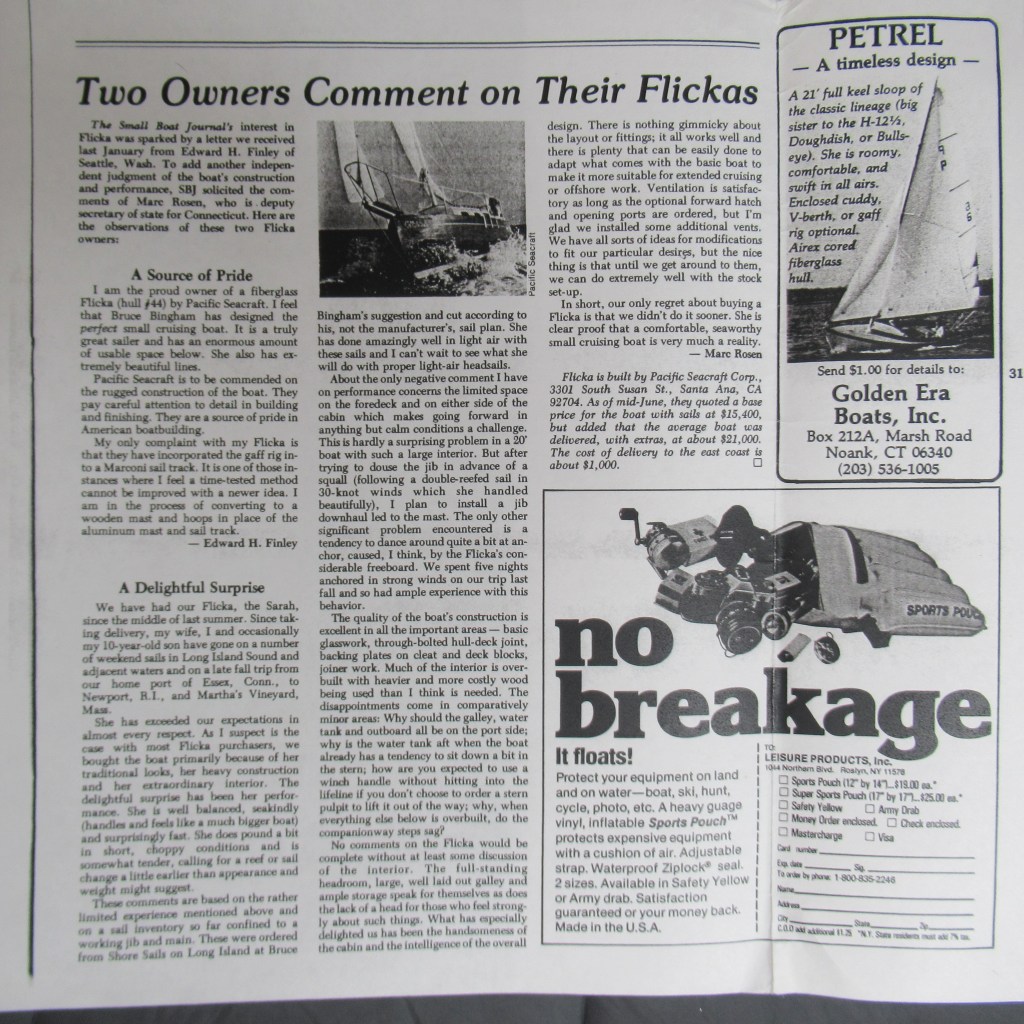
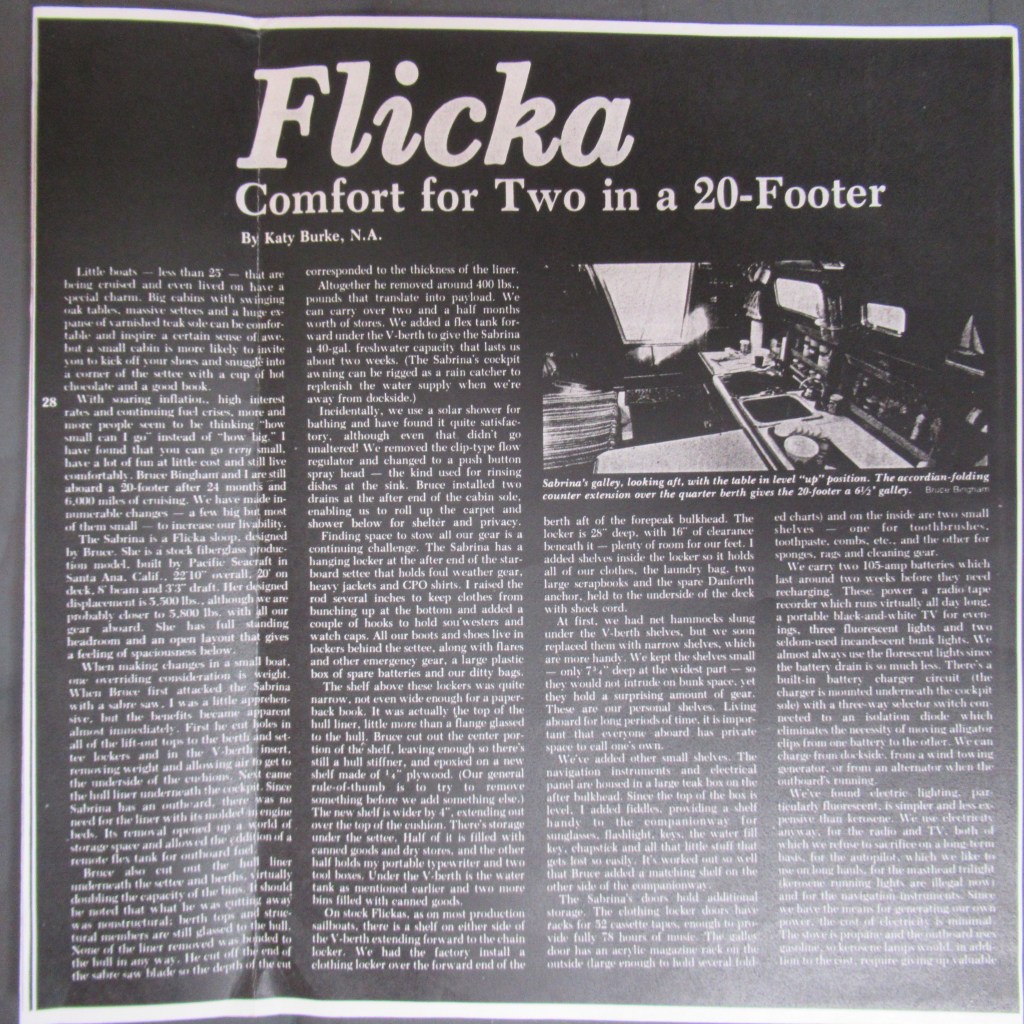
Here is some 80’s promotional literature from Pacific Seacraft for the Flicka 20.

I received a folder of various Flicka 20 hard copy brochures and articles when I purchased Sampaguita, Hull #317 and this was included. In my reduction of paper storage, I have decided to preserve and share them digitally.

All Copyrights are retained by the original owners.
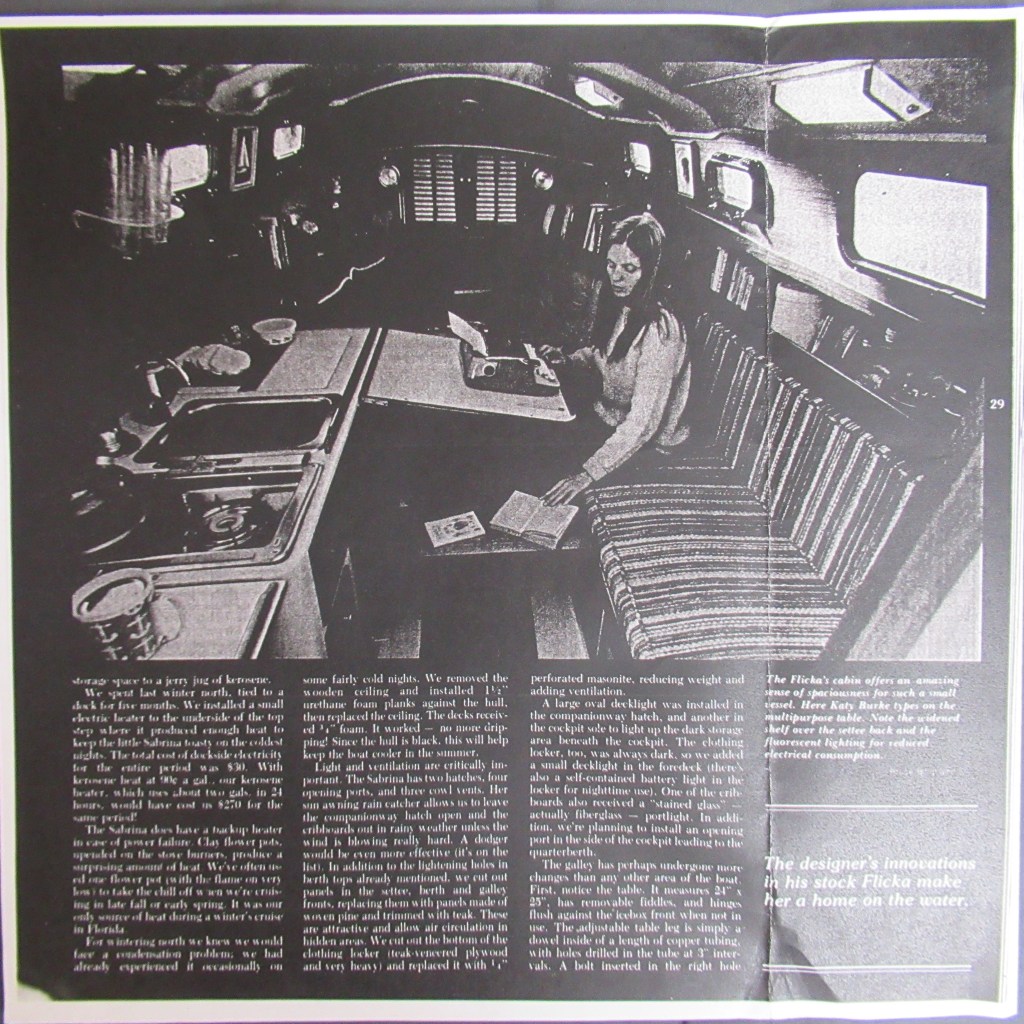
Here is some 80’s promotional literature from Pacific Seacraft for the Flicka 20.

I received a folder of various Flicka 20 hard copy brochures and articles when I purchased Sampaguita, Hull #317 and this was included. In my reduction of paper storage, I have decided to preserve and share them digitally.

All Copyrights are retained by the original owners.
Sailing the windward/leeward buoy races on the foredeck of Corvo with the Port Townsend Sailing Association One-Design Thunderbird Fleet on Wednesday evenings in Port Townsend Bay has made The Resourceful Sailor a better offshore sailor. Naturally, it has made them a better sailor overall, but writing about the nuances of sail trim and their controls, strategy, or rules feels a bit stuffy right now. This is about working the foredeck and managing agility, comfort, confidence, and fear.

On Corvo, The Resourceful Sailor was at the bottom of the pecking order. Because of age, lack of experience, or some other reason, the foredeck was assigned to them. It seemed appropriate and has proven a winning combination. Since winning is fun, he did as told. The veterans do the skippering, steering, line-controlling, and strategizing. The foredeck crew does the fancy footwork and jungle-gyming, with stints of being rail meat and anemometer in between.
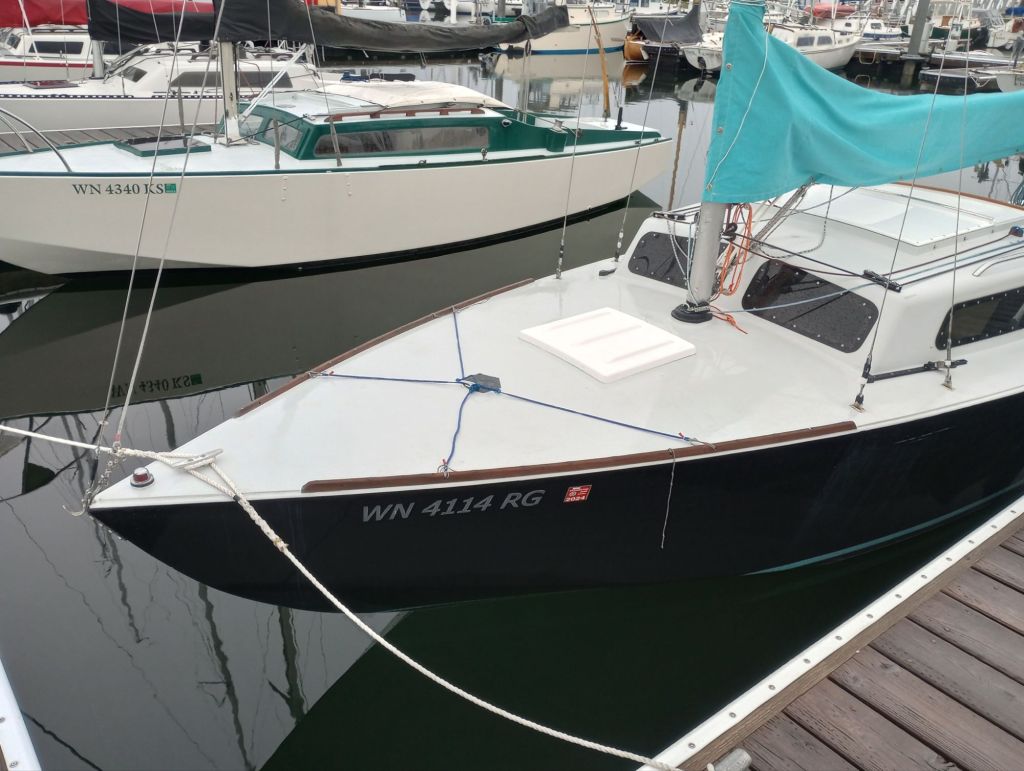
Corvo’s Foredeck

A Thunderbird, at 26 feet and 3850 pounds, is quick and squirrelly with a small foredeck and no lifelines. The foredeck crew hikes out on the high side during the windward leg. With each tack, jumping up, shuffling the flogging genoa across the deck and around the shrouds and climbing to the new high side, always watching the leads of the lines and keeping their feet from entangling in the sheets. On downwind legs, there is readying the nine-foot spinnaker pole, hoisting the kite, getting the headsail down and secured to the foredeck, easing the outhaul, and tending to the pole and boom positions. Depending on wind and traffic, the needs of the strategist and helmsman might require an immediate gybe of the kite and the pole, with subsequent gybing as necessary. For the sake of rounding out the job description, though not very physical, on both legs, the strategist likes input on the course wind field, such as favored sides and approaching gusts.
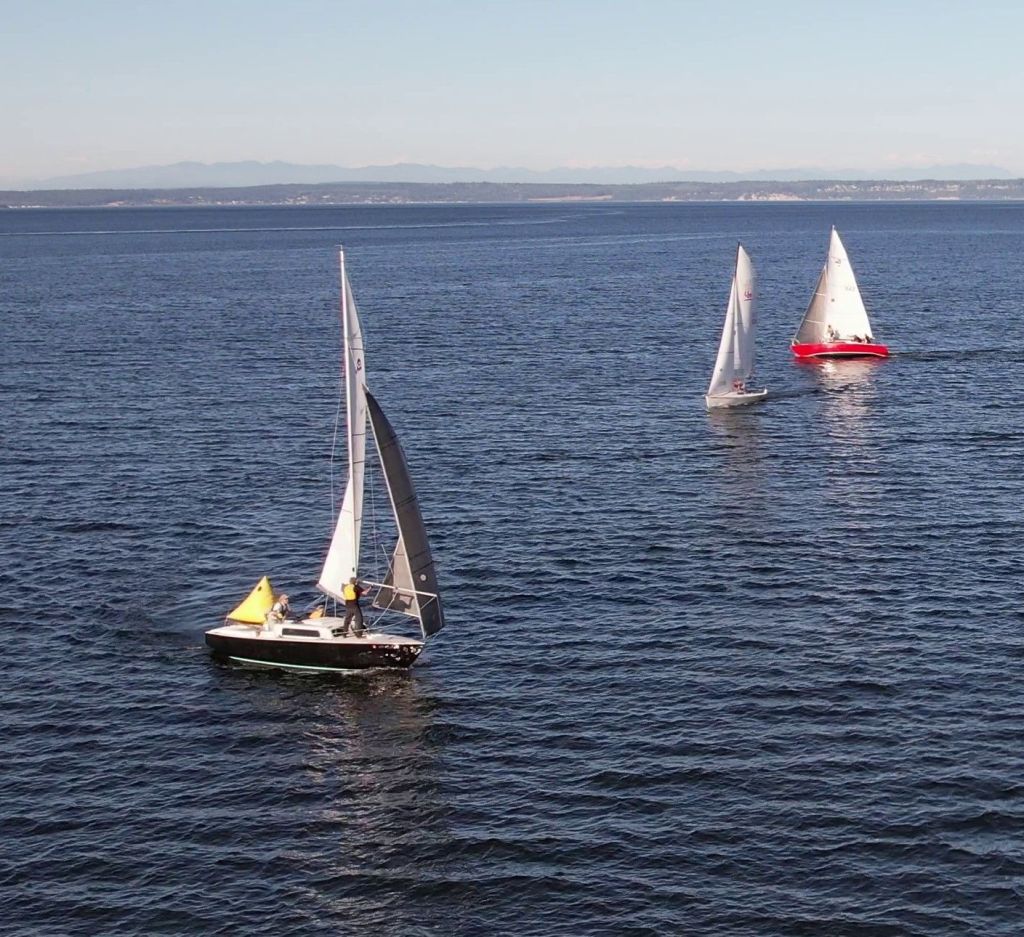
Rounding the Mark

These physical demands and repetitions in an exposed position on Corvo have made The Resourceful Sailor a better offshore sailor on Sampaguita, a Pacific Seacraft Flicka 20. With a foredeck even smaller than a T-Bird and six hank-on headsails, trips to the foredeck to match sail to wind are a regular occurrence. Deteriorating conditions demand it. As winds and seas build, so does the movement of Sampaguita and her foredeck.
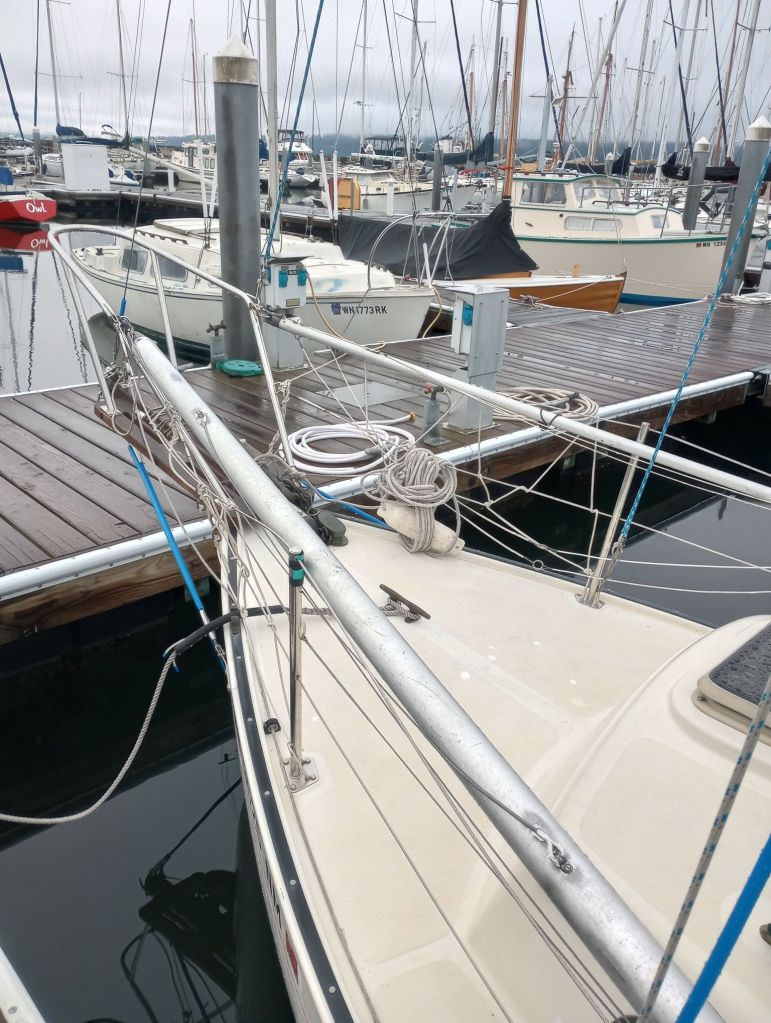
Sampaguita’s Foredeck

On a 2023 rounding of Vancouver Island in the Pacific Northwest, the confidence and comfort acquired on Corvo was also realized on Sampaguita. The sometimes feeling of dread over a headsail change was replaced with a more go-getter attitude. This has advanced even further as Sampaguita voyaged to Baja California. Night time? No problem. Steep wind against current hills of the Sea of Cortez? No problem. When not making it out to be more than it has to be, it goes pretty quickly. They felt more relaxed on deck, and pole-handling went from never before to whenever necessary. It was a comfortable feeling.

Since The Resourceful Sailor is apparently too rock-n-roll for roller-furling, the cliché, ‘the time to reef, is when you first think about it,’ could also read ‘the time to change the headsail is when you first think about it.’ Confidence is valued because hesitation could be dangerous. Tense, tentative, and scared movements do not work well for professional athletes, or amateur offshore sailors. Remember, keep your sailing safe and prudent, and have a blast.

https://youtu.be/QmVf4-buWlo


The La Paz Dinghy Dock

La Paz is a small city on the east coast of the Baja California peninsula, 100 miles or so into the Sea of Cortez. Sampaguita is here because it has a cruising community, and therefore boating infrastructure. This means we can provision, repair, water, receive packages, and actually purchase some boating supplies. (Though ordering might be better, if you have the time.) That said, this community seems to be dominated by white North Americans and Europeans. This is not to say there aren’t any Mexicans with yachts. I do believe I have seen some. But that’s not the bread and butter.

A Common Navigational Hazard. And These Are Small.


If you get off the Malecón, or waterfront for you gringos, it’s seems to be regular Mexico. This is not the west coast of Baja rural Mexico, which I prefer, but not touristy. I love walking around and just getting the feel. I don’t feel threatened and I like not being on camera all the time like I feel in the US. I have grown to detest that about America. It’s not that I want to do bad things. It’s just there are so many rules and regulations, you are constantly navigating them. Tiresome. And the “1-800 Turn Your Neighbor In” schtick always has you looking over your shoulder. I haven’t noticed any police activity off the Malecón either. Many intersections are 4-way stops, but I have many times seen people cruise straight on through. This is not the “no cop, no stop” thing. This is a “no cars or pedestrians, no worries” sort of vibe. As a pedestrian, I look out for myself. I have a good grasp of the laws of kinetic energy and keep situationally aware. Another thing I noticed as I put the miles on my sandals is there are many of those covers for the holes in the sidewalks missing. You know the ones where they access water, or gas, or electric? Not a couple, but many. I love that. Why, you say? That would never happen in America. Someone would be walking down the sidewalk in a typical American un-situationally aware sort of way, fall in, break a leg or ankle, and definitely sue someone. Obviously, that doesn’t happen here. The rest of the world is appalled at how sue-happy Americans are. There are a lot of missed kindnesses and opportunities in America because people are afraid of being sued. It’s part of our fear culture. Lame. Unless you’re a lawyer, then you too are taking it to the bank. English descendant countries are so bent on order, it is oppressive and tiresome. OK, Mexican cartels on the rise are a bummer. Apparently, they are branching out from narcotics into commodities. But I have felt freer in the last two months than I have in a long time. Much of the world laughs at Americans when we say we are free. Even if I eventually get a shakedown somehow before I leave Mexico, I have some give in the “bank.” There are some frustrations, but America is the land of people making people frustrated. In Mexico, frustration comes from things being broken. I tried to buy a National Park permit online because I have been to a lot of places where I am supposed to have one. A nice website, but when it comes down to the important function of selling someone a permit? Broken. I asked other cruisers about it and everyone had the same experience. But no enforcement, so no worries. The Mexican Navy is your biggest concern, but in the few times I have seen them, they seem to mind their own business. They are most keen on making sure your paperwork is in order by my understanding. But I can prove to them that I tried to set up an account and buy a permit. You can’t get blood from a stone. I finally had to give up. And it just didn’t feel like it was going to be a problem. Try that in America. I felt the biggest risk would be having to point out the dysfunctionality of their government.


Even Amazon is broken. I mistakenly thought Amazon was Amazon. Not true. Each country is an independent Amazon. Sort of. The thing with Amazon Mexico is there is no, zilch, nada customer support. So if you order something, you better want it. You can go to your order page and cancel the orders and they will disappear from that page and you’ll be told you have no orders. But you are still getting them and paying for them. Unless they decide to cancel them themselves. Then maybe they will actually be cancelled. Your order page will be empty, but depending on the point in the fulfillment, you still might be getting it and paying for it. This was a bit stressful as I foolishly had American-like expectations regarding Amazon. Silly me. After realizing I was only ever getting a circular path with my clicks on the website, I called Amazon US. Easy to talk to someone there. But they will inform you they cannot help with Amazon Mexico. It is separate, you will need to talk to them. They will even give you a phone number to call that connects you to a message in Español that hangs up when it finishes. Dead end. The US customer service guy I spoke to was Indian. He pointed out he had an Amazon US and an Amazon India account. He said, for example, in the US we have a 30-day return policy while India had no such thing.


From the beginning. I placed my first order, sort of a test order. My bank texted me to confirm it was real. I said yes. I also got validation charges and refunds from Amazon Mex and Google. OK, feels legit. The order is on the order page. I see it being processed just as expected. OK, I decided to make two bigger orders I needed. It looks like it will be shipped from the US (not connected? really?) and I want to get it within a certain number of days. (Amazon still guarantees times and import fees are also guaranteed as part of the costs. This system seems solid with less possibility of things being caught in customs and essentially one vendor for everything.) Well, these bigger orders tripped the security feature. The next morning, I had messages from Amazon in Español (but translatable) that they had cancelled my orders. I would need to reset my password with two-part verification and then remake my orders. OK, I can appreciate that, sort of. I reset my password, which, even though they are different, also reset my Amazon US password. (not connected? really?) I go to my order page and the test order is gone too. But then the charge went through on my credit card. WTF. These are being delivered to addresses in Mexico, which was likely part of the security issue. But the order is gone, so I can’t track it either. I pensively remake one of the new orders, but then decide I have lost confidence in Amazon Mexico, so I cancel it. I will order directly from Renogy. The next day, I see there is a new charge from them on my cc. The amount doesn’t jive either. WTF. This is when I started calling Amazon US with no positive result. Finally, I say to myself, lets remove that credit card from my account as it seems it is the only way to stop this craziness. I go into my payment page and find my credit cards. I click on the transaction tab and up comes all my orders! Not just the recent ones but even my past US transactions. (not connected? really?) Messed up. But the orders are there. The tracking numbers are there. The orders they cancelled were not there. Good. The strange amount was because they split up the order. (Just like they do in the US.) Though they aren’t connected, most of my items are being fulfilled by Amazon from the US. Really? So I decided to let it ride. If everything fails, I will order from Renogy and end up paying for them twice, but the expedition hinges on these solar panels. No panels, no expedition. It costs what it costs. The disruption of the expedition will cost much more. I can’t sell the boat here. I can’t leave it in La Paz. Bashing it back up the coast isn’t practical. It’s not that kind of boat. Taking it to dry storage at Punta Penasco at the head of the Sea of Cortez is an option, but not a good one. I decided I had to chill out and wait and see. Well, the test order arrived way early and was fine. Part of the next order is on the way. After a few days of struggle and suckiness, I think I have figured it out. It’s easier to buy the different things I need from one vendor, as long as it works. I know where my orders can be found and tracked. I know to only order if I am certain I want it, and I have no expectations of customer service. Sounds like Mexico.

The Sea of Cortez is abundant with marine life. When I was sailing at night, the water sparkled. There were random 2-foot diameter spots that would glow for a second or two and then disappear. I watched stingrays doing flips in the air. Schools of fish feed on the surface in a loud boiling type manner. One of the pangas that goes by the anchorage every morning and night does whale shark tours. Pretty cool. On the other hand, I will likely only spend a little bit of time in February exploring the closer islands. It’s not very small boat friendly in that the wind can blow quite seriously. At this time of the year, you get a northerly or a westerly. You need to choose your anchorages wisely. It’s a baby steps sort of sea because if the wind is raging, say from the north, you don’t want to be on there with an opposing current in a Flicka 20. Wrap around waves into anchorages can be a problem too. It’s like the strait of Juan de Fuca, but ten times bigger.

The Sea of Red


The Anchorage:
There are easily a hundred boats in the anchorage at any one time. They come and go to points on the mainland and the islands in the Sea of Cortez. It’s a staging ground because of its cruising resources. In general, the anchor depths are good at around 20 feet, but it’s kind of a crappy, uncomfortable anchorage. The current is strong here, so when the North wind of the Sea of Cortez bears down, it is choppy and lumpy. Plus, the local pangas zoom through at full speed kicking up a serious wake. There are no speed limits and it’s their country, so why would they care about the yatista gringos. I don’t blame them, they aren’t taking their pangas to Seattle.


Pitch or roll? Pitch, just make sure there is plenty of scope and spring to the anchor rode. Roll tends to throw things around more and the dishes in the sink make a lot of noise.


Group or no group? There is comradery in the group. (But don’t overestimate the fraternity. It’s each yatista for themself. Play by the rules and you’ll be OK. But don’t expect anything.) Someone might gift you fish. (A couple nights ago my anchor neighbor brought me fish. His daughter accidently turned off the freezer and the fish started to thaw. It had to go, so I got a fillet of Mahi and a huge chuck of tuna. Having no fridge, I had fish tacos that night and for brekky.) Your dinghy or paddleboard might need a tow. (This hasn’t happened to me yet, but I’ve seen it plenty.) Maybe someone lets you piggy back on their Starlink. (A super thanks to Mundial, and no thanks to that boat in Los Frailles that threw me to the wolves for my trip to De Los Muertos.)


An aside: In America we are coerced by fear to lock our internet, but I think the provider companies have the most to gain by that. I’m a firm believer in free internet access for all, everywhere. It doesn’t have to be secure to look up weather, or directions, and for people (and students) to have universal, equal, and free access to the internet.


Back to anchoring. In support of no group, here in Mexico, in case they are not using a holding tank, I like to keep my distance from the families of 4, 5, or 6. (In the US, the rules and the enforcement are clear, and pump out stations are abundant and free. In Mexico, not so much on any of that. I doubt there is much worry about it. Even in BC, Canada there are only a few No Discharge Zones.)


The Hurricane: La Paz was hit by a hurricane in October. It wreaked havoc. I have counted no fewer than 20 boats sunk or washed ashore and that’s just through casual observance. Sailboats and large motor yachts. At the channel entrance there is a 20-30 meter super yacht with its bow pointing out of the water. I think it was towed out there so it wasn’t an obstruction in the harbor. It doesn’t appear much is being done about these boats. I see no activity regarding them and it’s been a couple months. I wonder if people have walked away? I wouldn’t blame them, really. What a headache and expense. It might be worth never going back to Mexico again. Let it be stripped. (Whether looted or sanctioned.) Maybe a local could have a used marine merchandise store? Would the compulsory liability coverage cover breaking out the chainsaw on the hull? It sounds like a work opportunity for the right individuals in an underdeveloped and underregulated country. (Or if not underregulated, definitely underenforced, or a willingness to look the other way.) Maybe the cartels could get in on that?

I Don’t Think They Are Supposed To Be Like That


Boring 2023 Stats:
Travel Days – 94
Nights at Anchor – 111
Nights on a dock or mooring that wasn’t Port Townsend – 13
Nautical Miles – 3784

A classic AC/DC song on a local classic rock station with all classic English language songs, but all announcements and advertisements in Español. (Reminds me of WOUR, 96.9, The Rock of Central New York- sort of.)(A special thanks to Cris of Chile for teaching me how to make ñ on my phone. This way I can say Happy New Year instead of Happy New Ass.) Sampaguita has arrived in La Paz, Baja Sur, Mexico. When she and I mentioned we were in search of peace, this was not quite what we meant. Since we’re full of classic rock quotes, “You don’t always get what you want, but if you try sometimes, well, you might find, you get what you need.”

A Small Sampling of the Anchorage.

It is a very busy, full, and challenging anchorage. Not to mention the many sunk and washed ashore boats from October’s hurricane. There is a strong current in this channel, and when the wind and chop pick up, boats do something called “The La Paz Waltz.” You best make sure you are not too close to your neighbor or some important gear is going to get broken as boats swing out of unison.

Sampaguita is here for a while as we try to sort through some technical details and prepare for the next leg of our journey.

Provisioning for one. A small city, I have been sussing out the grocery options. There are several choices, but I am finding a need to rethink my eating options and strategies. Fresh food is ample and easy, but preserved, long range, non-refrigerated food options are totally different. Mainly, the variety of canned foods I am accustomed too from the States aren’t a thing here. And everything is loaded with sugar. The whole sugar-free market might be more of an American thing, I have come to learn. Even though products are labeled with “exceso de azúcar”, there are few-to-no options.


Marina De La Paz

Drinking water is proving easy so far. Marina De La Paz, of which Sampaguita is anchored right in front of, is cruiser friendly with a dinghy dock. 50 pesos (a little over $3 US) per day gets you access to land, drinking water, and garbage disposal. (La busura.) I have a 20 liter jug I fill up each time I go ashore. After 2 months of water conservation, I can be a little less discretionary. This, and other amenities, makes Marina De La Paz the center of cruiser activity. It is an excellent resource. It’s driven by the ex-pat snowbird and retired boating community. That’s still out of my peer group, but I appreciate it for what it is offering. As an aside, I have met many young (30-something) cruisers in my journey. I think this is awesome and by my understanding, a demographic shift. Canadians and Americans. Not necessarily affluent, but I think they are hip to the world not being the same one their parents’ was and responding appropriately. We are seeing this shift in all areas and fields in the younger generations. The world is changing so fast and so much, there is an increasing disconnect between generations. None of us are driving our parents’ Oldsmobiles. Do you even remember Oldsmobile?

More Dinghy Decisions

Sampaguita has a “new” used dinghy. This is for redundancy. The kayak’s bottom bladder relief valve was giving out, and while not fully deflating, was softening, making the ride a little wetter and carrying capacity less. (And making me nervous.) Still under warranty, I have a new valve on the way from Idaho. The variable here is international carrier service efficiency, and well, dependability. Fingers crossed. The dinghy came from an Austrian couple (a Danish brand) I met in Bahia Santa Maria, and reconnected with on my arrival in La Paz. The goods are it is drier and can carry more cargo. The bads are it still can’t be carried on deck. It will be more awkward and difficult to inflate and deflate and get aboard. There still is no motor, so oars it is. So before you congratulate me, it’s six of one, half dozen of another. People tend to think because something is more traditional, it is better. That’s just called conditioning.

Another big chore in the works is getting new solar panels and spare solar system parts to increase the efficacy and reliability of that system. This story is complicated and too early to report on. This is a big deal and the learning curve in logistics is proving challenging. Oh, and I need to visit a dentist too. I’m not sure if there is an issue or not and I won’t get into the details of my aging mouth, but whether you still have teeth or not, you can relate. This is where a considerate donation from you, the readers, would be helpful. Please consider the many things you are gated to pay for, both necessary and unnecessary. I’m not putting up a gate, but if you are reading this, you took time and went out of your way to be here. I appreciate that. If I provide heart, pluck, information, inspiration, or a unique perspective, the feedback would be helpful to keep the journey and this blog moving forward. None of what I am doing is easy, cheap, or leisurely. A donation will help to keep me inspired to continue reporting. It would be way cooler if I didn’t have to point out the tip jar, but no one seems to notice otherwise. The next round is on you.

PayPal: wheelersf@hotmail.com

There is also a Donate button on the home page. You can’t miss it.

If you prefer, I can receive it through Zelle instead. Contact me for the arrangement.

Thank you to R.N. and L.B. for their thoughtful contributions.

Whether that be Merry Christmas, Happy Hanukkah, Happy New Year, or something else I’m not educated to know about. For Sampaguita and I, it’s Happy Holiday. So that is what we wish. Here in Mexico, it is definitely Merry Christmas.

Funny meeting. My anchor neighbors here in Bahia De Los Muertos are on a boat named Opale. I met them first when on Breskell transiting the Northwest Passage in 2019. A small world. I did not recognize them or the boat in particular, but when we met here at the restaurant I guessed they were French by their boat and accent. It is fairly easy to spot a French built boat (and the accent.) (I have experience in both these matters.) Aluminum, cutter-rigged, centerboard type. The boat, that is. It was through this that we sorted out our past meeting.

I had a chance to upload some videos at the local restaurant. Happy Holidays.

Surf’s Up, Bro.
Sampaguita and her supervisor are all Rock and Roll. The sea lions too.
Oh, those pelicans!

In 2023, Sampaguita has rounded Vancouver Island with the farthest North being above the Scott Islands and has now rounded Cabo San Lucas at the tip of the Mexican Baja Peninsula. She is presently sitting at anchor in Bahia De Los Muertos (The Bay of the Dead) in the Sea of Cortez. We will likely be here through the holidays, waiting out a weather window to get to La Paz. The Sea of Cortez is notorious for choppy seas with wind against current. Northwest sailors are familiar with that. Think the Strait of Juan de Fuca or Georgia. More on that later.

Sampaguita Anchored in Bahia De Los Muertos. Her Supervisor Sips Pacifico.

After Bahia Santa Maria, we visited Magdalena Bay for two days. It was very similar to Santa Maria, but bigger. More desert, off-grid fish camps, and mangroves. Bigger meant wind shifts that made for pitchy anchorages due to increased fetch. Uninspired and seeing a weather window for the three day sail to Cabo San Lucas, we hit it.

Two days of decent sailing followed by a tedious day of motoring got us to Cabo San Lucas. (All motoring is tedious. If I wanted to motor, I would use a car. It’s faster, cheaper, and more efficient.)

“Look Kids, Big Ben, Parliament.” Bahia Magdalena is one of three Grey Whale birthing grounds in Central Baja. They were everywhere.

That place is totally lame. Las Vegas with water sports. Novices on jet skis woohoo-ing there way around. There’s more to it than that, but not worth the mention. If you like Cabo San Lucas, why would you read this blog? (I think the same of cruise ship lovers.) After arriving late and getting some rest, the next day I thought I would head into town and take a look-ee-loo, get some gasoline, and score some fresh food from the Wal-Mart. I inflated the kayak and headed in. It was lumpy and the marina was chaos with constant traffic. But I’m no novice and know what I am doing. As I approached the dinghy dock, the IGY Marina dock supervisor (Look that up, they have all the high end yacht destinations in the world. Not my people at all.) called me over to tell me that kayaks were not allowed in the marina. Mind you, I am already as far into the marina as possible by now. (I get it, 100 novices on paddle boards and kayaks on their woohoo vacation would stop marina commerce and endanger the idiots.) But this guy wouldn’t make an exception, that this was my dinghy. I could not tie up to the dinghy dock. If he let me, he would get into trouble. Not that I needed an escort to get out. I never ever saw any policia or harbor patrol in or outside the marina. I just couldn’t tie up. (If you’re big on law and order, this probably isn’t the blog for you either.) So IGY Marinas and Cabo San Lucas are dead to me. Period. I was still able to get fuel at the marina Chevron and throw my garbage away. Just no look-ee-loo or fresh food. And left with a sense of disrespect against my minimalist ways. So I paddled out of there, immediately deflated and stored the kayak, raised and sailed off the anchor, straight through all of their water sports, and said “Adios.” Sampaguita proceeded to have a great three hours of sailing at hull speed under full sail on a beam reach, on our way to Bahia Los Frailes.

Adios Cabo

I arrived in Bahia Los Frailes after an overnight and a day of motoring. (TEDIOUS.) It is just up inside the Sea of Cortez. I liked this place. I saw sting rays doing flips in the air and fish feeding frenzies. The anchorage was well protected with a little bit of wrap-around swell from the Sea. There was an off-grid fish camp here too. I spent a day resting up from five previous days of sailing and explored the sand dunes a bit. I probably should have headed up to Bahia De Los Muertos on this day, but it would have been 50 miles of motoring over a windless Sea, and I just was uninspired by that thought.

Bahia Los Frailes. In the Baja desert, most flora are prickly. All hold the rare commodity of water and it keeps the desperate at bay.

To avoid a day of motoring, I took the rest day in Los Frailes with a wind forecast of about 10 knots from the North on the next day. We are in a totally different weather pattern now(all North, all the time), and we are going the wrong direction. There was no cell reception in Los Frailes, so my forecast was a couple of days old. I asked another cruiser about the weather. (With the obvious Dishy McFlatFace, Starlink users are easy to spot. Cruisers have any weather forecast available on the internet now available to them if they have the power to run the “extra refrigerator.”) He was unwilling to turn on his Starlink for me, but gave me the Hurricane Weather Service he still had on his laptop. This jived with my old forecast. I went to bed early that night and woke up about midnight as seems to be a habit. Awake, with moonlight, and local knowledge of the exit, I decided to raise sail and anchor, and get under way. It would be a beat to Bahia De Los Muertos which could turn the 50 mile journey into as much as 100 miles, so I figured the sooner I left, the better. There was light wind and it was pleasant. With more of a west-ish bend I was making a good direction through the morning. Later, checking my phone, I found cell reception and data service. I checked PredictWind. Uh-oh. The forecast had strengthened and expanded. 15 knots from the North and right up to the edge of land. Committed and, really, without much choice, (if I didn’t give it a go, I might be in Los Frailes for a week or longer) and a mission to get to La Paz (my solar panels and main source of energy replacement are not up to the rigors of Sampaguita style expeditions and are failing) to take care of several important expedition preparations and life maintenance chores. Rather than turn tail and run back to Los Frailes, I continued on. The wind built and sail changes started, but things were still fine. Then the ebb turned to flood. The building wind against current for the next six hours resulted in some steep and big waves. Sampaguita was charging at hull speed on a close haul and it was a very wet and raucous experience. Unlike Sampaguita and I have ever done before. There was so much water coming over the deck, the boat was rolling in the waves, the rails were going under, and the rigging was slackening. I needed to keep as much sail on as possible to stay powered up to take on the hills, adjusting the rigging as water washed over me and the bulwarks. The plus side was that since I was going into the wind, water going into the cabin without the boards in wasn’t an issue. Sampaguita did really well, always making continuous headway. At one point I was adjusting the bowsprit stays, trying to get the split rings back on the turnbuckles. Every time I tried the water would hit my hands and knock the ring out of it. (it couldn’t wash away because it was on the turnbuckle, just not through the stud hole.) More and more water kept coming as I was entirely focused on success. Finally a wave completely washed over me and that was enough. It would have to wait. I finally looked up to realize I was in a washing machine of steep, six to seven foot waves, the biggest of the day. I tacked back closer to shore and this helped. After six hours of building seas, the tide switched to ebb and the going was easier again. After 23 hours of beating into the wind, and 77 nautical miles, I arrived in Bahia De Los Muertos around midnight. The entrance was easy, the moon was out, and I got in fine, dropping the anchor in 20 feet of water. Shedding my salty clothes, I climbed into the berth for some needed rest. I was asked recently how a Flicka 20 would do beating into a wind and sea on the ocean. The answer is she will do well, provided you have enough wind and are not shy about keeping as much sail on as possible. Which is to say, more than you would on an inland sea. Make sure your gear is up to snuff. Nothing appeared to get broken and the layer of salt has been refreshed anew. Should I have motored the day before? Eh, six of one, half dozen of the other. All’s well that ends well.

Remember, I’m no expert. I’m just a fool in a 20-foot boat and a microphone.

Here’s a pitch. I don’t do Facebook, Instagram, or X. I’m not withholding any information for Patreon subscribers. This blog is what I offer, and I offer it to everyone free of charge. I have never received donations (or payment for the terrible advertisements), but you are totally welcome to donate. Since I have never received donations, I do say what I want. I offer perspective, not just sailing dribble aimed at providing a service and teaching newbies. If you like catching a perspective along side your sailing intel, and enjoy the blog (and are not offended), you can donate through PayPal. These donations would go to keeping the expedition going, for example, new solar panels to keep the lights on. I don’t promise any special content, but would keep my perspective and sailing experiences coming. Thanks for your consideration.

My paypal address is wheelersf@hotmail.com

Mangroves From Above. Entrance Requires Careful Timing And Observing To Make Your Way Through The Surf. Dryly, That Is.

Perros: There are so many dogs in these rural Baja towns. No leashes, no chains, probably no spaying and neutering. Yet few (no) obvious strays. Some dogs have their territory and property and they keep to it without restraint while others stretch out a bit more. Completely opposite to America. Maybe there are vets, maybe money gets spent on vet services, but I doubt much. Though every tienda has dog food. These are not the commercial bags like in America. Small quantities in unlabeled plastic bags that a dog would eat in a few days. Depending on its size. I doubt there is overfeeding. These are mutts to the core. I’m careful as I walk by them, keep a watchful eye, but a calm, unfearful, and unchallenging demeanor (all animals, humans included, feel and react to that) and haven’t had any issues. Sometimes you’ll get a growler, like I did yesterday, but you wait and see and act like an animal to an animal. And we sorted it out. Its cohort was just a yapper that wouldn’t shut up, but non-threatening. And eventually its owner came around, yelling at it to quiet down(presumably.) My guess is if you have a biter and meany it quickly gets destroyed, and everyone moves on. There can be no leeway for such behavior in animal husbandry of this sort. You watch where you step and everything goes along just fine.


Chickens: I’m convinced that each town has cock fighting. Not that I’ve seen it, though I would very much like to. Some of you might not like that, but let me give you some background. Bear with me, even if repulsed, you might find this interesting. In my youth, I gained a bit of chicken experience. I was a member of 4-H and grew up on a small farm in central New York. Every year the Kiwanis Club would give any 4-Her who wanted them 25 baby chicks in the spring. The deal was you had to raise them, show some in the county fair, and in the fall, either donate a dozen eggs or a butchered and dressed bird back to the club, who presumably passed those on to the needy. This whole program was a boon to any rural family. We would alternate every year between an egg-laying breed and a meat-oriented breed. Egg-layers are good for a couple years so you need to refresh that resource. Egg-layers are delicious eating too while they are young (all the chicken you eat is young, as older birds are tough), but they are smaller breeds, so don’t produce as much to feed a family of five. The meat-oriented birds can grow quickly to be quite large, but hardly lay any eggs. They are not worth the feed, time, or real estate once beyond the tender age, which is only a few months. At that time (I’m not sure about now), it wasn’t possible to sex baby chicks, so you would generally expect to get about half female and half male. So, in your egg-layer year you would get about 13 fresh hens that would produce about two eggs each, every three days for a couple of years. Do the math, that is an abundance of eggs. Eggs every day for breakfast, baking, (and pancakes) still meant plenty. So, we traded them with one neighbor for fresh milk(unpasteurized) and butter, and another neighbor for haircuts. (Anyone who knows me, knows I am averse to paying for haircuts. Now you know why.) In a meat-oriented year, the hens were big and the roosters bigger and the freezers (we had three) were filled. (The gruesome details of butchering is a bit off topic.) We would only save a few to fill out the categories for showing in the fair. Now back to the cock fighting. I learned early on, you could only save one rooster per year. Egg or meat, you butchered all but the one you thought would be the best show bird. If you didn’t, you would have cock fighting. Period. I think about the first year, I kept two. Bad move. How this works is as they come of age, they begin to fight for command of the brood. One of them dominates and the other lives an isolated life of cowering at a safe distance. Even as a single digit aged youngster, I recognized this, and I felt bad for it. I never made that mistake again. Chicken lives aren’t that long, so the rotation works out. So, is cock fighting inhumane? In my small farm experience, one got to live and the others got eaten. Is that a humane way to settle things? Alternatively, you could cage them for separation. Is that humane? What’s the point? We had a chicken house where the brood would roost for the evening with boxes the hens would lay eggs in, but all had free range during the day. The second rooster wasn’t allowed in house at night by the dominator. It wasn’t enough to just establish dominance, it was a constant life of terror. Is that humane? In these rural western Baja towns, you can hear the roosters crowing. So, I followed my ear. It turns out the crowing seems to come from the same lot. If you can sneak a peek into that lot, which oddly, sometimes you can’t, you will see multiple roosters in cages, of course, otherwise, I just explained, they will fight. The most reasonable explanation for this to me is for cock fighting as an event. There will be hens around too, roaming free, sometimes with baby chicks, so I guess you could argue they are used for breeding and a variation of the genetic pool. If you have worthy credentials on Mexican culture, chickens, and genetics we might have a reasonable debate on such matters. If you are just a bleeding-heart, I’m not biting. I wouldn’t expect this to be cock fighting, as depicted in movies, to the death with artificial spurs added for destruction. I would expect something more along the lines of two roosters presented, wagers made, they are put together, they fight for dominance until one finally submits and runs away. Winners collect and the next animals are presented. If a rooster no longer remains competitive, I suspect its cage becomes a new one’s home. Otherwise, these would be just pets. Maybe, but this is difficult for me to buy. This is all pure speculation, of course, but it is on my list of investigative topics. If it is in Mexican culture to have chicken fights, bring it on. It is American conditioning to oppose this as entertainment, but I have no interest in imposing American conditioning on non-Americans. (Or Americans for that matter.) If you watch a nature channel and they show males of various species fighting for dominance, are you not observing the same thing for entertainment? I’ve shoveled my share of chicken crap, collected hundreds (thousands?) of eggs, fed and watered them daily, deloused and presented birds to judges, and have even been endeared to them, but with maybe the exception of that single proud rooster each year (and that had definite limits), I never considered them pets. And no sick chicken was taken to the vet. I recognize I might be considered cold. At this point in life, it is what it is.

I was recently asked if there were any farms in western Baja or is it all fishing and tourism. No, there are no farms here. It is all desert. I have not seen an active stream or river. I’ve been here for over a month with one day of light rain. I got doused in the surf and my clothes were dry in 20 minutes. When the wind blows, so does the dirt. Fishing (which is really to say, lobstering) is definitely a thing, but mostly on a small scale. Mostly pangas. Every now and then you see a bigger trawler. (I walked into the fish camps here in the mangroves of Bahia Santa Maria. Marcos with cincuenta anos of lobstering aqui, explained he went out every day at 0600, pulled, emptied, and redeployed his traps. The catch was brought back and kept in cages. Every few days, the big boat from his Co-op would come into the bay and collect their catch.) The pangas buzz in and out of the “harbor” every day. Generally, about 20-25 feet in length with typically one driver and one crew. These are open fiberglass boats that all look the same. They are driven by gasoline outboard engines of varying vintage, but sound and run the way they should. You will see around the camps and Co-ops the older stripped out engines for parts. Yamaha is a common brand and is a good engine. In Bahia Santa Maria, it was mostly 75 HP Yamahas. They are pretty consistent, which makes sense. You would want to be able to swap parts out, so if everyone uses the same, this is to alls’ advantage. I have yet to see any vendors, so wherever and whoever the vendor is, they are likely the determiners of the engine brands and sizes. It was similar in Greenland. Everyone had the same engine brand and it was 250 HP, regardless of the boat’s size. This made for some comical matchings. In small town America this happens too. If there is one store, the vendors choice is your choice if you’ve got to have it right away. But in America, you can travel outside of town to a different vendor, or order it online and receive it the next day. Rural Baja, (and Greenland) not so much.

A Typical Panga, Outboard, Pelican, and Fish Box As Seen At a Bahia Santa Maria Fish Camp


Every town seems to have at least one Co-op that controls the fishing. It’s quite possible/probable, they own the boats, the engines, and the fishing gear, so they also would be in on the determination of equipment. In Asuncion I spoke to Ricky who was the sole boat repairman for his Co-op. It appeared he was maintaining the whole fleet, which leads me to believe the Co-op owns the boats. They apparently gave him health insurance for his family, but it took 6 months to get his last paycheck. Working outside under a tarp, the scent of polyester resin was apparent. He had a Tyvek suit on sometimes, but he said it was difficult/impossible to get them to supply latex/nitrile gloves. He finally got them to get him some acetone so he could wash his hands. This, after he mistakenly got too much catalyst on his hands and the pain he experienced that eve. (In PT I would see old timers washing with acetone, but the younger generation cringes at it. To do that, I have to deem the chemical I mistakenly got on my hands worse for me than the acetone I’m using to get it off. I use gloves, but those 3M and Sikaflex type sealants are very difficult to apply without making a mess and getting it everywhere. If you are super diligent, you easily burn through many pairs of gloves for one sealant job. Far beyond the rural Mexican economy. When the pandemic hit and gloves became in short supply, you could hear the chatter about glove re-use and conservation.) These pangas live a hard life. In Asuncion, I watched a pair of fishermen come in and beach their boat. The “beach” was a mixture of rock and sand. They then got their pickup truck and dragged the boat up above the tide line. This was comedy, even for them. The ramp was dirt and uphill. The truck’s tires were a bit worn and getting more so at every attempt. They had a 1-inch line attached to the stem of the boat and hooked to a trailer hitch on the truck. They couldn’t just pull the panga up steadily. They had to back the truck down to the panga and gun it, jerking the boat up about 3 feet at a time, spinning the tires until forward motion ceased. Repeat about five or six times. I’m not suggesting this was the norm, but apparently this was their best option in this circumstance. Some pangas stay at moorings. In San Juanico, they were kept on la playa and each one was stored on a trailer. So, techniques depend on the facilities and the landings.

The Outer Bahia Santa Maria Fish Camp at the Base of Mount San Lazaro, and a Panga Exiting Through The Surf on A Morning Run


As for tourism, yes, and as I have mentioned, varies from town to town. In general, the cruisers don’t seem like huge tourism assets. Fuel and grocery are our main need as we tend to be self-sufficient. This is why in America; we are often not welcome. Gypsy boaters move on. If you are not a loose capital boater paying for a slip every night and eating at the restaurants, we don’t want you around. Less so in the Pacific Northwest, (but I recognized that attitude increasing in Port Townsend) but made very clear in Southern California. Consume, consume, consume. Conservation is for losers. A metaphor for the vibe I got is “You are not making my house bigger, I do not gain money from you, go away.” Anchor time limits, unwelcoming harbor patrols, and limiting shore access (thus, some places even limiting your ability to shop at the stores) are their present techniques. Back to Baja. Tourists on holiday must contribute some. But these are the outdoorsy types who, again, know how to get by with less. Maybe they drive a camper (land yacht) and stay at a campground. Baja is not where you take the family for a Disney-style vacation. It is not where a typical American would take their once a year, two-week vacation for an easy and luxurious time. I would say the expats help a bit, building their homes and the materials and labor associated with that. For example, my observation was that the local hardware store in an expat heavy town was far better than in an expat light one.


As for groceries on the west coast of Baja, it’s slim pickings. I’d buy more if there was more worth buying. There is some limited produce if it looks good. Nothing lasts too long in the heat. At la tienda y el barco. Some things in some places are kept in coolers. Meat is usually available in some places. Do it yourself bagging from the lift-up freezer is not uncommon. Though sometimes there is a meat counter. Tecate is available everywhere. Restock is once a week, so knowing which day that is helps. Lots of junk food. No sugarless/diet drinks whatsoever. Lots of Coca Cola products for you investors out there. Seafood must be a staple. Based on the stores, clearly the diet is simple. And it almost seems like the staples must not be coming from la tienda. Incidentals only? I can’t speak on the restaurants as I have not been to any. Geared toward tourists, my understanding is they are too pricey for most of the Mexican population. The “Enjoy life, eat out more often.” motto is not a good way to conserve limited funds regardless of where you live. If you are doing well enough that the expense of regularly eating out is still cost-effective time management, you probably don’t read Resourceful Sailor articles.


And remember, these are just speculations and observations of a student. I claim little-to-no expertise. I’m just a fool in a 20-foot boat with a microphone.

View From The Down Low

Life hangs from a fine thread. So fine, it’s a wonder we don’t die more often. Cats have it right. I joke, but I am very serious. As much of a driver as is my own mortality, the mortality of those around me drives me too. This sense of mortality causes some of us to reach for the stars and others of us to play it safe. There is one sure thing, no matter which you choose, there are no guarantees. Life is not fair. The universe doesn’t care about us. It says “Whatever. Next.” When I told people who ask what my hopes and plans were (not the cruisers I meet, but the landlubbers I left behind) it was often easy to hear the contempt or envy in their voice. The contempt group will say something like “It must be nice.” I reminded them, “It must be nice to have your spouse, your kids, your house, I hope you like your career, and your nice car.” You can hear it in their tone and see it in their eyes, their thinking, “Trust Funder?, Inheritance?, Rich parents?” They are blinded by their bias to think it could be sacrifice on a level completely unimaginable to them. Who would live like a homeless person when they don’t have to? Someone who despises the grind of everyday American life and who isn’t very good at it either. Someone who tries to save as many pennies as possible so they can have an adventure that makes them feel alive, because they know there has to be more to life than the unrewarding grind, because that’s not turning out to be worth it. The envy group, I like better. You can see the spark in their eyes. The “He’s doing it, maybe I still have a chance.” gleam. The “Good for you.” crowd who whether through circumstances, conditioning, railroading, or simply a conscious choice, have a life unconducive to my preferred lifestyle. They recognize what they have and where they are and maybe they’ll get around to an adventure too, but life passes by so fast, and there is always something getting in the way. Some people eventually achieve escape velocity, some have the rocket built but it fails to launch, others just sit in the armchair reading how to build rockets. (And then there is the Emperor. Keep a careful and cautious eye on him.) When I hear news from the home front about someone’s tragedy, I can’t say “Wow, if there is anything you need, just ask.” I’m not in a position to help. My best response is to say, “I’m sorry. I’ll keep doing what I’m doing for all of us.” The contempt crowd hates you and the envy crowd loves you.

Osprey, Bird of Prey. Life Is Not Fair. It Is What It Is.


Bahia to Bahia
I sit aboard Sampaguita in Bahia Santa Maria awaiting the wind to pass. Tomorrow looks pretty good and I hope to inflate the kayak and do some exploring. The wind in the bay comes on a bit stronger than the forecast. I think this is due to Mount San Lazaro squeezing it as it comes in from the Northwest. A neighbor said the afternoon wind yesterday was 20-25 knots, but was only forecast to be about 15. Today, I would expect the same, maybe a touch more. I can’t go out in the kayak in that wind. I will get blown to the south with the hope a neighbor would be watching and come rescue me in their power dinghy. Just this late morning Noel was on her paddle board with the two dogs trying to get from shore, up and across the wind to Mundial. I was helplessly watching. She wasn’t going to make it and it was hardly 10 knots yet. I couldn’t help because I don’t have a power dinghy. Luckily the neighbors saw it too and went out to aid. That happened to the Committed Sardine folks in Bahia Asuncion too. Beautiful days to explore, but a fresh wind kicks up and changes the game. (This happens to novice paddle board renters the world over.)

Exploring The Mangroves In The Kayak


Cruisers and the people I meet ask where I am going. I sheepishly say Chile, because I know what they mean. But I quickly follow up with, in today’s case, “I’m just trying to get to Man of War Cove in Bahia Magdelena.” So much can happen between now and then and Chile seems so far away and even more difficult to comprehend. So, it’s Bahia to Bahia, Bay to Bay, Day to Day. I’m just passing time in Mexico until it’s the season to sail to Marquesas. Then, likewise, to Chile. There seems like so much opportunity for plans to be foiled and changed and every day is so foreign and new. (Pun intended.) Who really knows? On the other hand, it might go off like clockwork, and that’s even more difficult to imagine. In a small boat fashion, I am moving slower than most. Both in transit and in moving on. The fast movers are all ages too. I can only speculate why because it would be impolite to ask. I guess most will have some life to return to. When I left Port Townsend I sold, gave away, or threw away everything that didn’t potentially belong on the boat. And I’m still trying to lighten an overloaded Sampaguita. My sister, moral supporter, and land-based contact received four flat-rate boxes of “important documents” of questionable importance. There is no house, career, kids, and no espousa to get back to. With my still good enough, but obviously deteriorating with age, health, and a health care system designed to leverage me into behaviors of questionable suitability, it might be said, this is the end game. How, where, when, why does it end? Who knows? That story is yet to be written. It changes your world perspective, as my two readers have likely noticed. And don’t get my rumination wrong. It’s how I’m wired and I thrive on it. I am having the most wild and interesting experiences with the time and mind space to articulate what I have thought for a long time. Instead of being trapped on a Flicka 20 in Port Townsend because I couldn’t compete in a cut-throat, ludicrously priced, and demoralizing housing market, seemingly geared toward affluent, retired emigrants, I’ve turned that Flicka 20 into a conduit of extreme adventure. I’ve met some of these emigrants. They are nice people even if they don’t acknowledge their impacts. They feel they have earned it. As an aside, mining this aged population is the future of Port Townsend, if that’s your thing, and if you are really paying attention, you’ll recognize the future is now. (Sorry, Whitney Houston. In case you thought I lost my sense of humor.) If I could have comfortably bought a house, I would not be here. I’ve been around the block enough to know that what seems like misfortune, might turn into the best fortune. It’s difficult to say for now. That story is yet to be written.


I’m gleaning a little more info here and there as to what the local mafia means. Bahia Tortuga was still the grittiest town we were in. Cedros was poorer, but by nature of being on an island in a poor country, this was to be expected. Cruisers were generally quick to move on from Tortuga, so it can be felt if not easily put a finger on. If the mafia is a crime syndicate, whether drug related or not, and they are putting the squeeze on people and businesses, it increases the grit. (My present neighbor, who recently arrived from Tortuga, said Enrique, the fuel baron I mentioned in a past post, was nowhere to be found. The accuracy of this rumor can’t be confirmed.) A lack of law enforcement raises the syndicates boldness and capabilities. If it’s a fishing town and they’re squeezing the Co-ops, then that cascades to everyone. I’ve heard rumors of vigilante groups hired for protection, military presences, people operating businesses incognito, and raids on lobster pots from neighboring lobstermen. There is less incentive to work, or at least legitimately, if 30% of not very much is being skimmed off. (Sound familiar?) I’m curious if the towns with more ex-pats and seemingly more prosperous, might have less mafia influence. The syndicates might realize it’s bad for business to cross that line. America doesn’t care about Mexican-on-Mexican violence. But if you involve Americans, they risk increased outside pressure for justice and it could disrupt the status quo. Do you remember the incident last March with the murders/kidnapping of the Americans who went to Matamoros from Brownsville for a medical procedure? That ended with the bosses turning the lackies in. Pressure relieved. Back to business as usual. I correlate that to Joe Pesci’s character in Goodfellas. Joe plays a hothead and he kills a made man from another family without permission for insulting him. To keep the peace, Joe had to be extinguished too. Just business. Am I afraid? Not so much. I don’t have much to lose and I went to sea alone in a 20-foot boat. Signing up for that was a signing off on fear. America is a very fear driven society and it was destroying me anyway. The future looked uninteresting enough to me, the thought of longevity also became uninteresting. You say “At least America has law and order.” Even though everyone has a camera in their pocket, the marina has a camera pointed at your house, your employer has cameras, anyone can fly a drone over your house (my house was a boat, so no real estate to keep people at a distance) we’re still led to believe crime and violence is on the rise. The compounding pressures of regulation in our society, constant (and what I would say, exclusive, though often with a smile) use of fear in marketing to keep people consuming, and from the government to keep people in line, are making Americans both mentally and physically unhealthy. People are breaking and using anti-social means of expressing their breakage on what seems like an increasing rate with no reasonable expectation of getting away with it. (Sometimes violently and sometimes just oddly interesting.) While I am essentially working harder as a single-handed sailor, especially physically, all of my chronic aches and pains have disappeared since I left in August. My daily constitution is more consistently regular than it has been in a long time. I’m basically eating the same foods. My cleanliness is sub-par. The two best explanations I can think of are less exposure to other germ-laden people and an elimination of the frantic and stressful life of living on land in America. The American lifestyle may not be as good and healthy as the propagandists would influence you to believe. Maybe I have cancer growing inside of me, but signing off on the fear of death has been very liberating too. So, I’m not afraid of the mafia. (And lose the opportunity to meet all the cool people?) I’ll use caution, because that’s the game. But live in fear? No thanks. America versus Mexico might be the classic “six of one, half dozen of the other.” Yes, I know the difference between being unafraid and feeling invincible. I am not afraid of vincibility.

A Fish Camp in the Mangroves.
In America, this would be shunned as a homeless camp. Derelict, dirtbag liveaboards. NIMBY. People can be pretty disgusting to each other. With humans, push will forever get pushback. It’s a feedback loop. The struggle continues as we can see the world over.
I reflect on my generation’s childhood fictitious heroes, Luke Skywalker, Han Solo, Princess Leah, Obi Wan Kenobi. Rebels, insurrectionists, freedom fighters, and terrorists. It’s interesting how perspectives influence how one views all these labels.