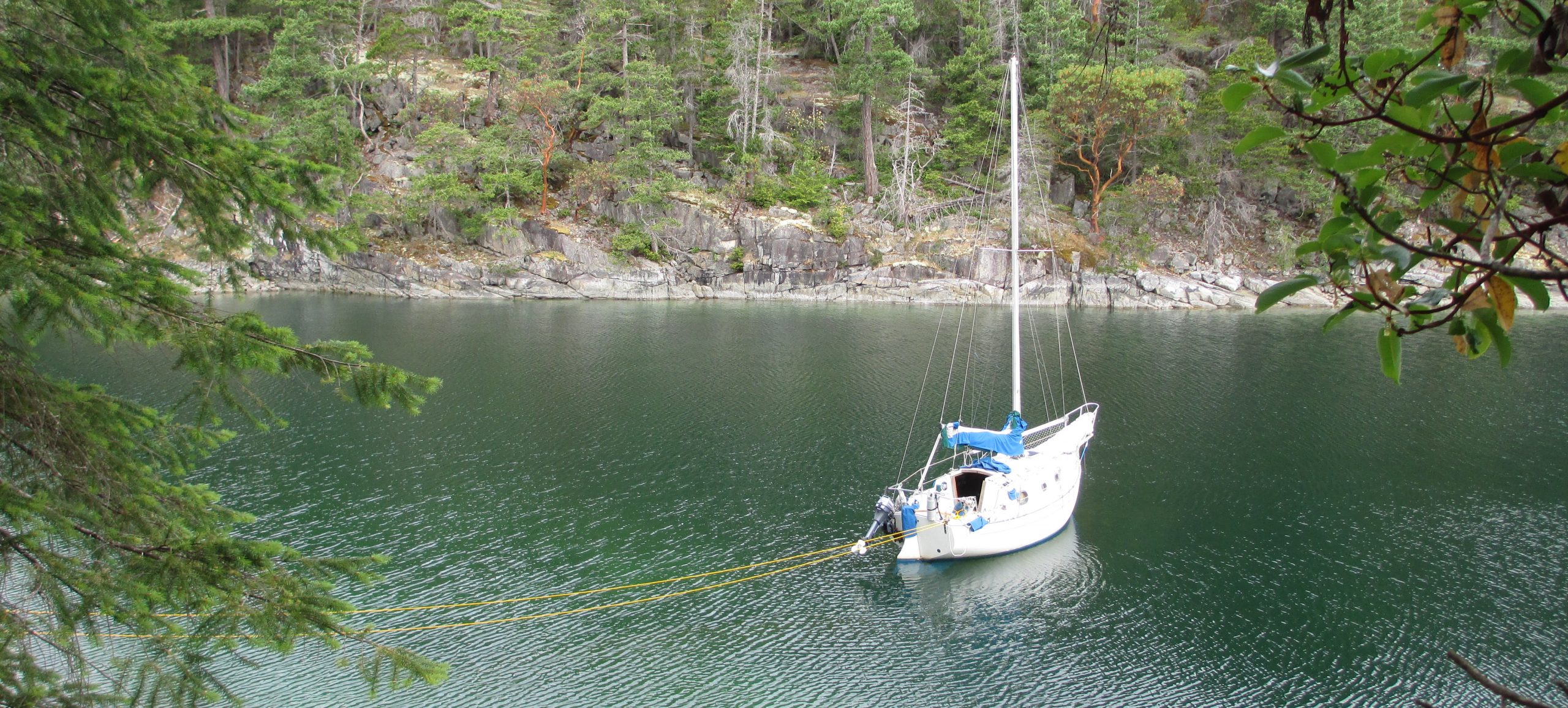
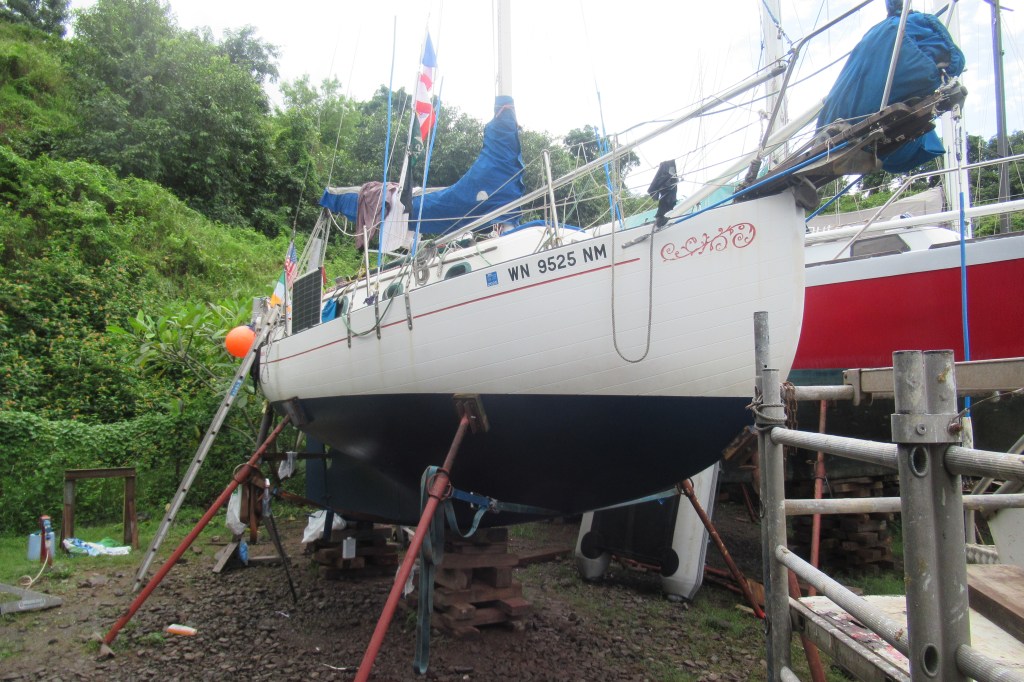
Are the chickens in the boat yard or are the boats in the chicken yard?
Why did the chicken cross the Pacific? To get to the Hiva Oa boat yard.
Which came first? The chicken or the boat?
Thank you. Thank you very much.


One of the first things people seem to ask, “Why don’t you have roller furling?” Really, it’s just another questionable decision I’ve made over the years. Here’s a fools thought process:
With hank on sails it means I have to go forward whenever a headsail change is required, or even dousing a sail. The plus side is it’s not very far. I wrote a piece about working the foredeck of a Thunderbird which helped me get more comfortable with it and I have been doing it for over 14 years. Granted, not on the open ocean.
My decision regarding this choice, whether sound or not, was this. I have always had a full suite of headsails on Sampaguita. They have always been hank-on. I bought a new 100% jib in 2023, but the 80% jib and the 140% genoa were still very serviceable. I also bought a 140% drifter in 2023, as well as a storm jib. I could have ditched all the hank-on sails I had, put on some roller furling gear and basically settled with a one-sail-does-all approach. This could have been operated from the safety and convenience of the cockpit with no apprehension and quick decision making as far as headsail size with lots of variability. Seems like a no-brainer, right?
Here’s the thing. That one sail approach means it is most efficient when it is fully extended. In most other positions, the cut isn’t right. A Flicka 20 goes to windward, but you won’t win any races in that direction. So optimal sail efficiency is best. (When I played drums, cymbal makers came up with something called the crash/ride. Really, it was neither. It was a marketing gimmick for those who couldn’t afford two cymbals.) So I can put up the right sail for the job and Sampaguita will perform her best. I get an optimal foil, as long as I set the sail trim correctly. Also, if something bad happens to one of my sails, I have others. Any change you make on a boat always has its surprises as far as performance, hardware and application. It’s never simple, no matter what the salesman says. This was part of my simple approach, and even it had a couple surprises and alterations required. Plus, it’s just me, and safety hasn’t been my first priority. If that were the case, I would have never left the dock.
My experience with roller furling sails is they also require a heavy acrylic cover on the leech for UV protection. That really messes with its light wind ability and set, with sails flopping around more. No wonder sailboats motor everywhere. Light wind is far more common than heavy wind. Also, both at the docks in Ballard and Port Townsend, and at anchor in Mexico, I have seen sails unfurl and shred due to inattentiveness and jamming. I have heard accounts from people I’ve met about there furlers jamming at sea. Or wearing out at an inconvenient time and coming out of the slot. Admittedly, if you are sailing downwind in the trades, it’s mostly barn door sailing so an efficient foil isn’t required, but you can see there are trade offs. It’s another one of those must-haves I passed on. It keeps me engaged at least. And keeps my fool schtick consistent.
Here are a couple videos of me changing headsails on the Pacific passage. They are sped up because, well, it’s a little like watching paint dry. Whatever. It is what it is.
If you’re still not convinced of the primitive existence aboard Sampaguita, here’s another video to swallow. When I arrived in Mexico, I decided I was uncomfortable with the water level in the sink. Sampaguita was so loaded up (read as overloaded) that the waterline was into the sink. Add any heel to port and it just increased. I was concerned about corrosion of the sink, and more importantly, corrosion of the thru-hull. With the stainless steel sink and the bronze thru-hull not playing nice together, someone’s going to lose. That someone was going to include me, regardless.
So I closed the thru-hull and soaked up some of the water and put a plug into the drain. Ya know, like the one you put in your tub at home. The sink then became a convenient holding basin which you can see in various other videos.
This means I have been doing the dishes in the cockpit since early November, 2023. Access to salt water has been easy and the saving of fresh water increased. Sampaguita doesn’t have a salt water pump for the sink, so the added fresh water savings has been a plus. A salt water pump would have meant another hole in the boat and since she has no other creature comforts that ALL cruisers seem to have, there was no point in making a big deal about it. And I closed it off anyway in the end, right? It would have been a big to-do about nothing. There have been a few of those.
With Sampaguita‘s low freeboard of 18 inches on a static waterline, (so with the rolling, varying between 6 and 30 inches,) you just reach over and scoop up salt water. Not a challenge at all. No need to use a bucket with a line. No dangerous reaching. Just wait for the roll to the side your on and take as much as you can! It’s a little like a pressure wash too. And no sharks have bitten off my hand. Yet.
So, this video is essentially a joke about that, and my foolish aquatic existence. I hope you have a good laugh, even if it’s a nervous one.
Disregard the following paragraph. Apparently, I am wrong. I apologize. I emailed with a broker and they said I did not need to import. They were not interested in selling the boat, but we’re kind in answering my questions.
Clarification for the uninitiated: You cannot just sail into a country and sell a boat. This is true for French Polynesia, France, Mexico, the United States, and most countries of the world. You are required to import the boat into the country first and pay the appropriate import fees. The boat is attached to me as per my declaration form. So this would take some bureaucratic hoop jumping and monetary input. It could be done. It would also likely need the help of someone familiar with the language and process. (more fees) Then maybe it needs to go to Tahiti for a broker (more fees) with the cost of moorage and storage (more fees). It takes time, so it might be a year of waiting, because there is a cyclone season here. Then you would have to find a crazy/fool person (some are kind and say brave) to buy a boat that small for ocean sailing (you only need one). In the end you’d likely be giving it away with a bunch of work. It would be better just to give it away, but the receiver would have to do the hoop jumping and I would have to trust they would. Not a solid approach. I also have no desire to go to Tahiti.
There is a third option for me. I have 18 months or two years(?) in the country as an Irish citizen. I wouldn’t mind finding a land home and staying here for a while, but I still have the boat liability. I can’t work so the boat would be a drain and hassle. I could raise chickens. They are everywhere and sometimes considered pests, but most people buy their eggs. And because there is no husbandry, they are not butchered at the right time, so people also buy their chicken meat. I’ve had some dialogue with different people about this. Funny, right?
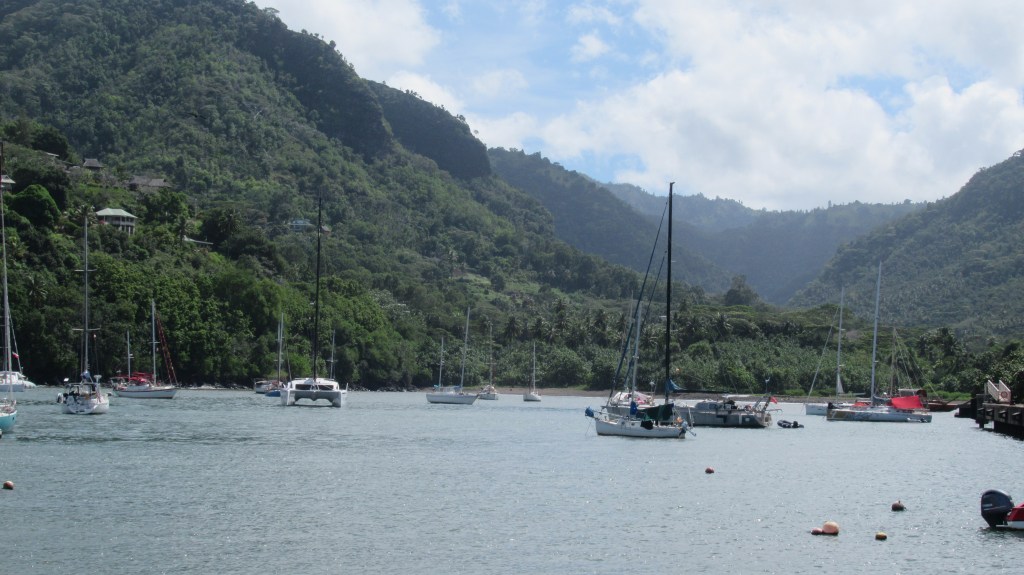
A day in the life of Sampaguita in Hiva Oa, Marquesas. April 23, 2024.
Thank you to all for your congratulations and interest. Some are asking for pictures and stories. I’m sorry, I am unable at this time to accommodate much. I just don’t have the heart right now. My search for peace has been a failure. Stress and anxiety are my burden and they follow me wherever I go. It is disappointing. I have always chosen the hard path, I guess. I know I have accomplished something, but have yet to be able to enjoy that thought.
The passage has really laid my life open to me. I lost my mojo a long time ago. Through foolish illusions I have been propping up my ego for years. The passage has stripped that all away and laid bare an analysis of my ridiculous life and its futility. With my ego went my confidence. Whether that confidence be true or false, that is what supports the ego.
My original Chilean plan has been abandoned. It was not based on sound route planning and understanding of what the Flicka is capable of on the open sea. Plans are fluid, so this is not really a big deal or any surprise. We learn as we go and adjust accordingly. Since Sampaguita is still my burden, this leaves me with two options. Continuing west or heading north to Port Townsend.
Continuing west is not something I am prepared to do. There are serious logistical obstacles to that which I nor Sampaguita are prepared or even able to overcome. From an armchair they may not be apparent but to a veteran cruiser in the present era managing the day-to-day, they are obvious. I am ill-equipped to handle them. I’ll not mention them all here as some cards need to be held close to one’s chest.
So that leaves Port Townsend. Does that excite me? No, it does not, but the route is the best gamble I have right now. A round the Pacific cruise is not to be ashamed of. And I think I know how to dispose of a boat there, which was my full intention at the end of this journey. My interest in living on a 20-foot boat is over and it was always my intention for this to be the last hurrah. I deemed Port Townsend to be an unsustainable place for me to live when I left and I don’t expect it to be different a year later. In fact, the United States doesn’t feel like a good fit for me anymore. But it is a place I know and think I can manage the wrapping of this up. After that, I have no idea.
Really, this is all about the boat now. I think the best thing for me would be for the boat to vanish into thin air. Then I wouldn’t have the liability of it anymore and my options would open up. And I wouldn’t have the stress and anxiety of it, at least. But I can’t abandon the boat here. It’s unsellable here. It doesn’t have enough value to store or to ship. It’s a $20000 boat at best, outfitted in a way that hardly anyone would be interested in. If I made it to Chile, I was going to give it to my friend there and deem it the cost of adventure. In Port Townsend I think I could sell it, give it away, or even DNR it. Besides it sinking in deep water, that is the best solution I can come up with.
It’s not Sampaguita’s fault. She’s doing the best she can do. I don’t begrudge her for it and she’s a fine boat. But she’s been at the whim of my decision-making and she is just a thing, no matter what superstitious mystiques tradition puts on a boat.
I appreciate the donations made. I have spent it all, however, if you feel I did not live up to your expectations, I will return anyone’s donation who asks. It is my intention to spend the next few weeks preparing the boat for my attempt at Port Townsend. Tomorrow we see if Sampaguita fits on the haul out trailer. It is questionable enough that they would not even take the 50% deposit usually required. I will be OK if not. I can manage in the water if I have to, though having things still(meaning not moving) would be helpful and easier. I expect the Port Townsend trip to take 60-70 days. I may stop in Hawaii, maybe not. I’d rather not. Hawaii has become like southern California, I think. Cruisers are pests. They only want the big money boats as that has become the en-vogue way to limit boats. Create financial and logistical barriers fewer can meet. I suspect I would be fraught with more stress and anxiety. I think I can provision for the long haul.
Maybe there will be blogs, maybe I will go dark. It is difficult to say today. I have nothing to say and no opinions to give. The heat is extreme and everything is a chore in it.
Humbly yours,
Joshua

Marquesas Update: The ship has come in! The supply ship that is, Aranui 5. Bigger than I thought and more hustle and bustle than I imagined. Lots of traffic, lots of containers, everywhere is restocked and people are in the prowl for newly arrived goods . Apparently an “every couple weeks” thing this time of year.
It looks like I’ll get to haul out. The boss says OK.
I hitchhiked into town and back, bought some delicious and still warm French bread, and went to the artisanal fair where I ate a delicious piece of barbequed fish.
Lots of rain last night, and as per usual, lots of heat during the day.
Thanks Monica, ‘Lectronic Latitude, and Latitude 38 for another Resourceful Sailor installment. This one talks about whisker poles for Sampaguita.
Here’s the link:
https://www.latitude38.com/lectronic/resourceful-sailor-whisker-poles/
Marquesas Update: I re-anchored again. I keep scooching the boat forward as room opens up. I think I’m good now. The depth is a little deeper and I’m a little more behind the breakwater. Still bow and stern anchored, but I think I could swing by the bower if I need to buoy the stern anchor. The wind is supposed to pick up this weekend. Not bad, 15 knots or so, but it will bring in more waves and swell and I don’t yet know how that will affect the anchorage.
I scheduled a haul out for fresh bottom paint and went to give a deposit today. Then the yard man, Tino, said he needed to measure the boat first. Sampaguita may be too small for the lift. It’s not the overhead Genie type, but the ramp style. What kind of idiot sails a 20-foot boat to Marquesas anyway?
Then I hitchhiked to town, went to the grocer for sausage, beer, limes and onions, and then to Pauline’s restaurant, Mokai, for lunch. I had the Mokai burger. Basically a hamburger with egg, coleslaw, and tomatoes. Pretty good. In the States, a hamburger is a safe choice, in Mexico tacos are the safe choice (don’t get a hamburger in Mexico!) In FP, a hamburger works. They raise cows and goats and chickens, and of course fish are a staple too. Goat is the world’s most eaten meat, though very little so in the States. Funny, right? On the same track, Formula One and Soccer are the biggest sports in the world, but not so much in the States. And the whole world uses the metric system, except the States. On the other hand the States’ money, military might, and communications dominate, so I guess you could say they focus on what really matters.
And now on to our regularly scheduled program.
Mexico really is a tremendously beautiful place. In the Northern Hemisphere’s arid belt, present day Mexico fell outside of America’s 19th century Manifest Destiny movement of the continents more temperate latitudes. While the advances in technology of the 20th and 21st century have allowed for broader climatic habitability and a more soft invasion from her American and Canadian neighbors to the north, the daunting aridity still remains Mexico’s best defense and charm.
Los Frailles was Sampaguita’s last Mexican stop. The furthest south, quality anchorage on either side of the Baja peninsula, it is well protected from the Sea of Cortez’s formidable north winds. The clean and clear water teaming with schools of fish that loudly appear to set the water boiling in a feeding frenzy, and the manta rays doing flips in the air for whatever reason they do that for, offered a diving opportunity for a last chance inspection of Sampaguita’s hull before heading west into the Pacific. Paola had done a good job of cleaning in La Paz and this was confirmed in Los Frailles.
Sampaguita stopped here on her way north in December and I tried in vain to find the path to the top of the hill on the cape. Reassured by Benedict and Mark of Opale, whom I spent Christmas with in Bahia de Los Muertos, that there was a trail, I was committed to finding it this time around. Alas, it was located and the ascent was more than worthwhile.
From the top, I took the accompanying video. I could see for miles and miles in every direction. Up the coast, down the coast, the mountain range to the west and the Sea of Cortez to the east. I could look down and see condors soaring below. The Mexican fisherman camp with its beached pangas alongside the fair-skinned RV park and waterfront estates. The humbler local dwellings and dried up watering holes. It was a fantastic “last view” of Mexico.
I hope you enjoy. Thanks for taking the time to visit Sailing With Josh.
Thank you for your support and interest. I do appreciate it. It makes me feel less alone. (Also I fixed the previous posts video. User error.)
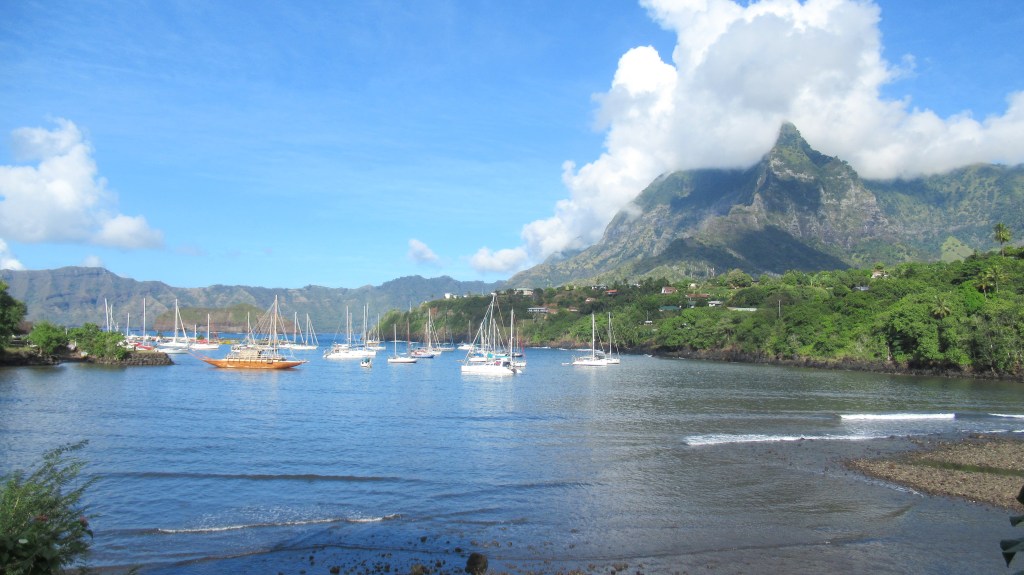
Marquesas Update: I checked in today to French Polynesia as an Irish citizen. It took 5 minutes once I walked the 2.5 miles to get there. (I walked there yesterday and back to no avail because they were closed.) No fuss, no visa, no bond.
Enter the Gendarmerie. “Bon jour” the Gendarme said. “Bon jour” I said. “Parlez-vous Anglais?” asked I. “Yes. Are you here to check in?” “Yes” “Did you fill out the online declaration?” “Yes” “Do you have the number?” “Uh, no. I have my passport, can you find it from that?” “We’ll see.” Gendarme takes my Irish passport, goes into the back room and shuts the door. Three minutes pass. He comes out. “Were you able to find it?” “Yes, everything looks good.” He pulls out a stamp and stamps the passport, then grabs a pen and writes in the date and hands it to me. “That’s it?” That’s it.” “Merci.” And I exit. I then went to one of three local restaurant/cafés, had a cup of coffee and chatted with the owner, Pauline, from Tahiti. She spoke pretty good English. (More on that conversation another time.) I hung out there until the kitchen opened and had the pêche du jour. Then walked the 2.5 miles home in the heavy rain. It was kind of like taking a warm shower, but going somewhere at the same time.
Part of the mental gruel during the passage that was challenging was anxiety around everything being in order and working out when I arrived. You make decisions that seem the best ones at the time, but there are loose ends and unknowns. Over 39 days a stupid mind makes a bunch of stuff up. And all you can do is wait and endure. I was hoping to find a bit more peace on the open ocean, but of course, I drug all that land stress along with me. That was disappointing. I know you can’t escape yourself but I was hoping some space would help. Foolish me. At 52 it is so difficult to break the conditioning of a lifetime. Of parentage, country, culture, experience, trauma, etc. I’m sure some are better at it than others. The older I get, the more people there are, the more rules, more barriers, more costs, more people treating people badly, the more I am stressed by land. So far, most of the things that worried me pending arrival have all worked out fine, which is great. Even comically so. But I resent that I come from a fear culture and conditioning that really has hurt my growth in my life and prevented peace. My failure is my own but failure nonetheless. I really believe it is by design. Stressed people work and fight harder to survive. Competition means there has to be winners and losers. It’s good for the economy. I realize I have far fewer days in front of me than behind me and when I look back, I feel pretty disappointed. You might think, “You’re in French Polynesia, paradise, living the dream.” I can see that it might look like that from behind your desk as you shed the suit and tie. But it’s not like that at all. Sure, I sailed a Flicka across the ocean. I did something only a handful of people would even want to do. Or think they want to do. Really, I’m just a fool on a tiny boat, busting butt just to survive day to day. Through potentially questionable decision making, I happen to be in Hiva Oa. Apparently, a glutton for punishment.
And now on with the regularly scheduled program.
Growing up, holiday meals were often spent at my Grandma Wheeler’s house on Otisco Lake near Syracuse, NY. One side dish we seemed to always have was salt potatoes. G-Wheeler would use baby potatoes, which lent to a high skin to “meat” ratio, and had a small sauce pan of melted butter to mash them up in. It’s a simple but amazingly delicious combination. Who doesn’t like potatoes, salt, and butter? (Regardless of whether you should be eating it or not.)
The key is to boil the potatoes, skin and all, in salty water. How much salt? I’ve discovered you can’t overdo it. The salt prevents the skins from coming off, raises the temperature of the water, and when drained, leaves a crystally coating of goodness over the potatoes.
When I moved to Seattle in the 2010s and started having “family” style lunches while working at Card Kingdom with workmate and pal, Andi “Snax,” I learned that this was a regional dish that many didn’t know about. It was one of those odd reflective moments about when you grow up with something and think everyone else does too…..but they don’t. This was when research turned up the intel about Syracuse salt miners having this on their shift.
Now, Sampaguita has her own take on this delicacy, inspired by, rather than a direct copy of, the original dish. The following video was meant to be a bit of a joke on Sampaguita’s low freeboard, taking advantage of her salt water environment, and keeping things simple. If you have the endurance, you will see it turned into much more. Martha Stewart, Rachel Ray, or whoever the en-vogue cooking show host is nowadays (who cares?), can’t touch this.
Here is another installment of A Flicka Sails Herself. This one shows the wind vane at work in the light air and the improvised bimini and weather cloths. And then nothing but the Big Blue.
I saw a few cargo ships in the first days of the passage in the NE trades. Then it was weeks of seeing no other boats. Not even on the AIS. (When I was looking.)
It wasn’t until the last day on the approach to Hiva Oa that I saw a few other sailboats.


 sailingwithjosh
 Sailing With Josh