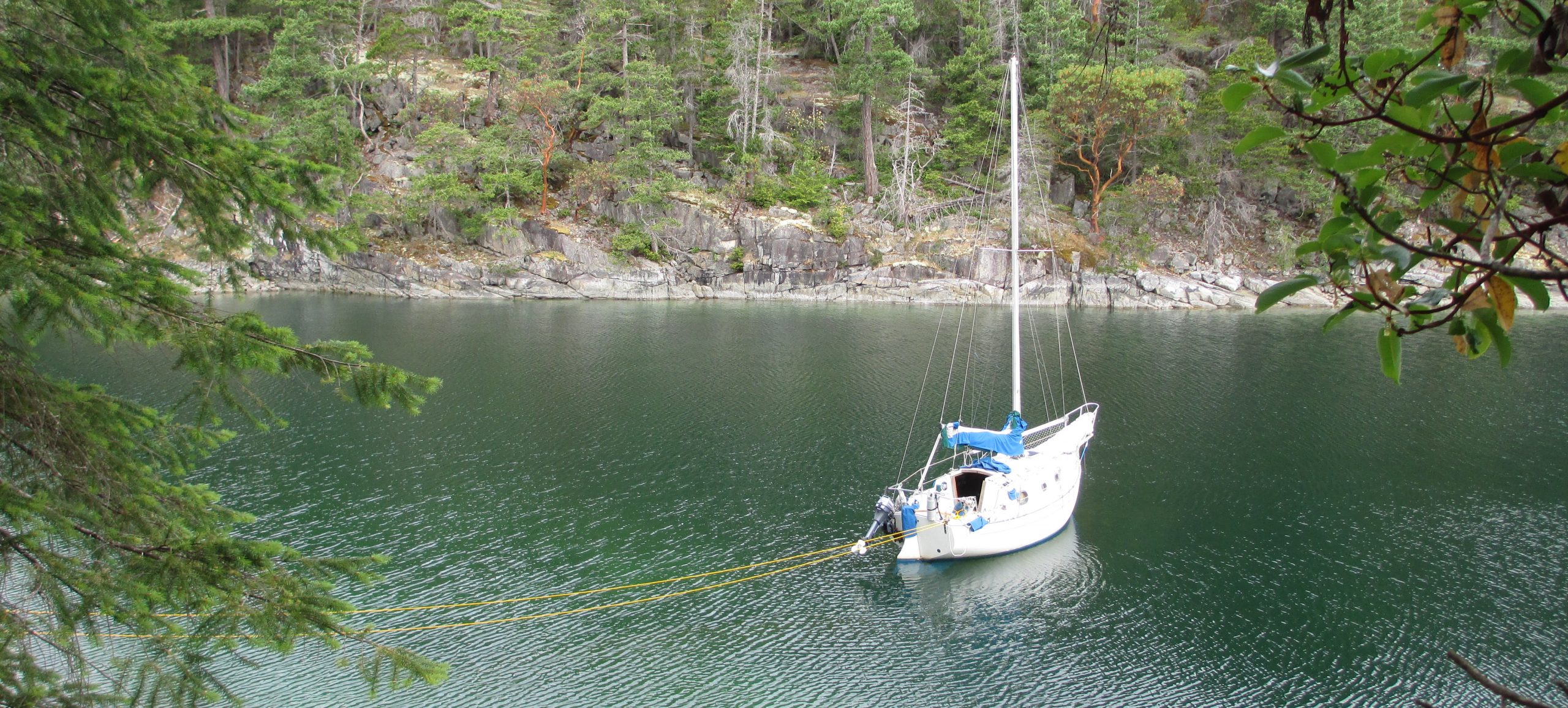
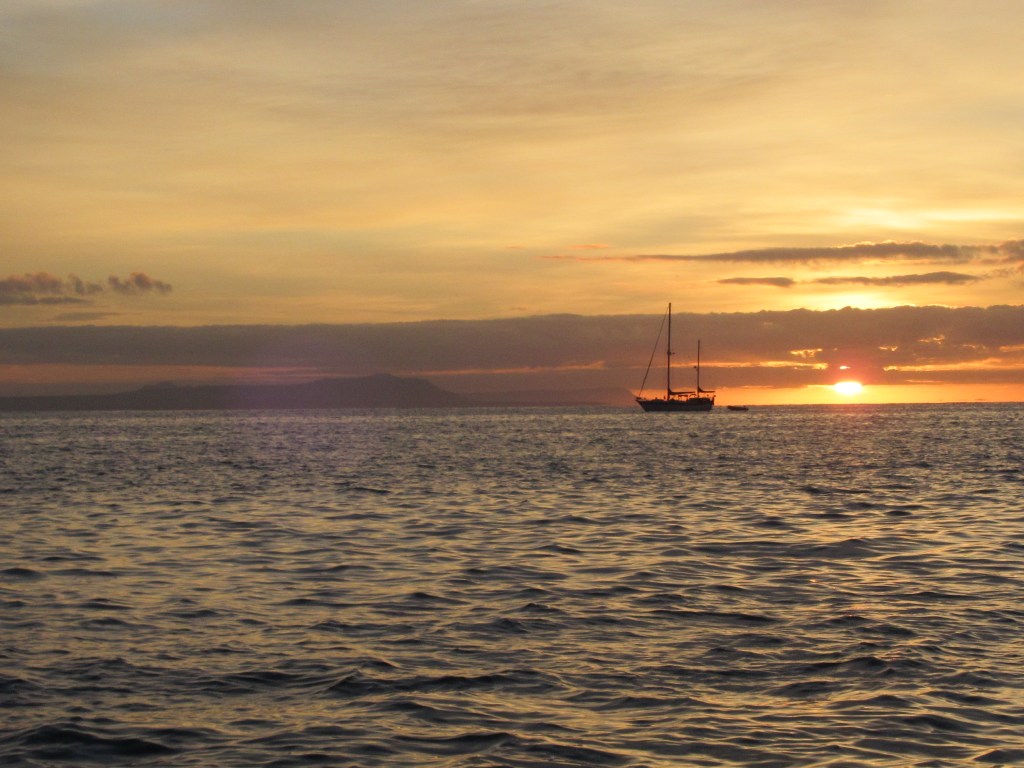
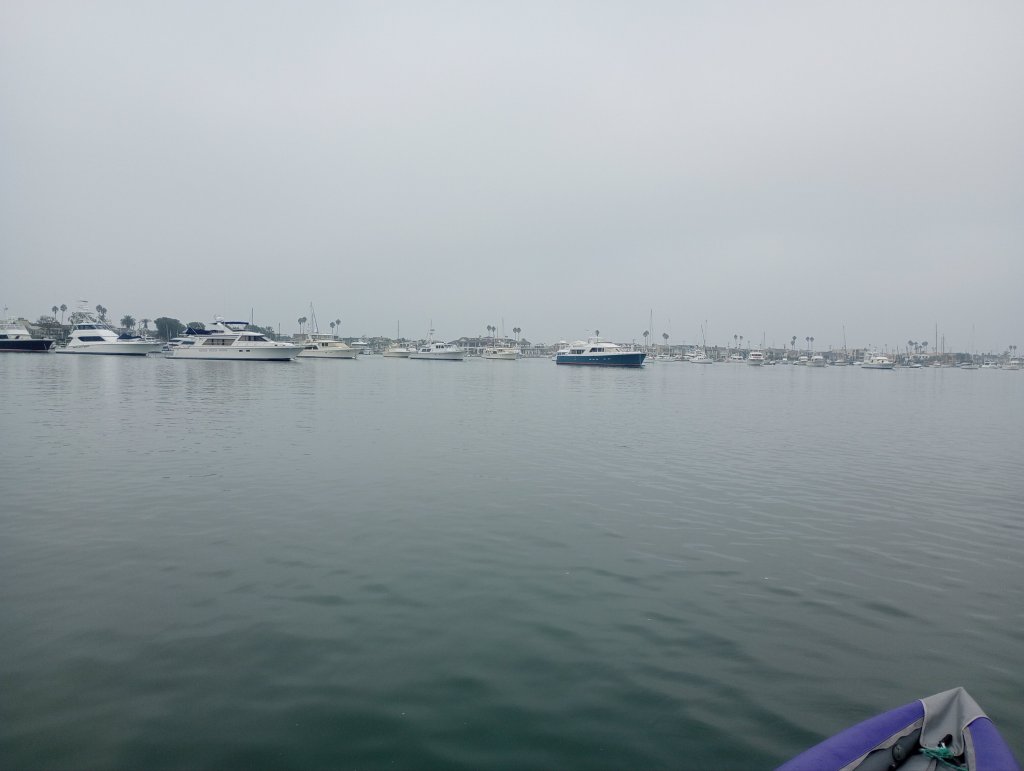
Anchor News: Sampaguita pitched her way through a good 24+ hours of 20-30 knot winds in Bahia Tortuga. A nearby boat said they recorded 32 knots. (Sampaguita has no anemometer.) I did know it was coming which is why I stayed in Tortuga. I was a little concerned. I had enough room to let out 30 more feet of anchor rode, and the anchor remained well set. I don’t have a windlass, so I’ve theorized some Sampaguita specific ways to gain mechanical advantage to haul up the anchor in such conditions and other contingency plans and am happy to not yet have had to test them. As a friend has recently said, my minimalist path minimizes my options. It does have its assets and liabilities, for sure. The practical answer to these things Sampaguita doesn’t have would be a different boat. I should have moved the boat on Sunday to the NE corner of the bay, but contrasting weather predictions got the better of me. The NE corner wouldn’t have reduced the wind, but it would have reduced the fetch and the pitching. I got away with it this time. The next day saw gusty conditions ranging from 0-30 knots, but the waves weren’t there so it was less concerning. Under those conditions I don’t want to leave the boat. Plus, the kayak would be difficult-to-impossible (and very wet) to use. Downwind, sure, upwind, no. So, I stayed aboard at anchor watch as one should do. In the end it was just pitchy. You can see throughout the anchorage, the 40’+ boats all pitch half as much as Sampaguita. They bridge the waves better. It’s not that it is uncomfortable. It’s the tugging at the anchor that’s worrisome. On the positive side, bad decisions make better stories.
Sampaguita spent the American Thanksgiving Day in Bahia Asunción, arriving in the morning after an overnight trip from Bahia Tortuga. On Wednesday morn we played the game of “what ifs” and “what abouts” pulling up the anchor. The wind was about 15-20 knots and the boat was pitching a bit. After weathering the blow noted above (which after landing in Bahia Asunción and learning what they experienced, was nothing. They had 45 knots and a much more adventurous time.) it was forefront in my mind to practice and try some of my new theories. (Some of us love the “what ifs and abouts” games, right, Jim S.?) After pulling tediously, and with considerable effort, the first 60 feet of nylon rode and then the first 50 feet of chain, the last 30 feet of chain was too much. Mind you, I’m in about 20-25 feet of water. That anchor was very well set from the blow and wouldn’t budge. Good news, really, right? The pitching pulled the chain from my hands 6 inches by 6 inches, and the strain was painful on the hands. I had to resort to letting back out the previous 50 feet of chain, taking a rest and rethinking my approach. I hadn’t started the engine yet as part of the game and ultimately this was how I got the anchor to release quite easily. (I considered sailing off anchor, but with that much wind, and Sampaguita pinned to the bottom, experience says she will power up considerably, and the single-hander pulling chain up at the bow can’t release the sheet and de-power her. That is fraught with danger.) But first I set up a line from the sheet winch, through the storm jib block, and to the bow with a chain hook on it to give me mechanical advantage and to hold the chain, as Sampaguita’s anchor cleat is more rode friendly than chain friendly. This allowed me to partially pull in and hold the chain, but still provide a segment of elasticity to the pitching bow as well as give me mechanical advantage. Then it was a game of hustle. Start the motor, go to the bow, pull in some chain, set the chain hook, back to the cockpit, adjust the winch so the line is in a good fairlead spot, back to the bow, haul in some more chain, reset the chain hook, back to the cockpit, increase the throttle of the engine just enough to get a tiny bit of forward motion, back to the bow, haul in the rest of the chain and anchor, secure it quickly, then navigate Sampaguita through the boats, get the already triple reefed main sail up and then run off out of the bay. Then it was easy peasy. Set up the Windpilot and you move from heavy laborer to supervisor, tidy up and secure everything, and be on your way.
That nice North wind, under triple reef and 80% jib, carried us most of the 60 miles to Bahia Asunción through the day and early eve. We could have pushed a little harder, but we don’t do that as a rule. We save the rig for when we have to. Much too late to enter the bay, we meandered about through the night off of Isla San Roque and waited till the daylight for our entrance. With the anchor down about 1100 local time, I was greeted by Grant of Mundial (a Downeaster 38?), who was inviting me to the cruiser’s potluck at Shari Bondy’s house/hotel at 1400 hours on the peninsula. (Mundial had a harrowing tale to tell in their blow, but that is Grant and Noel’s story. All’s well, that ends well, and lessons were learned by everybody.) I got it together in time enough to attend and had turkey (with gravy!) and other delicious baked foods I haven’t had in months. High style.
Observation: Pelicans are the seagulls of Baja Mexico. They are responsible for the nasty flavor of guano that a cruiser becomes so familiar with. You have to keep them off your boat or they will create a very unpleasant frosting. They haven’t roosted on Sampaguita yet, but I have shoo-ed away a couple from the kayak. Last night I came to realize something. I could hear them outside feeding, so I would intermittently get up to make sure they were not getting comfortable. After watching them for a few minutes I was wondering what it was about my boat that they might be attracted to. I have a very bright anchor light. It is atop the mast, but it does not light up the deck of the boat because the base is so close to the top. This creates a shadow. However, that shadow does create a halo of light at about a ten-meter radius on the water. About eight pelicans were sitting around the boat in that halo and feeding like crazy. It occurred to me that the bright halo of LED light was helping them to spot the food in the water, and that was what was attracting them. (As long as they kept their distance, it was cool by me.) It also occurred to me, though this was not quite so obvious, and I am not a marine biologist, that the halo may have also been attracting the organisms they were feeding upon. I was creating an artificial ecosystem. If so, that is another example of human alteration of the natural environment. While I acknowledge it, I do not feel bad. On the grand scale of the human effects on the world, Sampaguita and I can have our 5-watt LED anchor light if we want.
Experience: I was strolling around San Bartolomé the way I do. Solo and slowly, just observing the village and marveling at it, being friendly, saying and waving to passer-bys, whether on foot or in their cars. I walked by a house and someone said “hello.” I turn and responded, we had a few words, and they invite me to have a Tecate. So, I say “Si.” Raul, the main instigator, speaks some Ingles, and he clearly wants to practice it. Obviously, I am a gringo, so I fit the bill. It turns out to be a gathering place for a small group of local fishermen. I gather it is Ramon’s porch, who doesn’t speak Ingles, but as is the custom amongst all humans, follows the socially charismatic leadership of Raul. Through the course of a couple hours several other fishermen congregate and we chat in broken Ingles and broken Espanol, drinking Tecate, them introducing local fruit from the trees in their yard, and Ramon even gave me lobster tail from his freezer. (I ate it that eve. It was delicious.) (He told me to hide it in my bag quickly and not say anything, because, assumingly, some people would disapprove of giving goods to a gringo yatista or would want some themselves.) Lobster boats are everywhere. The San Benito lobster boat wanted to sell me a lobster earlier in the day, which sounds great, right? But experience has told me there is more to consider. In Newfoundland, on Breskell, we had lobster one night. It was delicious. But whole lobsters are a messy affair and the juice squirts everywhere. And gets all over everything, your clothes, your bedding, and there is no laundry, and the boat smells like bad fish for a few days. It’s not worth it. (So Ramon’s dressed out lobster tail was a bigger gift than he likely imagined.) They can tell I’m not your typical yatista. “You are solo?” “No house?” “No kids?” “No friends to travel with?” “Su barco es seis metros?” “We see you have heart. You must be searching for something.” I haven’t seen this kind of spirit in America in years. Maybe I’ve been in the wrong places.

Experience 2: On my Sunday visit to Puerto San Bartolomé, the village on Bahia Tortuga, I came across the local Sunday baseball game. Twenty-five steps into the grand stand and Raymond was inviting me over and offering me a cerveza. So over I go. We can barely communicate, but we try and nobody gets frustrated when we miss the mark. People come and go, some of them I met the day before. (It is a small town.) The teams aren’t that good, but baseball is popular. I have noticed lots of MLB caps wherever I go and the players all wear their favorite. They have mix-match uniforms, but they all have the classic baseball pants on. I don’t know if they have sponsors or not. The field is in OK condition and there are lights, but I don’t know if they work. The home run fence is mostly intact. The catchers share some of the gear and there is one umpire who stands behind the pitcher. The teams are all ages. We have a great time cheering on the good plays regardless of the team. There was no visible scoreboard, so I had no idea which inning it was and what the final score was. There was loud, Mexican music cranked between every pitch. It was a wild time. Raymond is very kind and treats me like Familia. No problema. After the game he invites me to his house and feeds me some pescadoro pico de gallo(?) It is in stark contrast to America where people are very leery of strangers. In Seattle, there is something well known to emigrants called “The Seattle Freeze.” Nobody just invites a stranger over and welcomes them into their home or inner circle. Maybe it has to do with the more you have, the more you are afraid to lose? Food for thought. I have been warned by most of these new amigos about the mafia (this is not the Godfather mafia we traditionally associate with mafia) and I pick up, they too worry about them. We have it in the US too. I gather these are just locals who use power and intimidation to control others. There are some obvious local-take-advantage situations, just like in America. The big difference might be in America they work within the law. In Mexico, they might work more above the law. I am still trying to suss it out. The local fuel baron, who is infamous on Navionics and in the international cruising community, known for excessive delivery costs, bad metering, and tainted fuel, does his community a disservice. He creates a bad vibe and by my observation, cruisers don’t spend much time (therefore, much money) in Bahia Tortuga. Mostly Americans and Canadians, they are well versed in scammers. They recognize it and just don’t like it. On the other hand, the Baja Ha-Ha Rally stops for a couple days. 100+ boats (an armada) descend on the bay and the town. I am sure the local fuel baron and economy gets a boost from this. Maybe even too much, clearing the goods from the shelves, preventing the locals whose economy is more day to day from getting some of the supplies they need. (Remember the toilet paper rushes of the pandemic?) I will say, the local super mercado was excellent. They had some very delicious granny smith apples. I love a good granny smith apple.
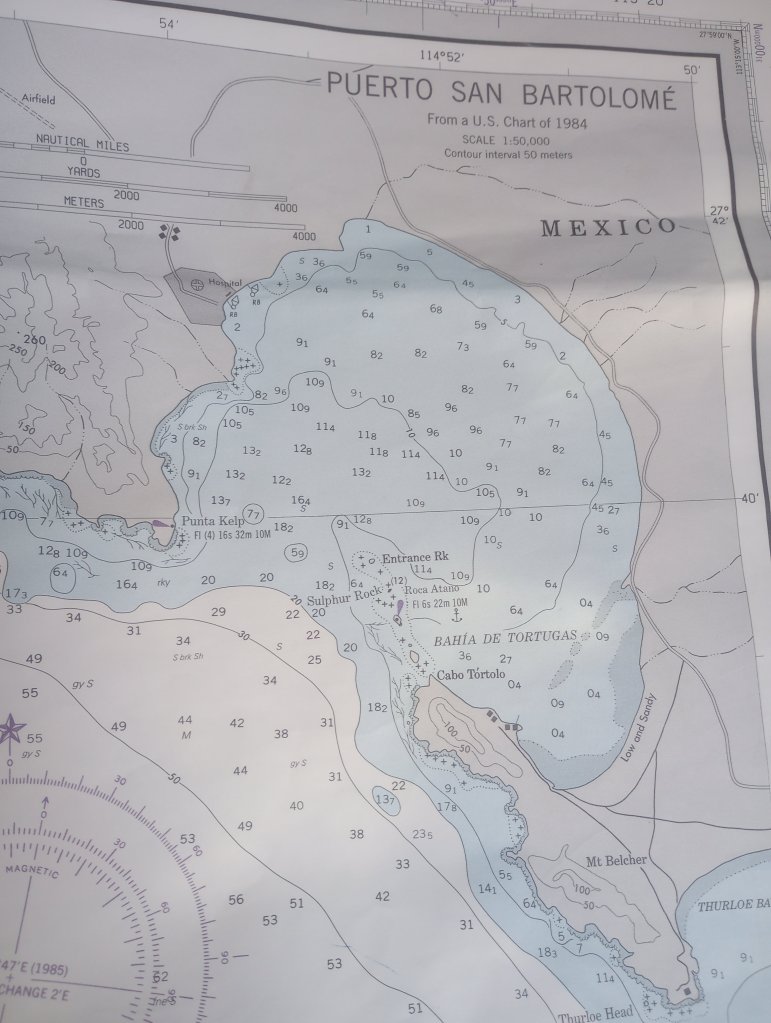
Observation #2: An aside on the Rally boat that sunk entering Bahia Tortuga. Navionics, though modern, crowd source-able, and a common go-to, has very incomplete and deceiving Mexican chart-age details. I have some older US Defense Mapping Agency paper charts I rescued from the Ballard Mill Marina dumpster years ago thinking one day they might be handy, and they clearly show the dangers and rocks off the Point that boat hit. Navionics does not. Just sayin’.

Qoute of The Day: “A Dana 24 is minimalistic. A Flicka 20 is just stupid.”- Joshua Wheeler, 2023. They have an allure to the uninitiated. That allure is where most of the traffic to this site comes from. But to paraphrase John Vigor from his book, 20 Small Boats That Will Take You Anywhere, (#20?) (Details are elusive with limited internet access) only a self-loathing, low-esteem, masochistic, and lonely fool would go cruising in one. (You won’t get the big boat girls and small boat girls might be few and far between in your peer group.) If you are self-aware enough to realize this about yourself, you might be Flicka cruiser material. Most Flicka owners have a trophy boat. A strong, cute, well-built boat from a reputable manufacturer with a nice interior. They like the idea that it could theoretically go anywhere, but they mostly daysail and the moorage is affordable. (And their significant other says, “Go have a good time, honey. Let me know when you’re ready to buy a bigger boat.”) Alternatively, it is trailer-able. So, if you have the wherewithal to also buy the hefty trailer and the even heftier truck to pull the total 7000 pounds safely around, you can have a high style aquatic RV set-up for a summer holiday, or be a snowbird with. (Or you cash those three in and buy a Dana.) Yes, there are a few documented journey’s on Flickas to add to the romantic notion of them. And I don’t know most of those other folks, so I can’t say where they all fall in the spectrum. I’ve painted with a broad brush here, but I think after 10 years and 10000 miles with Sampaguita, I might have some qualifications regarding Flicka 20s. Then again, I’m just a fool.
Weird Universe Ether Experience: If the above wasn’t enough in two days, two blasts from the pasts contacted me on Thanksgiving. You might think “What’s so strange about that?” To know me is to realize that happens extremely rarely. (You have to think in years.) On top of that, I abandoned social media well over a year ago, so I have lost touch with the masses who use those common links to each other. Being manipulated by those moguls under the guise they were doing me a service was destroying me. But it also means people have to purposely come to me. That really sets people apart. I salute Terry P. and Banjo for their initiative. And I salute those folks who come to this blog and drop me a line too. If that’s you, and you read this, then you know who you are.
I guess all I needed to do was mention rain. Want and ye shall get, or something like that. Sampaguita is anchored in Bahia Tortuga, Baja, Mexico. We arrived this morning. Well, actually, we arrived last night in the classic two-hours-late fashion. Scott and Emily of Committed Sardine were kind enough to give me some coordinates of four lobster pots near the entrance as a guide/hazard lane. I figured out how to put them in Navionics, which was new for me. However, the skies were overcast, so it was very dark when I got there. Plus, the wind was being quite variable, coming and going as it pleased. It’s one thing to pick up a pot with the rudder or engine when the conditions are calm and there is light. I can sort through that. But in the wind and dark, that’s no bueno. I opted to heave to and spend the night offshore, which was quite pleasant. Hardly any rolling and no traffic. I slept pretty well. I had a west-ish drift which was all I cared about. I could drift that direction for months, while an east-ish drift would have put me on the rocks fairly quickly.

About five in the morning an offshore breeze picked up and I quickly made up the four miles I drifted on one port tack, straight to the bay with the sunrise. I was able to beat into the bay and anchor without starting the engine which is true Sampaguita style. Small boats don’t take much wind and a patient sailor is also important too. I haven’t encountered any other of the two since I left Port Townsend in August. It’s a diesel fest, whereas Sampaguita’s Tohatsu has used about two liters of gasoline since Ensenada. I’ll top that off as per usual at the local Pemex station.
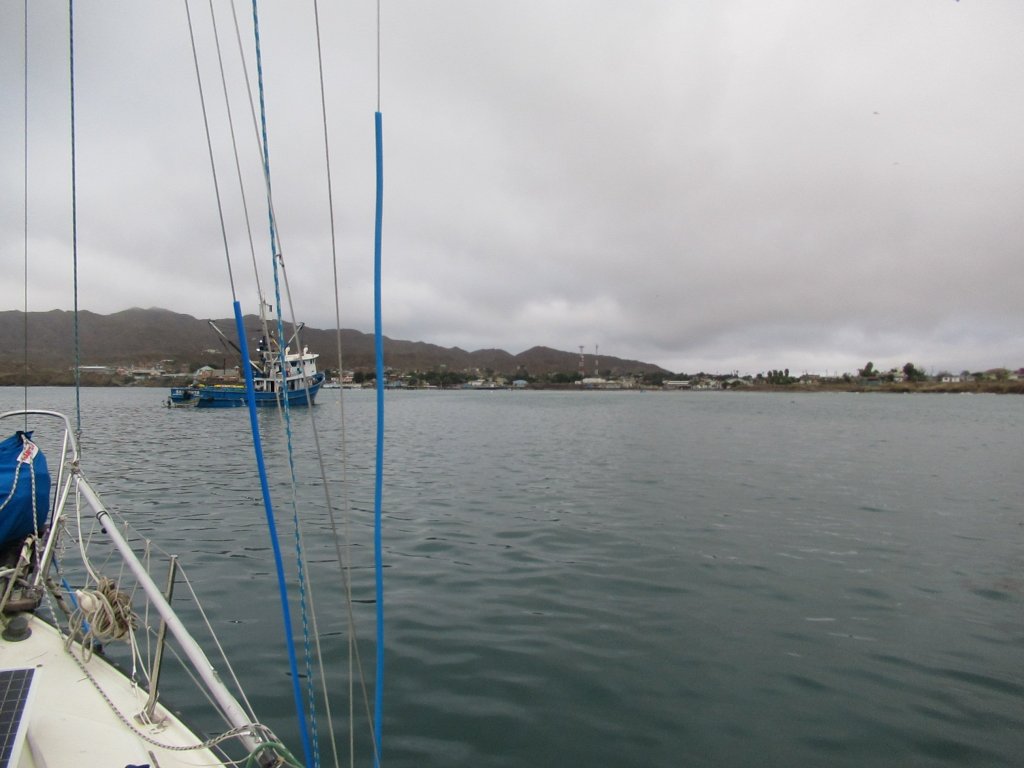
It’s overcast now and a light, but continuous rain has been falling. The caveat is the solar panels aren’t producing much charge. That’s another angle of the diesel engine. I’ll just conserve even more. My two-battery set up run independent of each other, so I can get one nice and full while I use the other. Being Lithium, they don’t demand to be fully charged the way lead acid batteries do for long life. It’s OK to run them down to 20% over a several days.
We left Isla Cedros the previous morning, sailing off anchor. Ok, it wasn’t so much sailing than drifting, but once again, if its an offshore direction, it’s fine by us. After about an hour, a light headwind filled in and will full main and the 140% drifter we tightened up the sheets, making a little more apparent wind, and off we went. I hadn’t planned on getting to Bahia Tortuga (Turtle Bay if you hadn’t bothered to look it up yet) until the next day, but the sailing was so good, we ALMOST made it in one day. So, it was no disappointment to spend the night at sea. In fact, I never look at it as a disappointment. I signed up for this and it would be bad for morale to think of it as a disappointment. Another reason why I sail alone and all the other boats probably motor most of the time.
I really liked the town of Cedros. Poor as mud, but the people were not unhappy and were friendly. It is difficult to describe the level of poverty and decay going on, but I enjoyed trying to communicate with the people and explore. I’ve noticed a clannishness between other boats. Sampaguita is the runt of the litter and left to fend for herself and make her own way. There were several family boats and it seemed like a cultural opportunity for the kids to go ashore, but I’m not convinced they did much. I’m not a family man so I guess I don’t get why not. The island kids were all very curious and I had some interactions, though, mi Espanol is so bad and their ability to improvise was not developed. The use of mobile phone translation apps helped in a few cases, but I decided I wasn’t a fan. Like most crutches, it does allow communication, but not really a learning of the language.

Experience: I walked down an alley, or maybe it was a street/dirt road(like most were) that it wouldn’t surprise me if no white person had ever walked down. I would love to be wrong in that. I heard drumstick like tapping. I look over into the yard (not a yard but with a present lack of what else to call it) and there was a young girl tapping on her house. “Ah, tambour” I said and she and her sisters ran in the house. I continued on for a short distance, but the street was a dead end, so I turned around and returned. They had also resumed. When I walked by, I motioned them to bring me the sticks. The house was a foot off the street, so it was not an intrusion. The girl came over. She had two sets of sticks and handed me a pair. (She explained later that they can’t be bought in the store. A local carpenter makes them. This is obvious.) I started playing and, for those who know my previous life, it became obvious that it wasn’t my first rodeo. She wasn’t very good, but was a good student, and I taught her a few things. Eventually her mother invites me in and feeds me three delicious carne tacos. ( I regret my inability to say what a treat this is. I don’t get to have fresh meat on the boat unless I buy and eat it right away. No refrigeration, remember? They do have a refrigerator.) They have no English skills and my Espanol is terrible, so communication was slow and awkward. They offered me a glass of water from the water cooler to go with it, apologizing it was all they had to offer. (It’s all I would have wanted.) As an aside, I never saw any of the three girls or their mother have any of the water. I know it was good drinking water. My point is that fresh drinking water is very valuable. (None of that Martha Stewart “Drink eight glasses of water every day, sipping as you go.”) I recognized this gesture. There is much more to say on this encounter, but I will save it for a full-length essay. This is an example of taking a detour in life and the unexpected encounters of doing so.
Boat Hack #1: Every sailmaker I got a quote from thought I should have a drifter. This is a light cloth sail for very light winds. Having never had one, I wasn’t convinced, but also never having bought sails before, I recognized the repeated suggestions. It wasn’t inexpensive. Like many things, it’s not so much the material, it’s the labor. It’s big, so it takes a bit of both. They are often made of nylon, which is very light. But in conversation with the sailmaker, I decided to go with a lightweight dacron cloth. This is because I am rough on everything, and it theoretically would be a bit more durable, though not quite as light wind-ish. When conditions are right, it is really an effective sail.
Boat Hack #2: Starlink seems to be the new go-to for cruisers. The Emperor of the Western World has done it again. First PayPal, then Tesla, and now Space X/Starlink. My understanding is it has become semi-required equipment for boat-schooling families. People working while cruising need it to maintain, and generally, other cruisers are using it too, because being connected via the internet has become a normal way of life. I guess normal has never been Sampaguita’s way. I see the value in it for sure, in particular, for weather forecasting. Sampaguita requires a bit of extra strategy weather-ways because of her size, but it is quite costly still to get the hardware and subscriptions. The other, and more decisive factor with Sampaguita, is the energy requirements. It’s an AC product using several amps while in use, and we don’t have the energy replacement capabilities to keep up with that and our other needs. (Especially apparent with multiple overcast days.) Starlink needs that diesel engine. Sampaguita will never have a diesel engine and her supervisor has no desire to drive everywhere. So, it’s presently not in the cards for her, and well, another boat is not presently in the cards for me. So, it’s old-school for us. We’ll manage the best we can and it will work out if it works out.
Baja California is not the same as Southern California. Sampaguita left Ensenada at 4:30PM on Tuesday, November 7th. Not an ideal leaving time with an hour of sunlight left, but we had a couple lessons about Mexican time. First, a common answer here is “mañana.” Second, some agencies run on PST, while others run on DST. For example, the Puerto Capitán’s office closed at 2PM. “But it’s only 1PM?” Not for them. So, that paperwork took until the next morning. Then, the marina’s representative wasn’t in until the afternoon so that’s why we didn’t get all the proper stamps we needed until 4PM on Tuesday. Since I was committed to not paying $50 to stay another eve in the marina, off we went. (The marina was nothing special at all and the harbor water quality is on par with Nome, Alaska’s. That’s a compliment for neither.) It’s a good thing we are accustomed to spending the night at sea. While most things in Ensenada are relatively cheap compared to the States, the marinas, which mostly cater to tourist yatistas, charge California prices. Since anchoring is prohibited in Ensenada, they have you by the rudder.
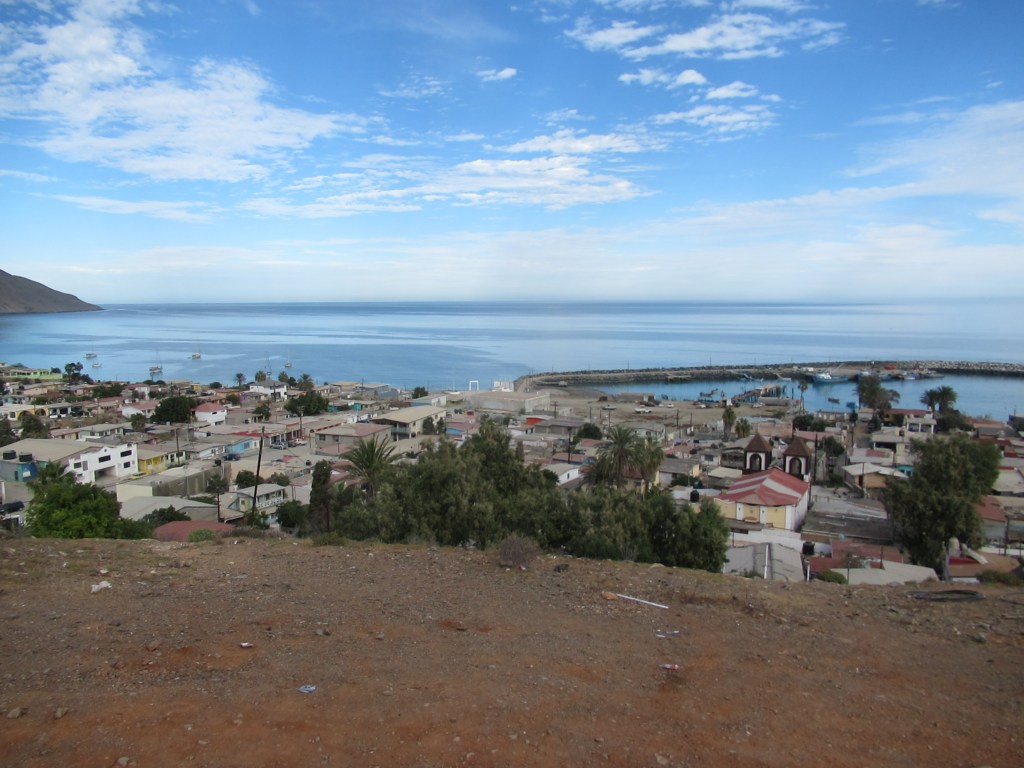
But off we went and it was fine. Sampaguita spent the next five days and nights at sea traveling south to Isla Cedros. There were some anchorages in between, but we could never seem to get to them at the right times. To early in the day, or too late, to anchor. The days which are now less than twelve hours, just don’t give a slow boat enough time to get from point to point. Three of those nights were dead calms. I would lower the sails and roll and drift (for some of it in the wrong direction because of tidal flow) and endure it until the morning. Two of those nights I was able to sail along quite nicely. The prevailing winds are NW and following which is a big deal. The expression “Fair winds and following seas.” Is based on truth.
Regarding the rolling, that might sound dreadful to most. That’s why I sail alone. Below, in Sampaguita’s settee on the starboard side (the only one she has) it is mitigated by the fact that I sleep low in the boat, just under the waterline. The motion is less there. Step the three feet up into the cockpit and you better be hanging on. Boats with crew greater than one and diesel engines just power up and keep going. That’s not the kind of sailor I am. I could run the outboard, but I don’t do that when I am trying to get some sleep. That sort of engine use has a slew of other considerations that come into play. I’m not on holiday, I’m on expedition, so the work is fine. The other two nights, I got to sail on through. I would slow the boat down so that I was not catapulting across the see at top speed and blind. But it sure was nice to know that you had covered forty miles with a more comfortable motion when the sun rose.

If any of you are appalled at my single-handed ways and consider them inherently dangerous and un-seamanlike, I will not argue with you. But I also will not mind if you don’t go to sea. Show me a sailor who wants to sail like me and that I want to sail with and I will reconsider. Also, I will give you my PayPal address so you can donate gobs of money for a bigger boat with all the bells and whistles. Moving on.
Regarding Mexican nautical charting, Dorothy, you are not in Kansas anymore. These are not the US charts you are accustomed to having a high degree of confidence in. There are many more uncharted navigational hazards, and some info is just wrong. Cases in point, one of the Baja Ha-Ha boats sank entering Bahia Tortuga last week. They were much closer to shore than recommended and they found an uncharted rock. The boat itself is also now a navigational hazard to boot. In the anchorage we’re in now there are uncharted rocks you can see when the tide is low. A very personal experience, I tried to anchor a few miles up the coast from where I am now. I was getting mixed signals from my antiquated depth sounder and the Navionics review of the anchorage. The Navionics charts themselves said there was 26 feet of water. I decided to drop the anchor and see. It went and went and went. 26 feet was more like 26 fathoms. No wonder the depth sounder seemed weird. I made the Herculean effort to get the anchor back on board and learned a very valuable lesson. On the bright side, better too deep than too shallow.
Presently there are nine boats at anchor here. Three of us went to the Puerto Capitán’s office and checked in as is the respectful thing to do. There is no cost and no one is checking up on anyone, but they appreciate the consideration. It was realized that most of the boats did not check in. We also filled out the check out paperwork at the same time, so you go when you go. There is also an official harbor here with a breakwater. That demands a proper check-in and a fee to use. So that is why there is an office to begin with.

The town, I like so far. Small, dusty, friendly, and with no pretense whatsoever. Island lifestyle in an economically depressed country. Perfect. Yes, as is typical of Mexico, there is lots of trash, but I mentioned no pretense, right? That’s the trade off for the uptight Americana I’ve grown weary of. As represented by the trash, they sell both kinds of beer here. Tecate and Tecate Light.
I went down the main street into various markets. There are several for such a small town and they all sell essentially the same thing, which seems odd. I don’t yet know the underlying reasons for this. I went in and strolled through each one, not buying anything until I went to one that felt right. That’s how I’ve become in the last few years. You don’t really need much so why buy from someone you don’t like or who doesn’t feel right. That’s not an American custom, because who has time for that? AKA, the Rat Race.
I did find one. I walked in and exchanged the friendly “Hola” and “Como está.” One young man said “You speak English? He speaks English.” pointing to his compadre. Sure enough, he spoke excellent English. Clearly not from around these here parts. Not that you need to speak English to buy groceries at all. Totally unnecessary. But Charlie, from Mexacali (though his dad was from Pennsylvania), and I had a real proper down to earth conversation, not one about selling me anything. He and his amigo were actually on the island for a two-year addiction recovery work program. They were putting orders together for the weekly resupply delivery from the mainland. His mate, Alex, did not speak much English, but was no less friendly and engaged. A couple other young people came in and were clearly listening to us. And because of this experience, I purchased some goods there and will go there whenever I need anything while in town, or until I’m treated poorly. In America, it seems when you walk into a store people are friendly because they want to sell you something, not just to be friendly. That’s applauded as customer service. It has no depth and their main motive is extraction. Also, if they get too chatty, there boss will harangue them for not staying on target.
As an aside (I noticed this in Greenland too) older people speak much less English than younger people. Younger people are much more exposed to the English language through the internet nowadays. It is not that I prefer to speak in English. I would prefer to enerjita mi Español. But my grasp of it is pocito, so it truly is tedious and difficult to communicate and rewarding conversation it is not, for either side.
Observation 1: It is really difficult to listen to AM radio at anchor. To the kids out there who may not even know what AM radio is (uh, where is that on the internet?) a small transistor radio (uh, what’s a transistor radio?) you have to tune the radio by physically positioning it in an orientation conducive to picking up the signal. But when you are at anchor the boat moves around constantly and the radio goes in and out of tune.
Observation 2: Someday, it will rain. Beginning the first of June, I have been through the Inside Passage and around Vancouver Island, down the West Coast of the US, and now nearly half way down Baja. In those thousands of miles, including the summer layover in Port Townsend, I think I have experienced two days of drizzle. Never in my life have I been so long without experiencing rain. I don’t say this to spurn some diatribe on global warming. I am neither an environmentalist nor an anti-environmentalist and I am put-off by the hypocrisy of everyone I hear from both sides. No, all Sampaguita and I want is a little extra water for bathing and washing up.
Observation 3: Both at Ensenada and on Isla Cedros, beer is sold by the single. For example, here, it is 19 pesos for a single can of Tecate. About $1 US. If you want a 6-pack, you pay 19 Pesos times 6. This is great for me as I do not have refrigeration. So, if I only want one, it will be cold. To buy a 6-pack, because I had to or felt an economic pressure to buy 6, I’d have 5 warm beers. Or over consume. In the States, you are economically punished for only buying 1 beer. That single will cost more than 1/6 of the 6-pack. So, over-consumption is encouraged and rewarded. Not only is there no conservation, but if I had to buy 6, then I’d have more need to replace that money through some sort of capitalist means, which is never environmentally sound. Imagine if everyone in the world consumed on the level that Americans did? It’s a good thing I’m not an environmentalist. The contradiction would be unbearable.
Boat Hack: “If it’s windy, put a reef in it, if it’s windy, put a reef in it.” To the tune of Beyoncé’s “If you want it, put a ring on it.” That’s sailor/musician humor from someone who’s been both and prone to compulsive echolalic behavior. We are who we are. You will be great by being yourself. Others will be great by making you conform. You decide.
Viva La Mexico. A new chapter has begun as Sampaguita arrived in Baja California’s Ensenada this morning about 10AM.
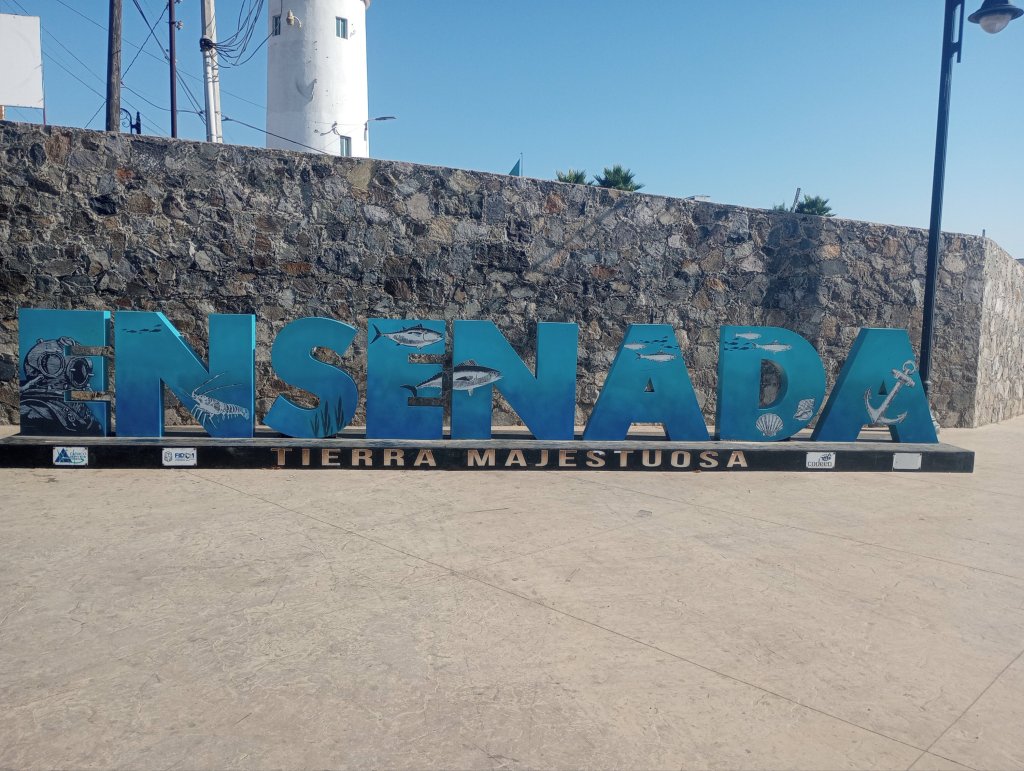
It was a long slog from San Diego that took about 25 hours. But we weren’t the only ones. We planned on an all day and an overnight, but apparently that’s the sail du jour. There were no fewer than four of us who did the same thing. The crux of the biscuit is about getting to Ensenada early enough to take care of the arrival formalities, and those folks don’t work overtime.

Sampaguita left the Port of San Diego Guest Dock at about 8AM and headed up to Pearson’s Fuel Dock to top off the gasoline and propane reserves. Buzz had no qualms about filling a one gallon jerry can and .8 gallons of propane. It seems ridiculous but that is small boat consumption for you. Shame on me for being so un-American. No apologies. And I shouldn’t have to. Those small amounts of fuel last me a long time. Ironically, and maybe you’ve heard me say it before, people can’t be bothered serving customers who only use a little. It turns out that, in California especially, you have to be a consumption pig to to get respect and not be nicked with costly minimum charges for only using a little. If you think you are going to save the planet, forget it. The economy is going to burn it up. So enjoy it while you can. That’s what I’m doing. And Kudos to old man Don Pearson(who I met) who is clearly grounded in yesteryear and its values.

I spent the week provisioning from several different angles and the water tanks are brimming. Sampaguita had a nice six day rest too. We sailed off Pearson’s dock and headed south with wind that kept coming and going. Start the motor, Turn it off. Rinse and repeat. With the excitement and anxiety of getting to Mexico, the traffic, and the ever changing conditions, no rest was to be had. I would nod off on occasion in the supervisor’s chair, but then the boat would lurch and I’d nearly fall forward down the companionway, or backwards into the cockpit. Actually, it was kind of hilarious.
So I arrived in Ensenada exhausted and delirious, but ready to take on Mexican bureaucracy in a language I only have a weak grasp of. But never fear, here at Baja Naval, the most affordable marina in town, Yajahira was all about getting her three new arrivals through the process. For a fee of only $30 each she took care of everything. She had all the papers needed and then walked us all to the Immigration/Port Captain/TIP building and in kinder words, told us to shut up, don’t ask questions, and sign on the dotted lines. Don’t even think about declaring anything. It turns out the other three marinas had a representative there handling their customers too. And they do this everyday, so they have a rapport with the bureaucrats. In fact, I think the bureaucrats are disinterested in dealing with the gringos and you are much better off in Yajahira’s hands. And its Mexico, so don’t worry about it. You personally can’t get away with it, but if you hire a local, it’s all smooth sailing. Under my delirious state, it was thirty dollars well spent. It went fast, you know it was done right, and you go on with your day. A bargain.

So I went to the supermarcado, bought a six pack of Corona for $4, four tilapia fillets for $2 and an assortment of other groceries dirt cheap. Food for thought the next time you go to your American supermarket and buy the same beer from the same factory, going through just as many hands, for over twice the price. People appear so vibrant here, in comparison to Newport Beach, where the fanciest dressed people with the world’s finest cars all walk around with void faces. On the flip side, I also chuckled rather than judged, as I walked through the boatyard here and they were sanding the bottom of a Nordhavn yacht. The workers had all the right PPE but no vacuums for their electric sanders. It’s some places that’s a criminal offense. However, not your country, not your choice. To each their own.

I’ll get a good nights rest tonight, enjoy my Corona, and even take a shower. If I remember how.
Boat Hack: If it’s not broke, don’t break it fixing it.
Thank you Latitude 38! This is my first hard copy publication with them (but it’s online too) and appears in the November 2023 issue. Special props to Monica and John for looking out for The Resourceful Sailor. The Resourceful Sailor’s Whale Tales appears in the Sightings section of the mag and highlights some whale encounters I had on my journey down the West Coast in Sampaguita, a Pacific Seacraft Flicka 20, this fall.
The link is below, but if you prefer a hard copy, there are lots of places to get one. I’m presently in San Diego and see them in the stand outside The Marine Exchange. You never know, the copy you pick may have the Golden Ticket inside.
Sampaguita sits at the Shelter Island Guest Dock, in San Diego Bay. We’ll be here for a few days getting our ducks in a row. Looking back, the last time Sampaguita was at a dock was Morro Bay. That doesn’t count being on a buoy at Cat Harbor, Santa Catalina Island for two nights. Being on a buoy is like being at anchor.
As we have moved from anchorage to anchorage here in Southern California, I was reflecting on getting some good days of sailing. Sampaguita’s sail from Bonita Cove was another great day. In a very light offshore breeze we sailed off the anchor. The water was calm, Sampaguita maintained steerage, and we were able to sail out the channel into the Pacific.
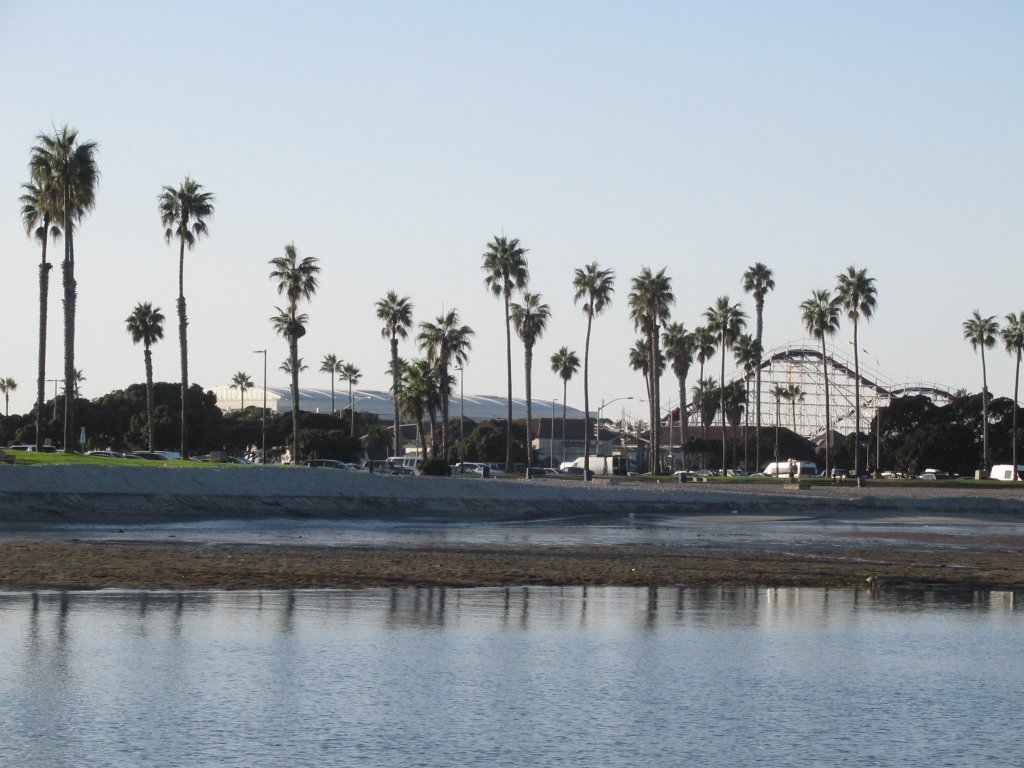
When arriving at Mission Bay, we entered just after the ebb had started. The boats leaving were pitching some on the way out, so I was a bit concerned, from being able to hear the surf all night, that the channel could be choppy. It worked out the back hour of the flood was a good time for us to leave, so I took advantage of that. No chop, just long low surges and easy to sail through.
Once in the ocean, I changed out the 100% jib for the drifter. Having the drifter on inside would have been great, but the jib is easier to tack in light winds, so for maneuverability sake, I used that. The wind backed around to the prevailing NW and steadily increased as Sampaguita rode it south.
By the time we neared Point Loma, Sampaguita was doing over four knots broad reaching on a port tack. As we began to make the giant u-turn around the Point, I dropped the drifter and returned the 100%, weaving through the lobster pots, on a reach. Turning into the wind getting compressed by the Point, first one reef was taken in the main, and then a second.

Reefed down and close hauled, we tore up the channel in a relatively flat sea, with only the wakes of gun-metal grey boats steaming by. I could hear Corvo’s (a Thunderbird back in PT), skippers in my mind, “Use the puffs to climb when you can.” This kept me on the windward side of the channel, so we laid Shelter Island on one long exciting tack. And I wasn’t the only one. You don’t get that kind of sailing on the open ocean.
The day was filled with helicopters, hovercrafts, and assault carriers making continuous turns to starboard. I’m either in the safest place, or the most dangerous place. There is quite a buzz here. Lots of sailboats too. I missed the exit of the Baja HaHa fleet though. It must have been a spectacle as there were something like 113 boats.
The dock here will suit my needs just fine, and fits in my budget. It’s exciting to have finished another leg of the voyage and prepare for a new. It looks like Roseville will provide most-to-all of the goods and services I’ll need, with a good bit of walking exercise to boot.

P.S. – I fell asleep last night to the sound of helicopters in the distance, and Daryl Hall and Daryl’s House Band with Special Guest Todd Rundgren emanating across the water from Humphrey’s Concerts By The Bay. I CAN cope with that.
I love it when a plan comes together(80s reference.) Sampaguita did another overnight trip to get to Bonita Cove, Mission Bay, from Dana Point.

We had used up our five days anchoring allowance in Dana Point in our holding pattern as we wait for the Baja HaHa boats to leave San Diego. My understanding is we’re allowed three days here, which means I’ll move to San Diego Bay on Monday, the day they are scheduled to leave. That is unless the hurricanes have spooked them. But the Grand Poobah of the event seems committed to the date. Either way, I’ll have to move on and that’s the only place to go.
Regarding Dana Point, there was good and bad. Having five days was great. However, the Harbor Patrol is the Orange County Sheriff, and their conditioning and training has the young white men posturing and generally being unfriendly. They come around and flash their bright spot light on everyone’s boat to let you know they’re watching. It’s a put off to their profession.
Also, Dana Point has very limited shore access. I think they really just want you to pony up for a slip. The access was enough to go to the stores for provisions, but that’s it, so ironically they are limiting your ability to spend money on shore. Unless, I repeat, you pony up for a slip too. While I could use a shower, that’s a really expensive one. The rest of the time you are restricted to the boat. That said, it was fine as I don’t go to restaurants anyway and am good at keeping myself entertained. (And since it’s just me, being a bit dirty is fine.)
Though a high end community, they can’t hold a candle to Newport Beach when it comes to conspicuous consumption. But don’t think everyone who lives there is over-the-top. Once you get away from the shore and head to the Albertson’s, the Trade Joe’s, the Ralph’s, or the gas station, you see the regular people. Phew. As for Newport Beach, while mind blowing regarding wealth, they offer excellent shore access, goods and services, and a considerate civilian harbor patrol that even granted me an extra overnight upon request. I had no problem not washing my dishes, and thus, not discharging grey water as requested. (Not to be confused with black water, which is sewage, which you’re not really allowed to discharge anywhere inside three nautical miles of shore.) Mutual respect pays off.
As for Sampaguita’s overnight, it was only fifty miles, but I’ve developed a mantra recently. “If we can’t get there before dark, there is no hurry to get there before dawn.” Entering an unknown harbor at night is risky, not to forget the crab/lobster pot minefield that’s often at an entrance conspiring to foul your propeller.
We sailed off the anchor with the prevailing Northwesterly that had us doing four to five knots most of the way. With about ten miles left, the dark arrived and the wind faded. We rolled in a dead calm all night long unable to even heave to for mitigation. There were no boats within a few miles of me throughout the evening, so I was able to lay down, but sleep was mostly impossible with the rolling. I’ve learned to expect it. It’s part of boat life, which I enjoy, so I must enjoy that too, right?
When the sun rose, the wind did not, so we motored up and headed to Bonita Cove, where there was plenty of room. My plan was to get here in the AM, so as to hopefully get a freshly vacated anchor spot and beat the local weekend crowd. Success. It started filling in as I wrote this.
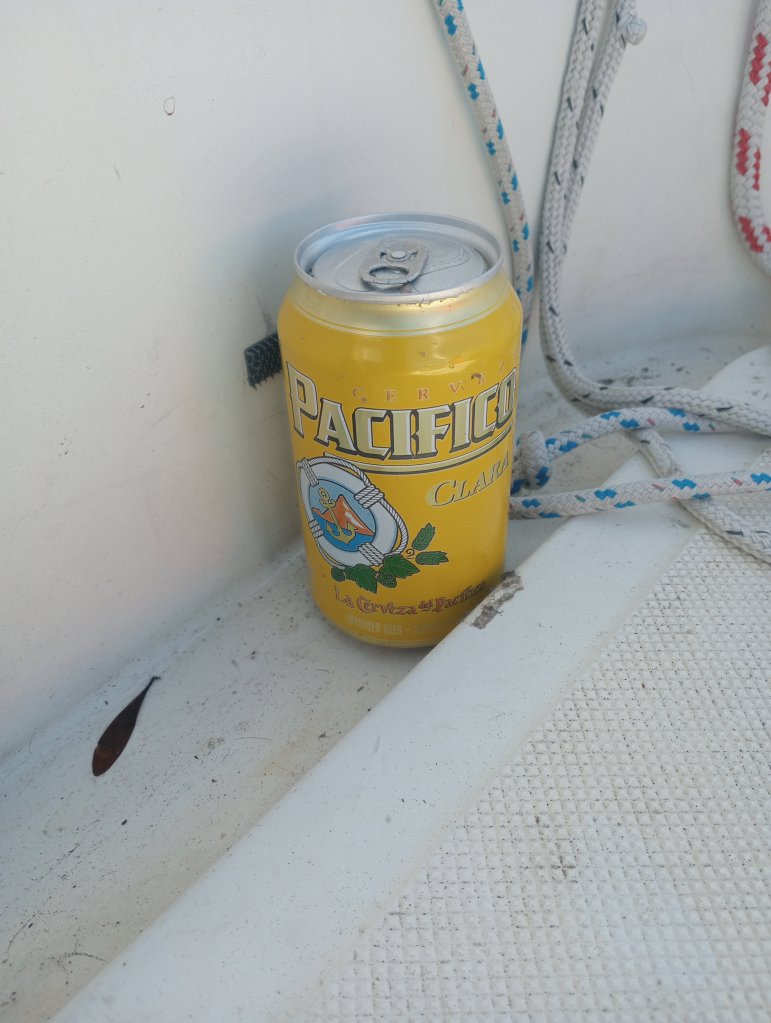
EVENT: I was passing a safe distance from Camp Pendleton, purposely outside the restricted area where there were no fewer than three military helicopters doing some sort of exercises, when I saw a can floating in the water. I was close enough to see that it was a sealed can of Pacifico. The wind was about ten knots and my pace was about four. I thought about it for five to ten seconds, before I committed to picking it up. I was on a broad reach when I tried to quickly tack around. That just put me in irons. So I fell back off and gybed around instead. The beautiful thing about a small boat is a controlled gybe is easy to do in even heavy wind, which this wasn’t. The sail, thus the power, is very manageable. I kept an eye on the can, like a proper MOB drill, powered up and beating, made my first approach. Not close enough. But my second approach was spot on and I was able to simply lean over the side and pick it up. That’s another thing about a small boat. Try doing that on a Westsail.
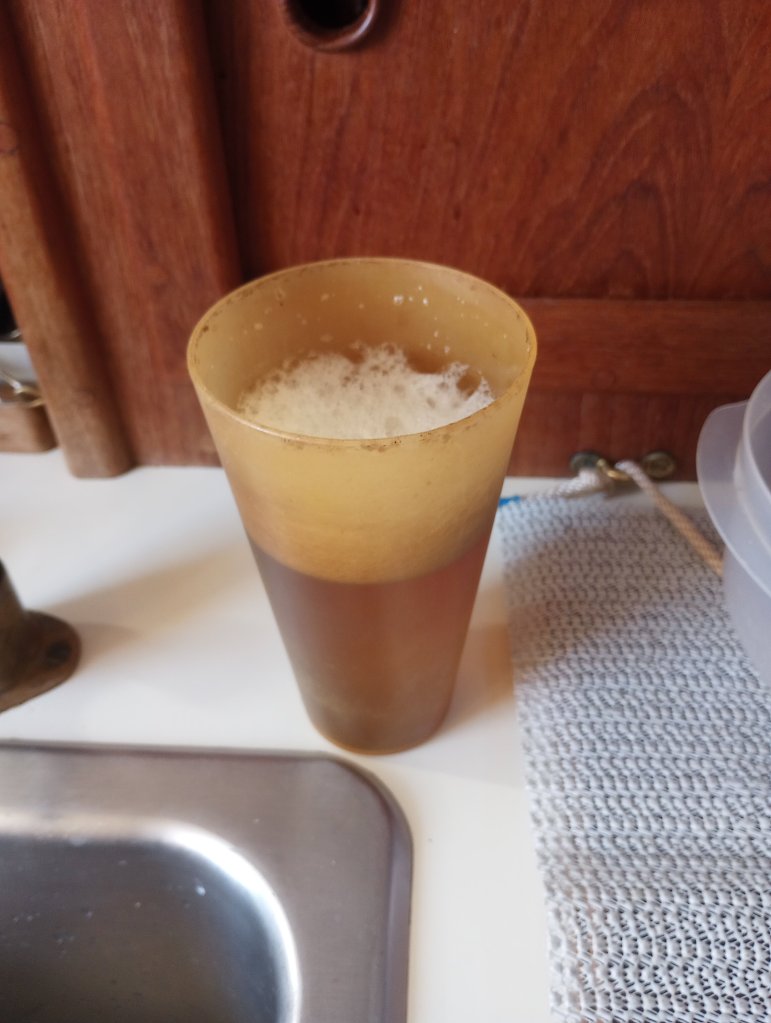
BOAT HACK: Cabbage lasts weeks without refrigeration, even in Southern California. Sampaguita does not have refrigeration and the chore of keeping up with ice has never appealed to me. Over the past ten years of living aboard I’ve learned the foods I can keep and those I can’t. So I just eat those I can. The FDA requires foods to have refrigeration labels, but I’ve learned those are suggestions to mitigate litigation. Many things are just fine. Part of my voyage south is adjusting to the warmer temperatures regarding food storage and that is going fine too. So forget the lettuce which will only last a day and accept cabbage as a substitute. It even costs less. Bonus.
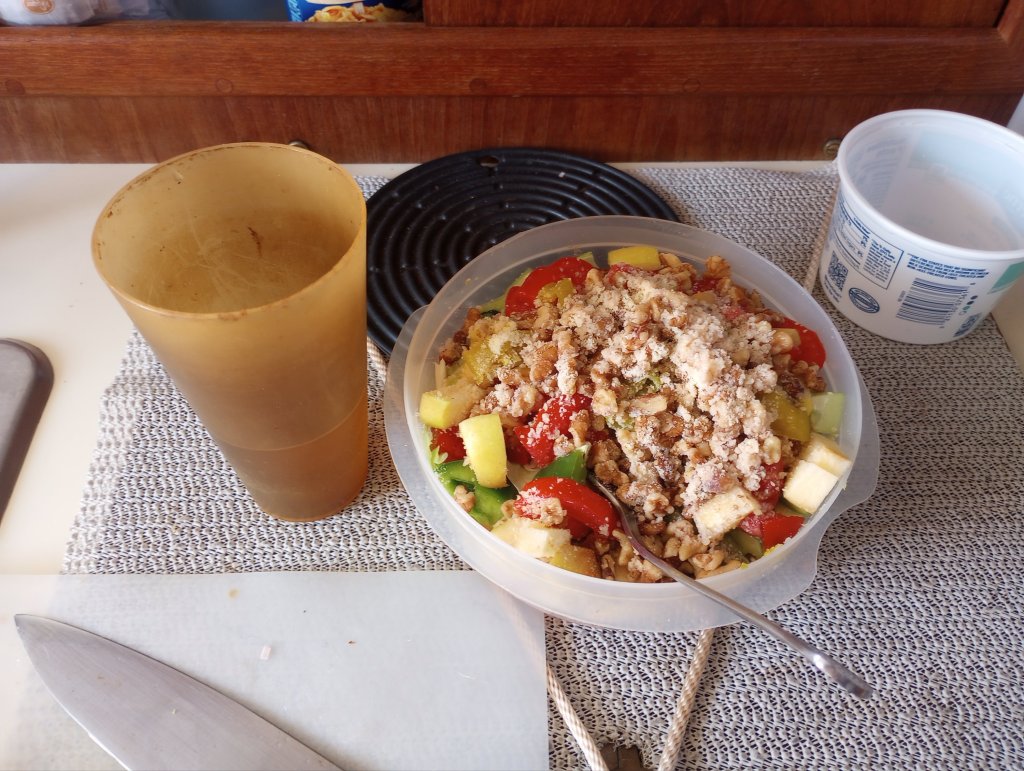
OBSERVATION: The Salish Sea (aka Puget Sound and connecting waters) has plenty of Navy and military facilities. A huge boat yard, a nuclear submarine base, F-18 Growlers, and there is a weapons depot just across from Port Townsend. (Funny story. When I first arrived in Seattle and was reconning on Google Earth for expeditions in my 60s era Grumman canoe I saw Indian Island. I thought to myself, “They must be developing that area now because it looks like a bunch of culdesacs have been built.” Stupid me! I was to eventually learn those were not culdesacs, but weapons bunkers!) What we don’t have much of is military exercises on the water. But here in Southern California you better be listening to your VHF radio because several times a day I have heard something like “This is Warship XXX, at position XX° XX.XXX’ N, XX° XX.XXX’ W. We are conducting live fire exercises. Mariners are advised to stay 8 nautical miles away.” No problem! Or “This is Warship 72 (an aircraft carrier) at position XX° XX.XXX’ N, XX° XX.XXX’ W. We are doing continuous turns to port. All mariners are requested to stay well clear.” This one I watched. They did a good job.🤣 No matter how one might feel about this, national security and the defense industry are a big deal. Just ask the Ukrainians, or the Israelis, or the Palestinians, or the Iraqis, or the Afghans, or the South Koreans, or the Filipinos, or the Taiwanese. I haven’t even mentioned a country in Africa yet, but I’ll stop there.
“Securite, Securite, Securite. All stations, all stations, all stations. This is the United States Coast Guard Sector San Diego, United States Coast Guard Sector San Diego, United States Coast Guard Sector San Diego. Be advised. Out.”
Sampaguita. Sam′pə gē′tə. What a beautiful name that no one can understand on the radio, at least here in the States. It’s not any better on the telephone, or in person, for that matter.
All of the Harbor Patrols encountered so far are at a loss with it. It is also noted they have all been white. I mention this because Spanish speakers do not have any trouble with it. Nor Filipinos. In Friday Harbor, at San Juan Island in the Pacific Northwest, I encountered a customs official of Filipino heritage who lit right up when I told him the name of the vessel. “Ah, Sampaguita, that’s the national flower of the Philippines,” he said with obvious pride. For my fairer skinned readers who don’t think to “Google” it, it is known in English as arabian jasmine.
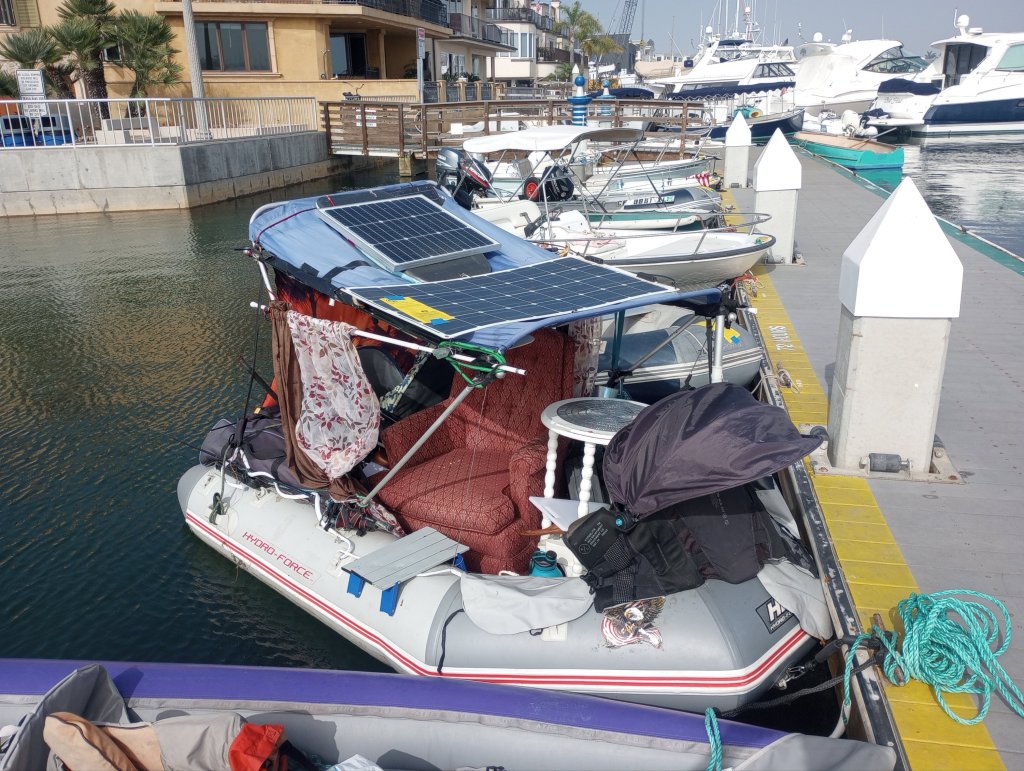
I can’t be credited with giving her the name. I inherited it when I purchased her over ten years ago. While I’m not the superstitious type, I also couldn’t be bothered with changing it either. In fact, the name was invisible until only this past August when I decided, for the ease of formalities, to re-paint it. This, I deem, was a good call. People have trouble wrapping their head around a boat with no name. So I gave them what they needed. And most still can’t handle it. But it becomes their problem, not mine, and is a good conversational ice breaker.
Sampaguita presently sits at anchor in the Dana Point anchorage. Previously known as Capistrano Bay, it was renamed after Richard Henry Dana, Jr., the author of Two Years Before The Mast. He spent time here with the merchant ship, Pilgrim, collecting cowhides from the local Spanish cattleman in the late 1830s. It’s a recommended read. I assume Pacific Seacraft’s Dana 24, the bigger stepsister of the Flicka 20, is also named after him.(Most Flicka owners have Dana envy, I am not excluded. However, that 20% more in length, costs way more than 20% more in dollars.)

It was a short day of travel here from Newport Beach, though it still took Sampaguita seven hours. We left early knowing the NW breeze would take a while to fill in. We sailed through and out of the harbor with a light southerly, so it required some tacking. The water was flat and the sails remained full, with just enough pressure. Once out of the harbor, we motored up for a while until the NW wind filled in. We got just enough to keep the boat moving downwind at 2-3 knots. However, once in the Dana Point Harbor, the local wind was considerably more, and on the nose. It seems to come in over the west facing cliff. It’s a small anchorage and we were lucky to get the last spot. We were visited and counted by the Harbor Patrol, who in this case, is the Orange County Sheriff. “How do you say the name of your boat?”

Observation: I woke up a little after midnight on October 21 in the Newport Beach anchorage. I brushed my teeth and sat in the companionway enjoying the quiet evening.
I happened to be looking north when I saw a strange thing. “Is that a shooting star?” “No, that is too bright and is visible for too long.” “What am I seeing?” I watched it for a few minutes as it passed overhead and out to sea. As it went, I recognized the vapor trails I used to see on TV in the 80s with the space shuttle launchings. Then I saw a bright light descending straight down from it out near Santa Catalina Island. After it was gone, I “Googled” something like “Did I see a rocket over Newport Beach tonight?” Sure enough, that was exactly what I saw. My first ever in-person rocket viewing. The descending bright light must have been the first stage booster.
October 21 Falcon 9 • Starlink 7-5
Launch time: 12:47 a.m. PDT (3:47 a.m. EDT, 0747 UTC)
Launch site: SLC-4E, Vandenberg Space Force Base, California
A SpaceX Falcon 9 rocket will launch another batch of 21 second-generation Starlink V2 Mini internet satellites from Space Launch Complex 4 East (SLC-4E). The Falcon 9’s first stage booster will land on the drone ship ‘Of Course I Still Love You’ in the Pacific Ocean
Updated: October 20
I often see the Starlink constellations streaming through the night sky. I am not enamored by The Elon Musk. However, I recognize that his vision and the human appetite for consumption have made him Emperor of The Western World. It is all much bigger than I or Sampaguita. It is easy to be caught up in day-to-day survival and not realize how fast we are rocketing(pun intended) into the future.
Two more things that have driven me to sea. One, “positive progress” is open to interpretation. Two, the world is changing so rapidly, I decided to go before I was not allowed to.
Well, almost. Sampaguita sits in the Newport Beach, CA anchorage, about as close as she can get by water. She was built by Pacific Seacraft of Fullerton, CA in 1985.
Sampaguita had an excellent sail from Santa Catalina Island to arrive in Newport Beach with the rising sun(and dense fog.) We had a fairly steady SE breeze of 5-10 knots crossing the San Pedro Channel which kept us moving on a starboard tack all night long. Between being in the lee of Catalina Island and an offshore breeze, the seas were quite moderate and the light wind propelled Sampaguita at 3-4 knots with very little sail slapping. The aura of Los Angeles glowed in the eastern sky and gave us pre-dawn lighting the entire time.
Since Sampaguita does not have a chart plotter, we used constellations, first Cassiopeia, then The Seven Sisters, to stay on course. For her captain, this is far more preferable than a constant high-tech glow of modern navigation equipment. This sounds romantic, and I suppose it is, but we are not complete Luddites. My handheld GPS unit, compass, and phone with Navionics are available and checked for reference. How do you think I knew which stars to choose?

We were kept company by the offshore oil platforms, Edith, Elly Ellen, and Eureka, and the local fishing fleet. That, and the VHF radio. I’ve noticed in southern California an increase in accents on the VHF. While English(mostly) is being used, it seems clearly a second language for some. It takes close listening to understand. As an aside, I’ve also noticed on my AM/FM Radio, there are many stations operating exclusively in languages other than English. I’m not sure if this was all less common in the Pacific Northwest, or I was just not paying attention. Likely both. I’m enjoying it.
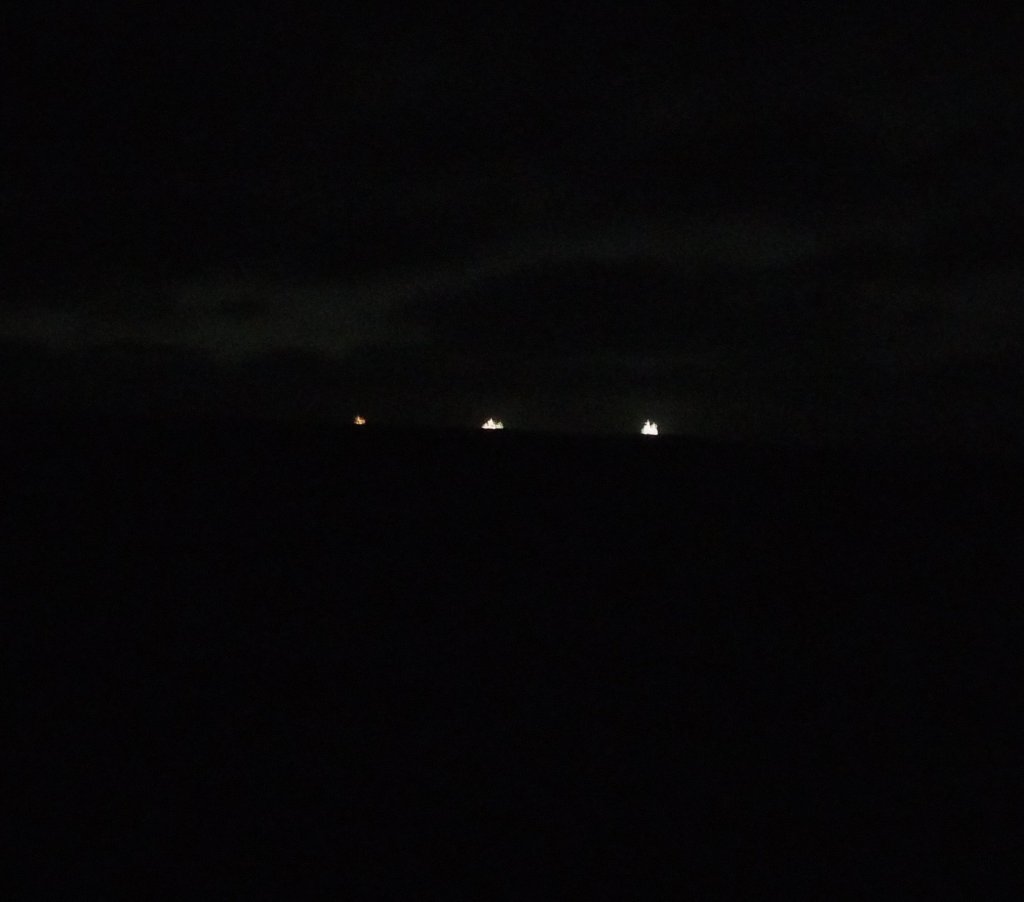
Arrival in Newport Beach was otherworldly. With the fog and dark, the visual slate was completely blank. My familiar world of Sampaguita was all there was. Only as the fog lifted and the light prevailed was that slate filled and the visual went from zero to a million. The presentation of this place, which is unlike anything I’ve known, or only have seen on television, is surreal. I’m not yet prepared to describe it.
We are happy to be here and happy our arrival was on schedule, which, if you’ve been reading, has been challenging for a slow boat.
Observation: A few weeks ago, when I first entered Californian waters, the pelicans started to appear, en masse. They are like pigeons in New York or Eagles in Alaska.
Pelicans aren’t small. One clear and beautiful night off the Northern California Coast I was sitting in the supervisors chair in awe of the stars when a green blur appeared in the sky. This startled me before I realized it was a pelican illuminated by the bright green starboard side of my LED tri-color navigation light atop Sampaguita’s mast. I watched the bird circle around and head back our way. As it approached, I thought, “Geez, I hope that pelican flies over top of the mast!” It did not. It flew straight into the mast and rigging! It hit near the top and then dropped like a stone to the deck, landing two feet away from me. I’m sure I flinched, and should have ducked below, but the disbelief and brevity of the moment was too much. The pelican then rolled overboard.
It hit the rig just below the top, so luckily it did not damage anything, in particular, the light and the VHF antenna. I cannot say the same for the pelican. Oddly, it never said a peep. I suspect the brightness of the LED had something to do with the incident. Kind of like with cars and bicycles. They are good for the user, bad for anyone approaching.
Say that three times fast.
Sampaguita and I are still resting here at Twin Harbors. For logistical reasons, we decided there was no rush to get to San Diego. The Baja HaHa Rally boats are likely beginning to congregate there, and we don’t wish to compete for anchorages and services with that group. Since they are an organized event with the support of San Diego Harbor, it might be that Sampaguita could be at a slight disadvantage. They leave on October 30 and it is my intention to trail behind them, rather than in front of, or with them.
Here, at Santa Catalina, we are sitting pretty. With plenty of provisions and water, and a sweet(and free) anchoring spot, we can bide our time for a few days. We’ve grown to appreciate it here too. The hiking is great. The people watching is great. The weather is great. We’ve been able to do some writing. Sleeping is easy without the rolling.

There is an interesting mix of folks. There are the holiday go-ers. They mainly congregate on the Isthmus side and behave like regular resort-ers. I haven’t mingled with them. I’m sure there are some nice people, but with different life views and values. There are the employees, a lot of them of all different sorts, as it is quite an operation here. It explains why it is so expensive.
Then there is what I’ll call the “local” crowd. I mean that endearingly. This is the group I relate to the best. There is Jerry, with the Harbor Patrol. Super down-to-earth and kind. He has been doing this gig for eighteen months and lives on his boat not far away from where Sampaguita is anchored. The other night I came back to the boat to find six avocados in my cockpit. It turns out an avocado farmer moored in the harbor and gave him a five gallon bucket of them. So he distributed them around and threw in a couple of limes. As I said, super cool. I met an older woman named Robin who lives on her boat in the harbor. She apparently raised her family here. Then there are the fisherman, both sport and commercial, who use it for the occasional overnight. I appreciate commercial fisherman. They are the cowboys of the sea. No pretense.

That said, everyone is nice. We all say hi and wave to each other as we pass.
A shout out to Jim and Karen of Jim and Karen’s Excellent Adventure. They are Port Townsend-ites who sailed the Pacific Seacraft Dana 24, Sockdolager, across the Pacific Ocean several years ago. A Dana 24 is the big stepsister of the Flicka 20. They were kind enough to have me over for coffee this spring to answer some questions I had about voyaging. One of Karen’s tips was to get a portable shortwave receiver radio since I would not have an SSB(single-sideband) radio. This was a small and economical way to listen in to SSB nets, though I cannot transmit. I can also get the WWV(Colorado) and the WWVH(Hawaii) Time Ticks as an aid to celestial navigation. It is also an AM/FM radio, which, at this point is how I have used it most. Here in Cat Harbor I have been listening to the MLB playoffs on ESPN AM radio and the chaos in the Middle East on NPR FM. I have no favorites in the baseball games or the Middle East.

It’s nice to be away from the mainland but I am not beyond reflection. The disgusting things that humans do to each other, both at home and abroad, are part of what’s driven me to sea. So far, this lifestyle suits me and I haven’t missed the land life and all it’s trappings at all.


 sailingwithjosh
 Sailing With Josh