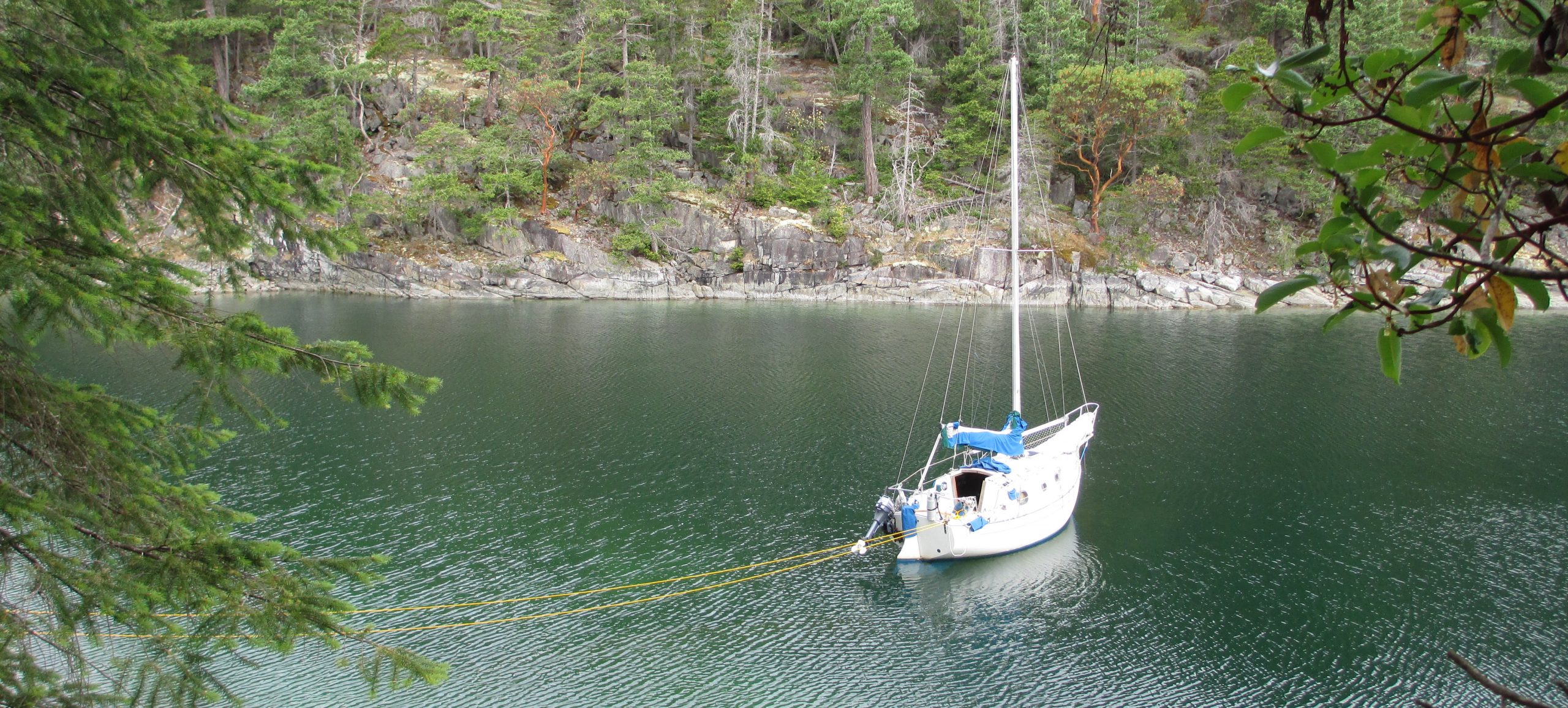
Sampaguita Sailing and San Juanico, Baja

Sampaguita and I sailed off the anchor from Bahia Asuncion on late Tuesday morning. We got a slightly later start than intended, but the morning wind was light and we got caught up in cleaning the sand and stones from the kayak. The Aire kayak is a whitewater kayak, which is to say it has a rugged PVC exterior shell with inflatable bladders inside. One for the bottom and one on each side. The bottom bladder is open to the sea via self-bailing holes. It came to my attention that sand was getting in around, under, and over the bladder, I suspect mostly from the high turbidity surf. Sand as an abrasive can’t be good for the bladders. So, I spent some time rinsing that away after deflation with buckets of salt water on Sampaguita’s deck. Of course, dried salt is also an abrasive, but I deemed it better than sand and pebbles. Sampaguita and I live a life of sand, salt, sun, and salt water. Four things that destroy most all manmade things. Some faster than others. I have had to explain that the electronic devices I use for communication, this blog, and the inReach, are all susceptible to sudden failure due to these elements. I can make no guarantees on electronic device functionality. So far everything is working and I have not had any major inundations of sea water, but, for example, my hands are always salty. And there just isn’t the easy availability of fresh water for much cleaning.
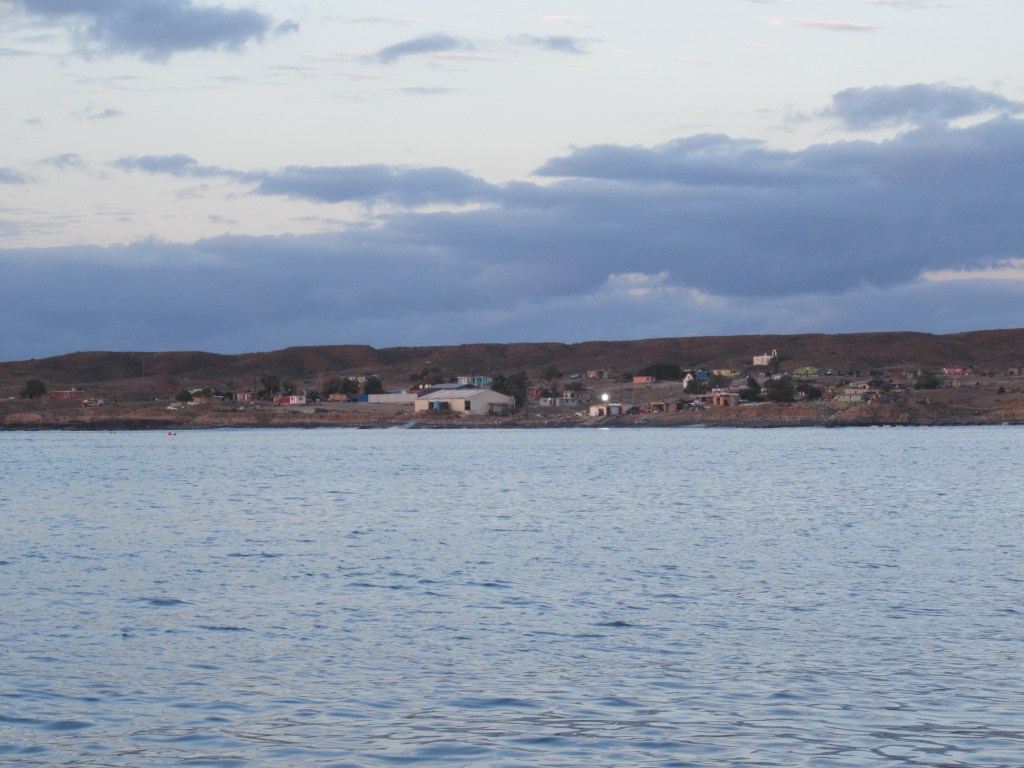
We set sail, but mostly meandered for an hour or so, with weak and variable wind. But then a south wind filled in and we close hauled with the drifter, slowly increasing speed. Over the next few hours, it clocked around to the northwest, building as the afternoon progressed. By mid-afternoon we were hauling along enough to change out the drifter for the 80% jib. I skipped the 100% because I realized it would soon be beyond that, and sailing orejas de burro (wing and wing to the yanks), the main was doing most of the work. Our goal was San Hipolito, about 20 nautical miles south of Asuncion. I wasn’t sure what kind of town it would be, but I was psyched to at least be able to have a day sail and anchor for the evening. So often I have to plan on an overnight. As usual, all Puntas (points) need to be given a wide berth due to rocks, both charted and uncharted. The important thing was I was going to make it before night fall as I made the wide turn to port. The 80% was definitely good to have on as I close hauled into la bahia. I actually reefed down to the second, then the third in the main. The third was probably unnecessary, but in classic Sampaguita style, I would be anchoring under sail and being a bit under powered made this more controlled. There were several warnings about lobster pots on entry, and sure enough I picked one up with the rudder. I saw it and stood well clear, but not clear enough. In the States, crabbers usually use a special line threaded with lead to keep it from floating. This is for everyone’s sake. With so many more pots, so many more crabbers, commercial, native, and recreational, and so many more boaters, it helps keep the lines out of props. The pot owners benefit because they lose less pots that get caught, cut, or dragged by boaters. This is not so in Mexico. For one, there are no recreational pots. The lobstermen are part of the co-op and those are the only folks fishing. Second, there are no recreational boaters except cruisers like myself coming through. Third, the lobstermen themselves are looking out for the pots. So, they just use cheap polypropylene line that floats. It’s very common for there to be 30 feet of line floating on the surface ahead of the buoys marking the pot. This is what got me. The first thing I noticed was that Sampaguita’s performance had suddenly diminished. Then I look back and realized I was dragging a buoy about 30 feet back. Going too fast to reach down with a boat hook to push it out of the small gap between the keel and the rudder, or pull it up and cut it, (I’ll do whatever is faster and easiest) I dropped the jib preparing to heave to, so as not fight the rush of water by the hull. But as soon as I slowed down with the dowsing of the jib, it unhooked on its own. So up the jib went again and I sailed into the anchorage. There were no other cruisers here and it was pretty obvious why. This was a one panga town. No cell tower, no gas station, and about 20-30 buildings on shore. No worries though, I was going to have a great night sleep and likely move on in the morn. There was a low swell that made its way into the anchorage that was putting quite a bit of surf on the beach, but for us about a quarter mile off shore, it was a nice “rock-a-bye baby” feel.
The production of unstowing, inflating, then deflating and restowing the kayak to go ashore prevented my doing so, so I was up with the sun preparing to move on. Weather would be chasing me from this area in a couple days anyway and I was hoping to get ahead of it. We sailed off anchor and made our way south. The wind was predicted to be a bit smarter on this day, but not having internet, I was going by my memory of what I had studied a couple days before. How much and how long was a little vague. It did that ‘build through the day thing’ and I was still uncertain of my destination. Would I try to duck into Abreojos for the evening? Would I just continue on to Bahia Santa Maria? Would I try to go to San Juanico in between? As the evening approached, I ruled out Abreojos. You have to stay at least six miles off shore and make an extra wide swing around the point due to known and unknown obstructions reaching out from land. This meant dark might come before I got in, plus with the building wind and corresponding sea, it would be a long sloppy wet approach, first on a reach, and then on a beat. All with the angst of trying to make it before dark. So, I decided to run with this breeze. It was on that line between a little more than I liked and too much for Sampaguita. I thought “maybe this will settle down as the evening goes on and I will at least cover some miles.” Well, it never settled down, but I did cover some miles. We catapulted through the moonlit evening at 4-5 knots under a triple-reefed main alone, all night long. Which is to say 12 hours. I periodically needed to adjust the windvane as the wind clocked a little and varied strength over the evening. The wave trains did not. The wave heights were at 4 feet, which is to say, there were some 2 footers and some 8 footers in there. I was mostly down below with the bottom two companionway boards in to keep out any boarding water and spray that insisted on trying. You would sometimes hear the toppling crest just outside the hull and the coinciding bump it gave Sampaguita if she yawed a little sideways to it. I wasn’t worried about the boat, but couldn’t help but wish it would taper off a bit. We made some serious miles though. About 0400 I hove-to because, after a snooze I realized I was close to overshooting San Juanico. The necessary and most comfortable angle of sailing had me angling a little off shore. Over the night, this amounted to being about 25 miles off. By the time I hove-to, I realized I would have to make a course about 85 degrees east, which was essentially back tracking a touch to make the landfall. I should have hove-to a couple hours earlier, on a port tack giving me an easterly drift, and ultimately a better angle of approach to San Juanico. About 0630, as light was coming on. I decided to see if I could still make it. If I found it to uncomfortable or hard, I would head to Bahia Santa Maria instead, still 100 or so miles off. It was still blowing good. Not as hard as it had at its most, but I would also be reaching, which meant my apparent wind would be stronger. I would be cutting across the waves, so it would be sloppy wet. I had the 80% jib, the triple-reefed main, and my yellow Gordon’s Fisherman costume on. We trimmed into that reach, aiming Sampaguita at about the hrading I thought we needed. I was using a regular compass for this initial heading because the electronics needed to be kept below and the companionway covered for protection from the spray. It felt doable and was glad I hove-to no later than I had. I wouldn’t have wanted to cut it much further. Storm sails are the next and last steps down as far as canvas and it wasn’t that kind of weather either. I popped down below, checking my headings with the handheld GPS and Navionics on the phone. They concurred with my initial assessment, so I grabbed a Lar-a-Bar and headed back to the cockpit to continue on. The Gordon’s costume was simply to keep the saltwater off my body. I had shorts and t-shirt on underneath and sandals on my feet. When the splashes came aboard, and they were often and large, I first cringed in preparation of receiving them. But very quickly realized the water is warmer than the air and was kind of like a hot shower. Not what I’m used to in the Pacific Northwest. I stuffed a rag around the anchor chain hawser to mitigate any water getting in there and then it was mostly supervising. I had to knee up on the transom with two wrenches to reach over the stern and adjust a couple screws that had strangely tightened on the windvane. I would periodically have to adjust the vane angle as the wind varied in direction and strength. A lesson on wind. Wind changes direction with speed. This is due to friction with the earth’s surface. So wind gusts come from a slightly different angle than the normal wind. You trim the sails to the normal wind, but that means the gusts both change the direction they hit the sails and the extra strength changes the balance of those sails. The boat reacts to this. The windvane is reacting to wind direction, but is also sensitive to the sail balance. The windvane was never overpowered, but it had to be tinkered with regularly to keep everything working together. Plus, the boat is yawing over the waves which changes its (and the sails) angle to the wind. None of this is rocket science, but it does keep you attentive and engaged. I would sometimes need to reach over and hand adjust the tiller to keep things working well. There is enough play in the windvanes control chain to do this without disengaging the vane. We were hauling transom at hull speed, dashing our way to San Juanico. I made the 25 miles in about 4.5 hours, which is to say we were going at about hull speed. The wind did let up a bit on our final approach but only slowed us down a knot or so. We sailed into the anchorage and anchored under sail, and who do you know is there? The catamaran 10X with Dave and Heidi on board and Mundial, with Grant and Noel.

10X is a boat I started picking up on my AIS receiver in northern California. I never actually met them until San Diego, but of all the boats, that is the one I keeping finding in anchorages and encountering the most. When you think, “they must be long gone ahead of me” they come rolling in from behind. Dave is a super intense marketer or something like that. 10X is part of his motto. Heidi is a retired PI from Las Vegas. Just to set their vibe. Grant and Noel, are heroes. Not just because they have been exceptionally kind to me, but because their kindness is authentic. They are from Morro Bay. When I first met them in Bahia Tortuga they came up to me in their dinghy and said they had seen me in Morro Bay. (I guess I stand out.) On that very first meeting they said if I could get their Starlink signal on my boat, I was welcome to use it. They immediately followed up with its name and their password. I have had other cruisers offer the same Starlink access, but they never offered its name or password. Do you get the difference? And here is another thing. Upon getting anchored in San Juanico, Grant immediately got in his dinghy and brought me over a smoked tuna fish sandwich with avocado and chips on the side. For a single-handed sailor who’s been at sea for over 28 hours with no division of labor in his life, this was an incredible treat. And they knew it. It was superb. They have that “it” thing, I don’t mind saying. Their box is collecting favors.
Experience: The next day, after morning chores of working on the running list of boat bits to look after, I inflated the kayak and went ashore. Each town is different. First, I don’t yet see a baseball field. Second, on first impression, where as Asuncion has a flavor of ex-pats, San Juanico seems to be overrun by them. It is a big surf town. La playa is huge and apparently unobstructed. Well protected from the prevailing northwesterlies, when a southerly comes in, its “surfs up.” I am led to believe the ex-pats are drawn to this. Also, when I was sailing in, it was obvious to see that many houses ashore, were not rural Mexican’s homes. I’ve seen enough of Baja to realize this. I also noticed several properties for sale. Not the classic rural Mexico sign painted on the building with a dollar sign and a phone number. Real brokerage signs. When I went to la tienda, there was an American woman in there complaining about some credit card fees she was incurring. I pegged her as American due to her outwardly rude and entitled nature. Canadians are still a bit more polite. She knew she couldn’t do anything about it, but was going to have her grievance. As an aside, you can get a credit card without foreign transaction fees, but if the processor on the vendor side charges fees, you nor your credit card can do anything about that. This is occurring more and more. The financial institutions are a profitable business to be in, if that’s your thing.
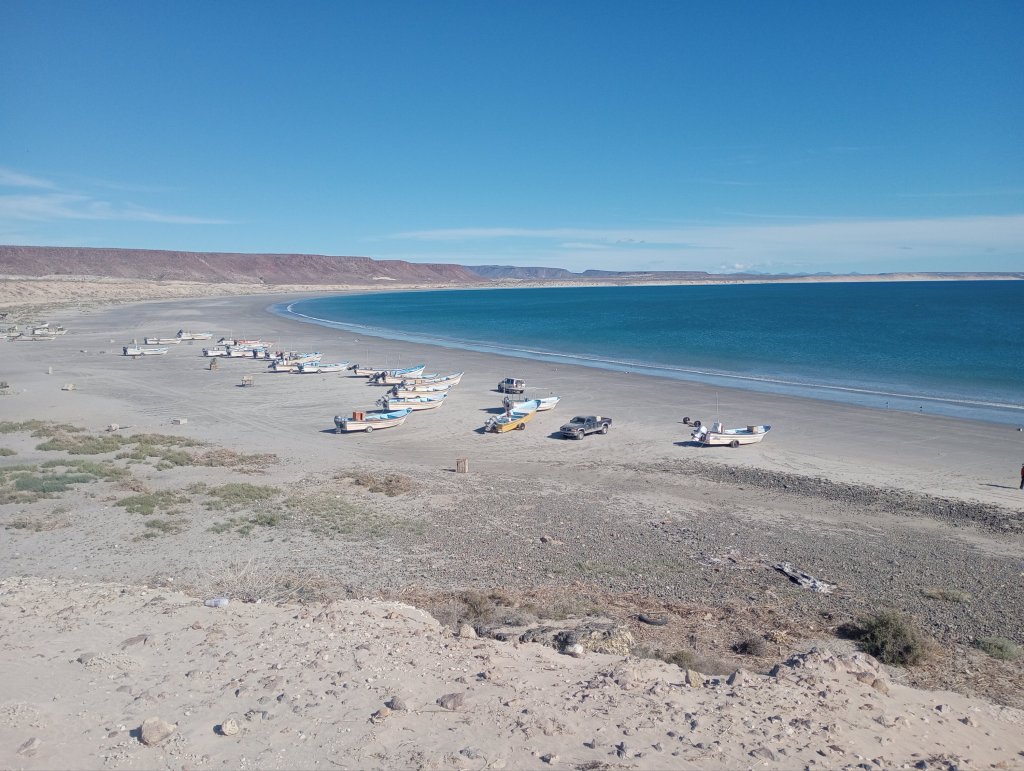
Observations: I came across a semi and trailer parked in an empty lot. It was surrounded by second-hand household goods that were apparently for sale, though I didn’t browse to find out. I can’t imagine any other reason. While it wasn’t a moving truck per se, the contents sure looked like someone’s move. All kinds of clandestine thoughts went through my head, but naturally, I have no idea what was up.
In my exploration, I seemed to stumble on the local gas station too. This is not the Pemex station of a bigger town, which looks like a typical petrol station found in America and other western countries. This was a fairly dilapidated small wooden shed, with, at first glance, the only evidence being a gasoline hose and nozzle hung on the side by the door. Someone had pulled up and I watched a caballero walk over from the next door shaded area to serve them. As I walked by, the pungent smell of gasoline was in the air and I could see in the door. The fuel was being pumped from a big blue 55-gallon plastic barrel(s) inside the shed. It was like some dystopian “Road Warrior” scene. I loved it. I haven’t painted a good picture here to capture the moment. It was definitely photo worthy, but I thought it too rude. “Look at the stupid gringo marvel at our dangerous ‘shed-bomb’ and amuse themselves with the best we have.” The Resourceful Sailor, anti-regulation part of me totally approves. The little kid in me who had a short phase of playing with gasoline, knows how dangerous it is. Rural Mexico, salute. Way to get by.
I think there might be an ex-pat opportunity to import America’s unwanted and obsolete fleet of gasoline cars as they are phased out for electric ones. (The jury is still out as to whether we are just trading one demon for another.) Rural Mexico could use them for parts and secondaries. Especially on Isla Cedros, a common scene was the stripped-out car that was flipped on its roof. This is not the stolen stripped car of urban America. This is how they get parts to fix the local cars. I gather they are flipped over to access the undercarriage. The roads are mostly dirt and rutty, which means the undercarriage of a vehicle takes a serious beating, and naturally, repairs are common. Having a spare car seems common too if you can afford it, because if your primary car needs repairing, it can take some time to find the parts and get the work done. Mexicans “manana” theme doesn’t always mean tomorrow. Tomorrow is always tomorrow. Their work ethic is different than we are accustomed to in America and it just takes longer to source the labor, time, and materials to do a job. We shan’t call it lazy, it’s just their priorities and values are elsewhere. America has an uptight, “gotta have it now, the show must go on regardless, what is it you do for a living, do you know who I am?” mentality. It makes for a strong economy, but an unpeaceful place to live. Mexico certainly has a weak economy, but people seem more calm, peaceful, polite, and family oriented. A job is just something you have to do and maybe not to be taken too seriously. While I have the data and experience to comment on America, admittedly, I don’t have the same on Mexico. I’m still trying to figure it all out.
I had two fishermen come up to the boat since I have arrived in San Juanico. One wanted to sell me shrimp, which was a first. The other was a lobsterman. This wasn’t a first for the voyage, but the first time I asked “a como?” (How much?) The lobster was offered at 200 pesos for one, which is $11-12 dollars US. I’m not sure if that is good by Mexican standards or not. I did not purchase one anyway. Even more notable to me was they both seemed genuinely marveled by, and joked about, Sampaguita’s diminutive size. Many pangas, while open boats, are actually longer than Sampaguita. I’m glad we could provide some entertainment.
Discover more from Sailing With Josh
Subscribe to get the latest posts sent to your email.


 sailingwithjosh
 Sailing With Josh
Hi!
LikeLike
Hi, still in San Juanico for a day or so.
LikeLike
What an adventure! As you are living on the edge, in your tiny boat on a large ocean, along a long coast I have been “busy” with family and living the “American way”…. get up, go to work, obligations, sleep repeat…. hats off to you for living on the edge, and prayers for a safe journey! I’m enjoying this latest post…. I have several to read, so jumped in today on just this one… “playing with ⛽️ gas” oh my!! Makes me remember stories from Frank about the Colombus crew…smh 🤦🏼♀️ 😆
LikeLike
Andrea, glad you are well. Say hi to Lori for me. A friend of Mine In Vermont said his work did a print job for Golden. I know she doesn’t work there now, but I thought of her. Frankie. I guess he’s In Colorado. Its what us hick little country kids did.
LikeLike
Boy, San Juanico doesn’t look like much shelter. Sounds like it’s fine though. Re the sinking of “Boat Bum Gal” …. I’m not seeing the rock on the paper chart, but isn’t there a marking on the Navionics chart off the point? Six knots in 20 knots at 2:00 a.m. that close to shore! Ouch. Good to be self-reliant and careful. Here’s to baseball, lobster and chicken dinners, Tecate, the kindness of fellow travelers and strangers, and a smooth trip down to Cabo. Gringo land! Loving the stories. Roland
LikeLike
There are rocks marked off the point on the paper chart. The asterisks. Punta Kelp. There wasn’t on Navionics but there is one now, along with wreck! There are other rocks in the bay marked on the chart, but not Navionics. I read a quote from captain saying he was concerned the old rig couldn’t handle 20 knots of wind. Why is the boat here then, right? Navionics gives “area” markings in places without specifics. This is often. Depths are sketchy too. It could be easy to think it’s ok under duress. Their whole approach is in question. I think that has been agreed upon. Navionics is great, but not so great. Lots of deficiencies. Reefs are everywhere here but nowhere on Navionics. Some are. The US is good, so I think people think it’s OK everywhere because it all looks the same and they paid for it. Definitely not. Just hoping that wont happen to me. I go Bahia to Bahia. Thanks for reading and subscribing.
LikeLike
Interesting and good to know. Thanks Josh.
LikeLike
Morning Josh, snow on the ground, not a lot yet but heavy early
, Lost power for about 24 hrs. On Monday. I think that’s the longest we have been without power. Been a little upsey downsey here, hope we get straightened around. Hope you are doing OK, continue being observant, get vegetables. Perhaps vitamin’s when you are able to get them
Leigh has snow this morning and she’s on way to Denver. Love you M.
LikeLike
Just had a vitamin. No tiendas in sight. No snow either. Clothing optional. Off grid and plenty of power.
LikeLike
Wise ass,. What’s a tiendas? clothes probably need washing anyway, good on for the vitamin, and I love power. Love you too. M
LikeLike