Small Boats and Big Boats – Advantages and Disadvantages?
Welcome to the most viewed page of this website. Please consider a donation on the blogs homepage. Your contribution inspires future content. Thank you for your consideration.
Please feel free to comment with any additions you think could be added to these lists that would help to define the title. This is a work in progress. Thank you.
Small Boat Advantage
- Finding a slip during a global pandemic is easier.
- Stepping and unstepping the mast may be DIY. Check out these videos.
- Light wind sailing – Small boats get to sail more often than big boats. Most winds are so light that big boats hardly get moving, while a small boat will be going over 60% hull speed. On the ocean, big boat’s sails tend to flop around in light winds due to the wave and swell motion, while the small boat sails on by. This just became very apparent to me while buddy boating with a Niagara 35, which ultimately needed to motor most of the time.
- Lower maintenance costs – Smaller gear means smaller prices. Smaller boats have less gear which means less to maintain.
- Lower moorage costs – Moorage is typically charged by the foot. Length Overall (LOA). Sometimes you will get charged for the length of the slip rather than the boat, regardless of the boat length.
- Lower initial cost? – This is variable and is dependent on many factors.
- It’s easier to find a space at a dock – During the busy season, the only space available may be right-sized for a smaller boat.
- Shallow draft for shallow water anchorages – More “gunkholing” opportunities.
- Sailing in and out of anchorages. A small boat is more nimble and can be easier to maneuver in crowded and small anchorages.
- Easier to single hand – Boat and sail management is easier because the loads are less. Docking and transiting locks can be easier.
- No re-entrance fees when returning to the US from Canada – Boats less than 30 feet are exempt from being charged a processing fee.
- For sailboats, lower vertical clearance – Going under fixed bridges, lines and trees can be easier. Drawbridges may not need to be opened.
- Possibilities of using an outboard motor – An outboard motor can be much less expensive and easier to purchase, replace and service. The entire propulsion system has the potential to be replaced completely anew for less than $4000US in 2018, tax included, without the help of a high-cost technician. I remove my outboard by myself at the dock and do my maintenance in a workshop where it is much easier to work with much less chance of accidental water pollution. Gasoline is relatively inexpensive and very common (though a bit more dangerous.) Depending on the installation, they can create less vibration and noise within the boat during operation.
- Warping the boat around in tight marinas is easier.
- Smaller turning radius.
- You may be able to raise and lower the mast on your own.
Small Boat Disadvantage
- I have noticed while cruising in California in particular, places are increasingly charging minimum amounts which often translates into a higher cost per foot for a small boat.
- Choppy anchorages are tenuous.
- Pitching (hobby-horsing)
- Space – You always need to move something to get to something. The Navigation table doubles as the stove top.
- All chain anchor rodes may be too heavy for the bow. Nylon rodes are more subject to chafe.
- Load carrying capabilities. Will you be able to carry enough supplies and water for long offshore passages?
- A lack of amenities and limited power consumption/charging capabilities. For example, head size and holding tank size. No oven, limited berths and less room to entertain guests.
- Slower travel as defined by the vessels hull speed.
- An outboard motor, due to its location hanging off the stern, adds extra weight at the extreme end of the boat which can contribute to trim issues, hobby-horsing, and ventilation in short, steep seas. The latter is problematic for the health of the motor as well as a loss of motive power at a time when you may need it most. This can often be mitigated by the angle of approach to the waves, speed and knowing the performance characteristics of your particular boat. Having highly flammable/explosive gasoline on board requires special care.
- The ‘back and fill’ technique with an outboard doesn’t work.
- Where do you put the dinghy?
- A small boat can be both lively and wet in a sea. (Comparatively speaking.)
Big Boat Advantage
- Space – A boat of twice the length has more than twice the volume.
- Stability – A well designed big boat is inherently more stable in breaking seas and high winds.
- Heavy wind sailing – Big boats can typically carry more sail in stronger winds due to stability.
- Amenities – More room to have more things.
- The potential for a powerful inboard motor whose weight and motive power is more centered in the boat. Many inboards are diesel, a less flammable/explosive fuel. A well-maintained diesel inboard can last for decades.
- More deck space for storage and walking around.
Big Boat Disadvantage
- Higher maintenance costs – more boat means more things, bigger gear and more of it. The more you have the more it will cost to maintain.
- Higher moorage costs – Moorage is based on Length Overall (LOA.) That being said, there will be considerably more living area per foot.
- Difficulty finding moorage space – Bigger slips will need to be available.
- Deeper draft – Requires deeper waters.
- The necessity for a powerful inboard motor. They are often installed in a fashion where it is difficult to service and clean. They can be expensive to service and are more dependent on a high-cost technician. They often create intense vibration and noise throughout the boat. Diesel can be smelly. Unless you purchase the boat new, the advantage of the longevity can be lost due to poor maintenance by the previous owners (remembering the high-cost technician and difficulty in servicing,) the age and the harsh operating conditions. The cost to replace the entire propulsion system anew will likely cost at least $20,000US in 2018 after tax. This is regardless of the size of the vessel.
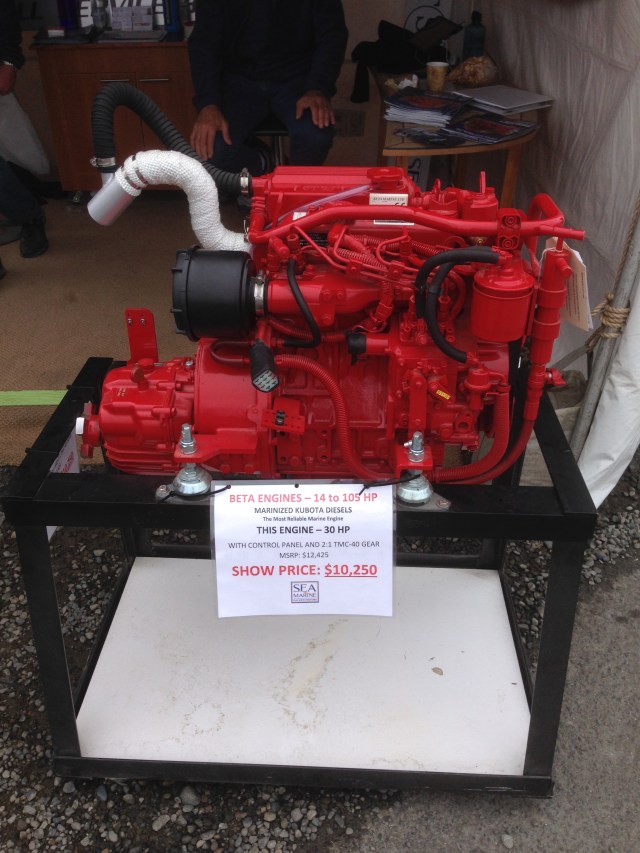
Here is a new Beta motor. This is in US dollars and does not include the shaft, propeller, and its accessories. It does not include the exhaust system, the intake system, the fuel tank, motor mounts, electronics, delivery, installation or taxes. Or the labor of installation. What else am I leaving out? If you were to spend the time and money for a new engine, why wouldn’t you update the whole system? Even if it is compatible?
- More difficult to single-hand – The boats handling may require more crew. If a sailboat, this can be mitigated by multiple masts and different sail plans. There is also specialized gear to help a single-hander handle the higher loads. These will all increase your purchase and maintenance costs significantly.


 sailingwithjosh
 Sailing With Josh
I concur with your assessment and that is why I love Kayaks. A Kayak is simply a lightweight narrow 1to 2 person rowboat and alike a Canoe very agile and maueverable and can be trailer hitched or better yet placed on top of the car. You can add Kayak Sail to it or a Trolling Motor as well. Safe Sailing 🙂 Cheers!
LikeLike
Great overview. I keep and sail my Compac 19 in the Florida Keys. She’s more than capable for cruising this region for days on end in all types of weather except maybe a hurricane. She lives on her trailer at a marina, and the ability to do that is the only reason I can keep the boat down there. Sailing in this area, draft and bridge clearance are major factors. I couldn’t go half the place I do with a bigger boat. When we need a slip or a mooring ball, it’s always pretty reasonable, even though most places down here have a 25′ minimum!
Sometimes we think it might be nice to have a cabin we can stand up in, but I think the trade offs we have made with this boat are well worth it.
LikeLike
Thanks for stopping by. I recently read a book, 2000 Miles Alone, it’s in my book list, related to Florida. So I now understand the draft and height situation there.
In Southern California, SF on down it was mostly a $50 minimum in any marina or ball. Very disappointing.
LikeLike
I have lots of daysailing and multiday charter experience in the Salish Sea but zero offshore sailing yet. I have read that a properly configured sailboat should be able to routinely take non-breaking seas of appx half it’s length, and beyond that it gets dicey. So a 35′ boat should be able to take 17.5′ seas, and a 50′ boat 25′ seas. Do you agree with that rule of thumb?
LikeLike
Thanks for stopping by. That’s a complicated question. I had to read it a couple times. I would suggest there are many considerations…What is the wave period?…Steepness?….Into the wind?…Off the wind?…Hove to?…Current?…Vessel design?…Handling characteristics?….Hand or vane steered?…Crew capabilities?…Wind speed?…Is there a container you are about to run into? And those are the few that come to mind on the spot.
I’m unwilling to commit on that. I would need much more experience, and then still be a fool. The thing I tell all people (and some of them don’t want to hear it) is get some offshore experience on someone else’s boat who has offshore experience. That’s what I did. You have no idea what being on a small craft (50-feet or below) on the ocean is like until you have been there. (Don’t tell your partner it’s going to be a holiday.)
Waves travel a long way, so you are hardly ever dealing with one wave train from one direction. It’s a washing machine. Those big triangle waves come out of nowhere. While my scariest drop off of a wave occurred in the Strait of Juan de Fuca, (so with a few exceptions, mostly current induced,) the Salish Sea is more like a kiddy pool compared to the ocean.
I’m not the first person to get away with being out there in a 20-foot boat and won’t be the last.
Thanks again.
LikeLike
Age may also be an important factor in the decision between big and small. I’ve owned many sailboats, but my all-time favorite boat was a Chevy-Lee Offshore 27, a sort-of big boat. Her narrow waterline and slack bilges made for a smooth and fast ride, with her full keel she tracked like she was on rails, and her accommodations were enough for 2 to cruise for a month or more. I sailed her for 10 years off the coast of South Carolina and through the Low Country – 4′ 6″ draft notwithstanding. I was also in my 40s, so single handing her was not a problem. Now I am 79, living next to the less forgiving (cold) waters of Maine, and looking for my next boat. This one will definitely be smaller, requiring less force whether that is managing a sail, or fending off a dock in dicey conditions. It is hard to accept that I am not as strong as I once was. But an important rule on the water, as elsewhere, is “know thyself.” A couple of nights, rather than long cruises seem in order. I find myself attracted to small catboats like the 17′ Compac Sun Cat, or the 18′ Marshall Sanderling – one line for sail control, easier set up at the ramp, and the ability to save the cost of a mooring or slip (if one wants to deal with launching and retrieving, which can be their own special hell on the wrong, windy day). Or maybe a small sloop like the Compac 16 or the Potter 15. The point for me is to keep sailing on a boat I can age into as the years (I hope) roll on.
LikeLike
Thanks for checking in. Though I don’t know them myself, I hear and see a lot about Compacs.
Maine is a beautiful place. I’ve never sailed there, but am from the East Coast. Washington, Alaska, and Maine seem to be the last bastions of wooden boats, which are a big deal here in Port Townsend. It’s the cold water. We have crab pots, you have lobster pots. I laughed pretty hard when I saw I could get lobster at McDonalds.
A trailerable boat is very practical if you have the vehicle to pull it and the place to park it. Especially with long winters.
It sounds like you still have heart. You’re ahead of me, but I changed out the Sampaguita’s outboard from a 105 pound 8hp Yamaha for a 61 pound 6hp Tohatsu for a few reasons. One of them was because it wasn’t getting any easier (interpret as – it was getting harder) to lift on and off the floating stern and carry it. You’re an inspiration. Thanks again.
LikeLike